




01. Edit your form online
Type text, add images, blackout confidential details, add comments, highlights and more.

Type text, add images, blackout confidential details, add comments, highlights and more.

Draw your signature, type it, upload its image, or use your mobile device as a signature pad.

Send it via email, link, or fax. You can also download it, export it or print it out.
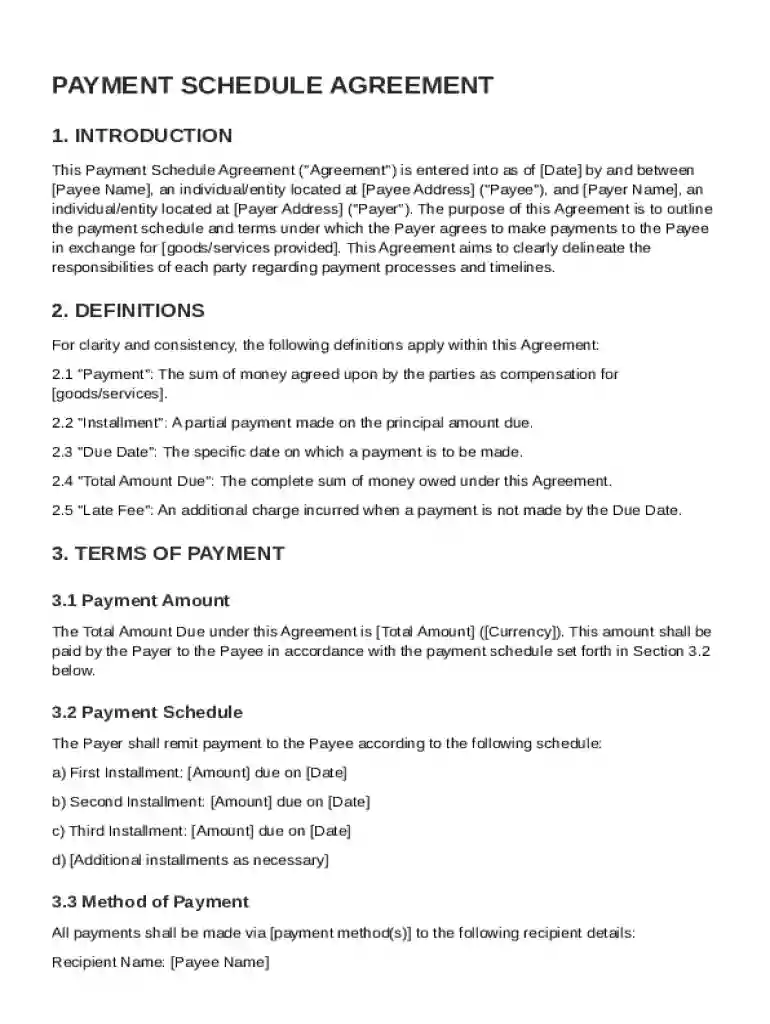
The Payment Schedule Agreement Template is a structured document that outlines the specific terms and conditions under which a payer agrees to make scheduled payments to a payee. This template serves as a legal agreement detailing the obligations of each party, ensuring transparency and clarity in financial transactions. Key elements of the template include:
Payment Schedule: A detailed timeline for the payments, including the frequency (weekly, monthly, etc.) and amount of each payment.
Parties Involved: Identification of the payer and payee, including names and contact information to ensure clear communication.
Definitions of Terms: Clarification of key terms used within the document to prevent misunderstandings.
Late Payment Terms: Specifications on what constitutes a late payment and any penalties or interest rates that may apply.
Modification Procedures: Guidelines outlining how the agreement can be altered, providing flexibility for changes in circumstances.
Termination Clauses: Conditions under which the agreement can be terminated by either party.
Governing Law: The legal jurisdiction that will oversee and enforce the terms of the agreement in case of a dispute.
Using the Payment Schedule Agreement Template effectively involves several steps to ensure both parties are accurately represented and protected. Here is a step-by-step process:
Review the Template: Before filling out the template, read through the entire document to understand the requirements and restrictions.
Fill Out Party Information: Begin by entering the details of both the payer and the payee, including full names, addresses, and contact information.
Define Payment Terms: Specify the payment amounts, due dates, and acceptable payment methods (e.g., bank transfer, check).
Set Late Payment Penalties: Determine and outline any fees or interest rates associated with late payments to encourage timely transactions.
Customization: Modify clauses like modification procedures and termination terms according to the specific needs of the agreement.
Review and Sign: Before finalizing, review the completed document to ensure accuracy. Secure signatures from both parties to establish a binding agreement.
Understanding the terminology within the Payment Schedule Agreement Template is essential for effective use. Key terms include:
The Payment Schedule Agreement Template is a powerful tool for legally binding financial transactions between parties. The template should adhere to the following legal standards:
Compliance with Laws: Ensure the agreement complies with federal and state regulations pertinent to financial transactions.
Legally Binding Signatures: Both parties must sign the agreement. Electronic signatures can be used if allowed by governing laws.
Retention: Maintain copies for records, as they may be required for legal verification or dispute resolution.
Governing Law Clause: Specify which jurisdiction’s laws will govern the agreement, which is particularly relevant for parties operating in different states.
The Payment Schedule Agreement Template can be used in various scenarios, including:
Small Business Loans: A business lending funds to an employee with structured repayment terms.
Personal Loans: Family or friend loans involving repayment over a set timeline.
Real Estate Transactions: Managing installment payments for purchasing property.
Service Agreements: Setting up scheduled payments for recurring services, such as cleaning or maintenance.
Each example demonstrates the flexibility and utility of the agreement in facilitating clear, organized payment terms across different contexts.
The template includes several crucial components, each designed to ensure clarity and protect the interests of both parties:
Agreement Overview: A brief summary of the purpose and scope of the agreement.
Roles and Responsibilities: Detailed descriptions of what is expected from both the payer and the payee.
Payment Methods: Accepted forms of payment and any related processes.
Amendment Protocol: Procedures to follow if changes are needed during the term of the agreement.
Communication Protocols: Established methods for how updates, changes, or disputes will be communicated between parties.
Different individuals and organizational entities can benefit from using the Payment Schedule Agreement Template:
Entrepreneurs: Managing cash flow and structuring repayment terms with investors or partners.
Freelancers: Ensuring timely payments from clients for ongoing projects.
Schools or Institutions: Setting installment plans for tuition or other fees.
Individuals: Organizing the repayment of personal loans or debts.
The template provides a structured approach that can be adapted for various payment scenarios, making it applicable to a wide range of users.


Choosing between a digital or paper version of the Payment Schedule Agreement Template comes with specific considerations:
Digital Version:
Paper Version:
The choice between digital and paper formats depends largely on the preferences and technological capacity of the parties involved.
At DocHub, your data security is our priority. We follow HIPAA, SOC2, GDPR, and other standards, so you can work on your documents with confidence.



Mar 24, 2022 The contract usually states the net price (before sales tax). Set up a time limit on when payments are due.
This agreement between debtor name and the agency name is made for the purpose of paying in full debtor names account balance of $ balance. Execution of this


