




01. Edit your form online
Type text, add images, blackout confidential details, add comments, highlights and more.

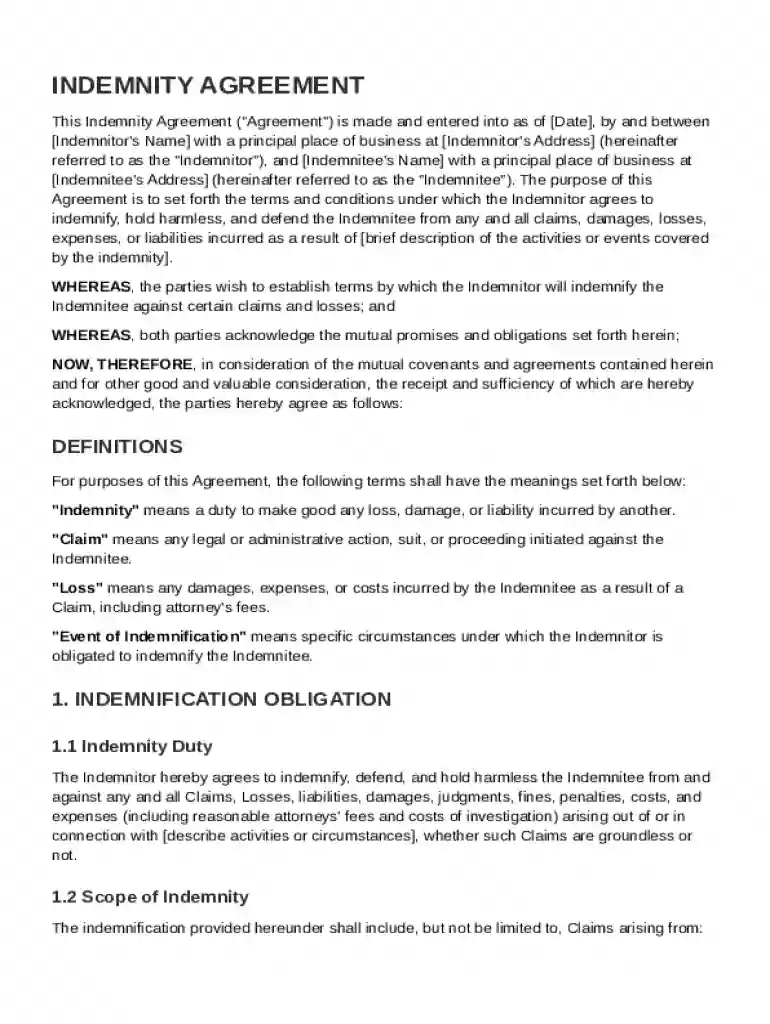
Type text, add images, blackout confidential details, add comments, highlights and more.

Draw your signature, type it, upload its image, or use your mobile device as a signature pad.

Send it via email, link, or fax. You can also download it, export it or print it out.
An Indemnity Agreement is a legal contract where one party, known as the Indemnitor, agrees to protect another party, the Indemnitee, against potential losses or claims. These agreements are often used in business transactions to allocate risk and responsibility. The document specifies the circumstances under which indemnification will occur and often includes definitions for terms like 'Indemnity', 'Claim', and 'Loss'. Understanding these terms is crucial for both parties to comprehend their obligations and the extent of their coverage under the agreement.
To effectively use an Indemnity Agreement Template, start by carefully reviewing the document to ensure it aligns with the intended scope and purpose. Customize the template by filling in the specific details of the agreement, such as the names and roles of the Indemnitor and Indemnitee, the nature of the indemnified activities, and the geographical scope of the agreement. Be sure to specify any exclusions or limitations to indemnification. Once completed, both parties should review the template, preferably with legal counsel, to ensure clarity and mutual understanding before signing.
Completing an Indemnity Agreement Template involves several key steps to ensure it is legally sound and effective. Begin by gathering necessary information about the parties involved and the specific risks that need coverage. Customize the template by filling in these details, ensuring that all fields are accurate and complete. Consider consulting a legal professional to review the document for any potential gaps or ambiguous language. Once finalized, both parties should sign the agreement, making sure the signing process follows any legal requirements for enforceability.
The legal use of an Indemnity Agreement Template hinges on its ability to define and allocate risk between parties in a legal transaction. The agreement must clearly state the indemnification terms, including the scope of protection and any exceptions. Compliance with relevant federal and state laws is essential, as these documents must be legally enforceable to protect the Indemnitee effectively. Regular updating of the template to reflect changing legal standards ensures its continued validity and effectiveness.
Understanding the terms included in an Indemnity Agreement is vital for all parties involved. Key terms often found in these agreements include 'Indemnity', which refers to the obligation to compensate for losses; 'Claim', indicating a demand for compensation; and 'Loss', describing the damage or liability incurred. Clearly defining these terms within the agreement reduces ambiguity and provides a solid foundation for executing the contract provisions.
An effective Indemnity Agreement Template includes several critical elements, ensuring comprehensive coverage and clear responsibilities. Key components often cover the scope of indemnification, exclusions, notification requirements, and control of defense. These elements work in tandem to delineate the responsibilities of each party in the event of a claim and to prescribe the steps necessary for processing such claims.
State-specific rules can heavily influence the construction and enforceability of an Indemnity Agreement. Each state in the U.S. may have distinct legal requirements regarding indemnity clauses, particularly in how they are structured and the terminology used. Understanding these nuances ensures that the agreement is not only comprehensive but also compliant with the legal standards of the state in which it is executed.
Indemnity Agreements are used across various industries to manage risk and liability. For instance, in construction, such agreements protect contractors from liabilities related to workplace injuries. In retail, companies may use them to handle liabilities arising from product defects. Including real-world examples in the agreement helps clarify its application and demonstrates how it functions in practice.
Different industries or situations might necessitate specific versions or alternatives of an Indemnity Agreement Template. Tailored versions exist for construction, software licensing, and more. Understanding the differences between these alternatives can help ensure the agreement provides adequate coverage specific to unique industry needs.
By understanding and utilizing these elements within the Indemnity Agreement Template, parties can effectively manage potential risks and liabilities inherent in business transactions.
At DocHub, your data security is our priority. We follow HIPAA, SOC2, GDPR, and other standards, so you can work on your documents with confidence.



Name and Address of the Witness. Signature of the Witness. 1. 2. NOTES: 1. Indemnity Bond should be on Non-Judicial stamp paper of Rs.200/-.
I acknowledge and agree that I am financially responsible for any damage caused to the premises or any other property, to extent caused by my willful misconduct


