






Definition and Meaning
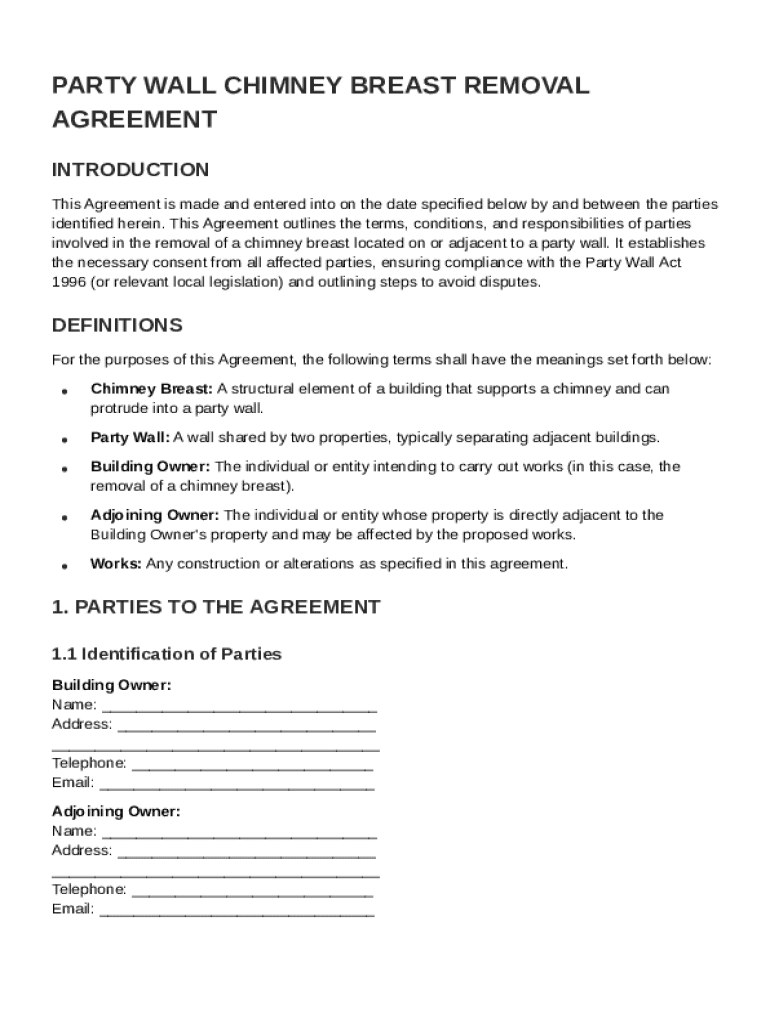
A Party Wall Chimney Breast Removal Agreement is a legally binding document that sets the conditions for removing a chimney breast that is part of or adjacent to a shared party wall. This document is essential in outlining the rights and duties of the Building Owner and the Adjoining Owner, helping prevent conflicts and ensuring compliance with the Party Wall Act 1996. The agreement covers areas such as notification, consent procedures, access rights for construction, structural safety considerations, and the responsibilities for any damages incurred during the removal process.
Key Elements of the Agreement
The Party Wall Chimney Breast Removal Agreement encompasses several critical sections that are vital for maintaining clear communication and responsibilities between the involved parties:
-
Notification Requirements: The Building Owner must notify the Adjoining Owner of their intention to remove the chimney breast, usually including a detailed description of the proposed works.
-
Structural Considerations: Guidelines should be set for ensuring the structural stability of the remaining wall post-removal. This may involve engaging a structural engineer to assess and certify the safety of the modifications.
-
Access Rights: Specifies the access requirements for the Building Owner or contractors to enter the Adjoining Owner's property for work execution and inspections.
-
Insurance Requirements: Outlines the obligation on either party to maintain adequate insurance coverage against damage, accidents, and liability during the construction process.
-
Dispute Resolution: Procedures for resolving any disagreements amicably, including potential arbitration or mediation, and the governing law to be used in disputes.
Steps to Complete the Agreement
Filling out a Party Wall Chimney Breast Removal Agreement requires careful attention to detail to ensure compliance and minimize potential disputes:
-
Preparation: Gather all necessary information, including property details, owner details, and the specifics of the proposed work.
-
Notification: Prepare formal notice to inform the Adjoining Owner of your intentions and include architectural plans and timelines.
-
Consultation: Engage in discussions with the Adjoining Owner to address any concerns and obtain consent for the works.
-
Drafting the Agreement: Work with a professional, if necessary, to draft the agreement incorporating all required elements and terms agreed upon by both parties.
-
Signing the Agreement: Ensure both parties review and sign the agreement before works commence to formalize the agreement legally.
Why Use a Party Wall Chimney Breast Removal Agreement
Using this agreement template helps avoid disputes and confusion by clarifying each party’s rights and responsibilities. It ensures adherence to legal requirements, provides structured processes for notifying and obtaining consent, and clarifies access and damage responsibilities. Furthermore, it is instrumental in maintaining good neighborly relations and avoiding costly legal disputes.
Legal Use and Compliance
The Party Wall Chimney Breast Removal Agreement must comply with the provisions of the Party Wall Act 1996, which governs alterations to shared walls. Compliance with this Act is crucial to avoid legal penalties. The document ensures that all parties are aware of and agree to the terms, which can serve as evidence in court should disagreements arise later.
Who Typically Uses This Agreement
Property developers, individual homeowners seeking to alter their property for renovations, and legal professionals or surveyors advising on party wall matters are the typical users. These parties use the agreement to ensure all statutory obligations are met while preserving the structural integrity of the party wall and surrounding areas.
Important Terms Related to the Agreement
Understanding specific legal terms within the agreement is essential for full comprehension and compliance:
-
Party Wall: A wall shared by two properties, which forms part of the structure of both.
-
Building Owner: The individual or entity proposing to conduct works on their property affecting the party wall.
-
Adjoining Owner: The individual or entity whose property shares the party wall with the Building Owner's property.
-
Consent: Both verbal and written agreement from the Adjoining Owner allowing the proposed works.
State-Specific Rules
While the Party Wall Act 1996 provides a framework applicable across the United States, individual states may have additional regulations or interpretations. It is vital for users to verify any state-specific requirements before finalizing the agreement to ensure full compliance with local laws and regulations.