




01. Edit your form online
Type text, add images, blackout confidential details, add comments, highlights and more.

Type text, add images, blackout confidential details, add comments, highlights and more.

Draw your signature, type it, upload its image, or use your mobile device as a signature pad.

Send it via email, link, or fax. You can also download it, export it or print it out.
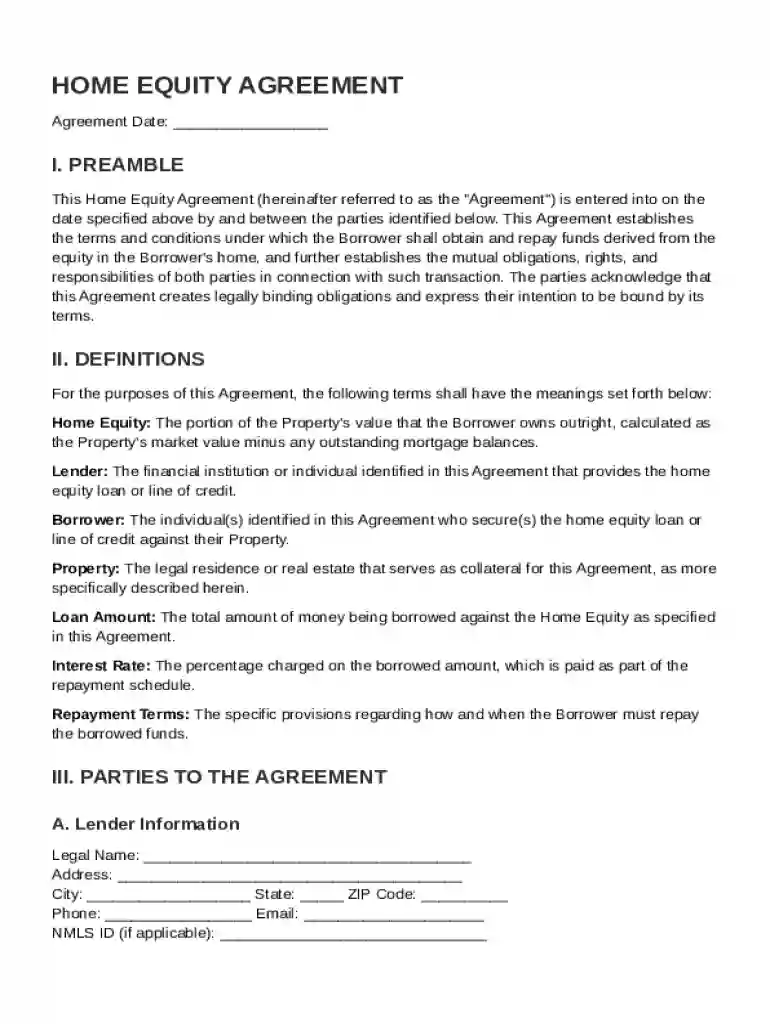
A Home Equity Agreement Template is a legal document detailing the terms under which a homeowner, referred to as the Borrower, can access funds based on the equity they have in their home. This template outlines crucial aspects such as the amount borrowed, interest rates, and repayment schedules. It also specifies the responsibilities of both the Borrower and the entity providing the loan, often called the Lender. The primary aim is to formalize the agreement and provide legal clarity and security for both parties involved.
Equity in a home refers to the portion of the property's value that the owner truly owns, free of any liens or loans. For example, if a property is valued at $300,000, with a mortgage balance of $100,000, the homeowner’s equity would be $200,000. This equity serves as collateral for the loan, allowing the Borrower to secure funds for various purposes such as home improvements, debt consolidation, or other financial needs.
The Home Equity Agreement Template encompasses several critical components that dictate the structure and enforceability of the agreement. These elements include:
Completing the Home Equity Agreement Template requires attention to detail and a structured approach:
The legal framework surrounding the Home Equity Agreement ensures that both parties adhere to the covenant. It is governed by state-specific laws which regulate the agreement’s enforceability and the protocol in case of default. Comprehending these legal intricacies ensures proper formulation and minimizes disputes.
These agreements must adhere to federal and state laws, such as the Truth in Lending Act, which mandates disclosure of loan terms and prevents predatory lending practices. Compliance with these regulations is crucial to validate the agreement and ensure fairness for the Borrower.
The rules for home equity agreements vary significantly across different states in the U.S. For instance, states like Texas have strict laws limiting home equity borrowing to 80 percent of the appraised home value, while others may allow borrowing up to 100 percent equity with stipulations.
States may also differ in terms of allowable fees, notice requirements, and the cooling-off period provided to Borrowers. It is essential to consult with local legal professionals or financial advisors to tailor the template according to state-specific mandates effectively.
Understanding relevant terminology is vital for navigating home equity agreements:
Practical uses of the Home Equity Agreement can be seen in several scenarios:
In each scenario, the availability of funds secured against home equity offers strategic financial solutions tailored to individual needs and circumstances.
Typically, financial institutions such as banks or mortgage lenders issue the Home Equity Agreement Template. These institutions are equipped with the legal expertise and financial acumen to draft and finalize these agreements, ensuring compliance with regulatory standards and clarity of terms. Some homeowners may also seek the service of real estate attorneys to craft agreements uniquely suited to their specific situations, further verifying the accuracy and legal integrity of the document.
At DocHub, your data security is our priority. We follow HIPAA, SOC2, GDPR, and other standards, so you can work on your documents with confidence.
The parties may provide in the arbitration agreement for certain forms of discovery, either greater or less than those found in the Courts rules of discovery.
Many types of agreements are executed by Emorys Office of Technology Transfer. Templates for many of these agreements can be found on this page.
APPENDIX 7: Home Equity Conversion Loan Agreement, PDF. APPENDIX 8: Repair Rider to Loan Agreement, PDF. APPENDIX 9: Condominium Rider, PDF. APPENDIX 10:


