






Definition & Meaning
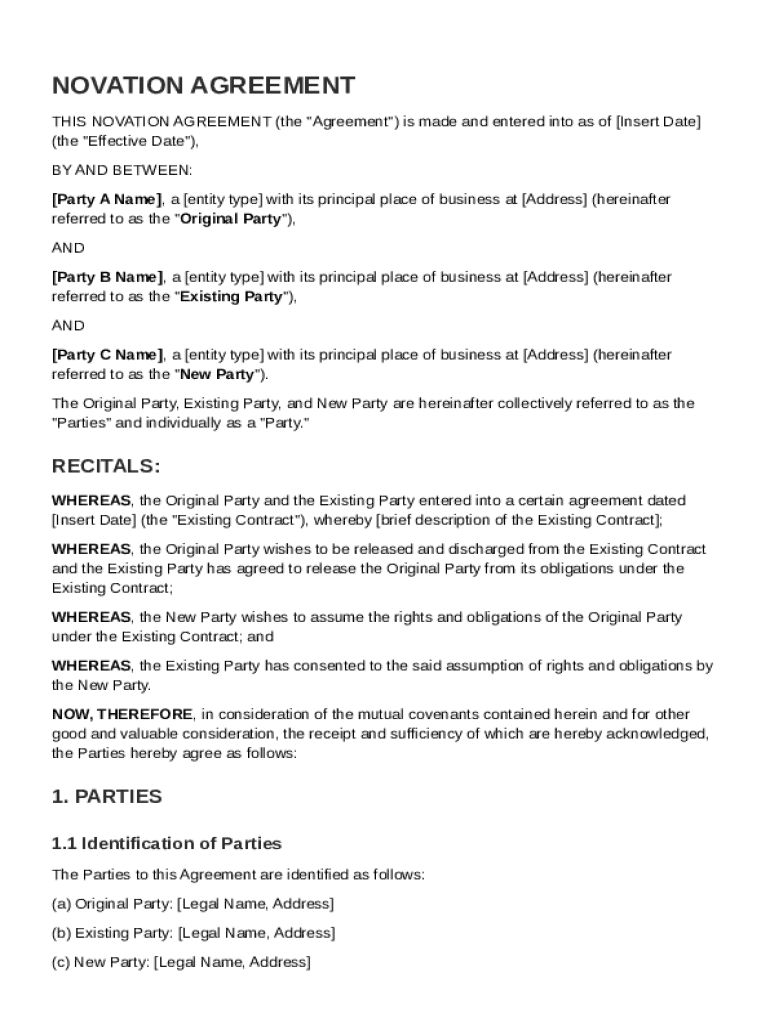
A novation agreement is a legal document used to transfer rights and obligations from one party to another within an existing contract. It allows a new party to step into the shoes of the original party, effectively replacing them in the contract. This agreement is commonly used in scenarios where the original party can no longer fulfill their contractual duties or wishes to transfer their role to someone else. The process requires the consent of the existing party and the new party. The novation agreement outlines the terms under which this transfer occurs, ensuring all parties acknowledge and accept the changes.
Key Elements of the Novation Agreement Template
A novation agreement template typically includes several crucial components to ensure clarity and legal enforceability:
- Identification of Parties: Clearly identifies the original party, the existing party, and the new party involved in the agreement.
- Release and Assumption of Obligations: Specifies that the original party is released from their contractual obligations and that these are assumed by the new party.
- Representations and Warranties: Contains assertions by the parties that they are authorized and competent to enter into the agreement and fulfill their respective roles.
- Governing Law: States the jurisdiction whose laws will govern the interpretation and enforcement of the agreement.
- Dispute Resolution: Includes mechanisms for resolving any disputes that may arise, such as mediation or arbitration.
How to Use the Novation Agreement Template
Using a novation agreement template involves several steps designed to ensure legal compliance and mutual understanding:
- Review the Existing Contract: Ensure the original contract allows for novation and understand the rights and obligations involved.
- Gather Relevant Information: Collect details of all parties, including identification numbers, addresses, and the specifics of the contract being novated.
- Complete the Template: Fill in the template with accurate information, ensuring each section is clearly addressed.
- Seek Legal Advice: Consult a legal professional to review the agreement and ensure it meets all necessary legal standards.
- Obtain Consent: Secure the written consent of the existing party, original party, and new party to the terms of the novation.
Steps to Complete the Novation Agreement Template
Completing a novation agreement template requires careful attention to detail to ensure its legality and completeness:
- Fill Out Party Information: Enter the legal names and contact details of the original, new, and existing parties.
- Define the Subject Matter: Clearly specify the contract or obligations being novated, including any applicable reference numbers.
- Detail the Transfer of Obligations: Accurately describe the obligations and rights being transferred from the original party to the new party.
- List Consideration: Outline any consideration given or received for the novation, such as financial compensation.
- Specify Conditions and Effective Date: Define any conditions precedent to the effectiveness of the novation and the date it takes effect.
- Include Signatures: Ensure all parties sign and date the agreement to indicate their acceptance.
Legal Use of the Novation Agreement Template
For a novation agreement to be legally valid, certain conditions must be fulfilled:
- Consent of All Parties: It is imperative to obtain explicit consent from all involved parties.
- Consideration: Generally, there should be some form of consideration provided, even if nominal, to support the transfer of contract rights and obligations.
- Compliance with Contractual Terms: The novation must align with any stipulations regarding assignment or novation that exist within the original contract.
- Written Format: A novation agreement should be in writing to create a documented record enforceable in court if necessary.
Examples of Using the Novation Agreement Template
A novation agreement can be applied in various scenarios, such as:
- Business Sales: When selling a business with ongoing contracts, novation is used to transfer those contracts to the new business owner.
- Service Contracts: A subcontractor might novate their obligations to a third party, with the main contractor’s approval, to ensure seamless project continuity.
- Lease Transfers: An original tenant can use novation to transfer lease obligations to a new tenant with the landlord's consent, allowing the original tenant to exit their lease early.
State-Specific Rules for the Novation Agreement Template
States may have specific rules affecting novation agreements, including:
- Variation in Governing Law: Depending on the state, the laws governing the novation process may differ, affecting how the agreement is drafted and enforced.
- Consumer Protections: Some states incorporate consumer protection statutes that could impact the rights of parties in a novation agreement.
- Disclosure Requirements: Certain jurisdictions may mandate the disclosure of specific information within the novation agreement.
Important Terms Related to the Novation Agreement Template
Understanding key terms is critical when dealing with a novation agreement:
- Assignor: The original party effectively exiting the contract.
- Assignee: The new party accepting the transferred obligations and rights.
- Continuing Party: The existing party remaining in the contract but now engaging with the assignee.
- Mutual Agreement: A consensus reached by all parties involved to proceed with the novation.
Who Typically Uses the Novation Agreement Template
Novation agreements are commonly used by:
- Corporations: Large businesses often use novation to transfer contracts within subsidiaries or during mergers and acquisitions.
- Real Estate Professionals: Landlords and tenants utilize novation to manage leases efficiently.
- Financial Institutions: Banks might novate loan agreements when selling loan portfolios to other financial entities.
- Project Managers: In industries like construction, novation ensures continuity when changing contractors or subcontractors.