




01. Edit your form online
Type text, add images, blackout confidential details, add comments, highlights and more.

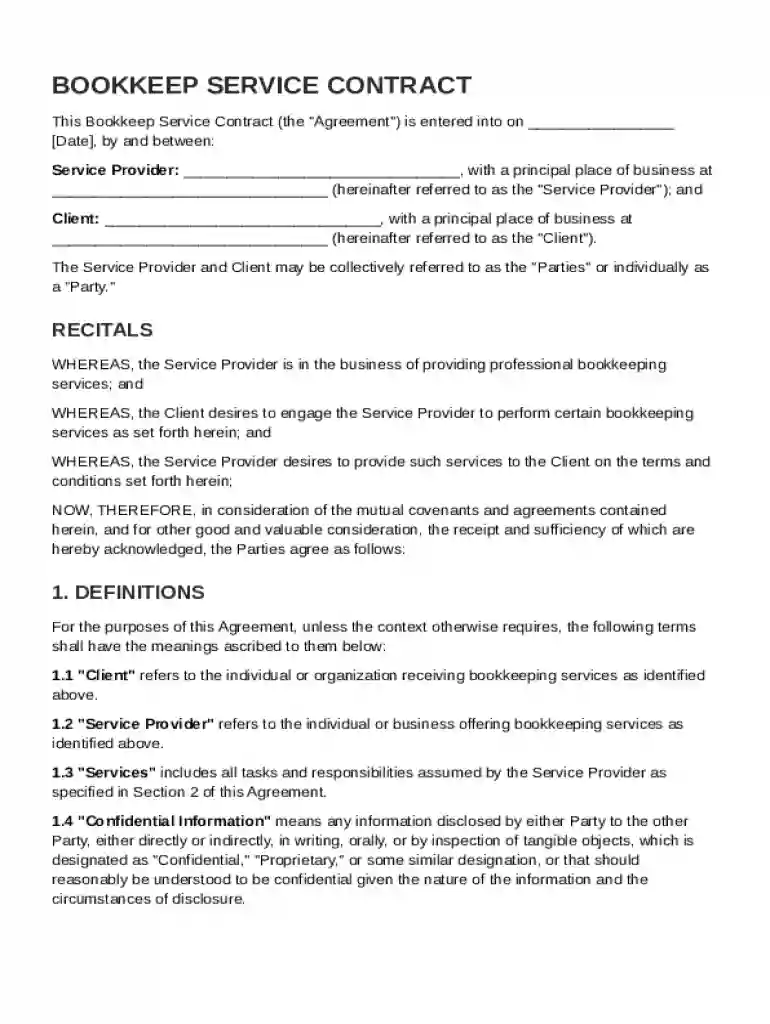
Type text, add images, blackout confidential details, add comments, highlights and more.

Draw your signature, type it, upload its image, or use your mobile device as a signature pad.

Send it via email, link, or fax. You can also download it, export it or print it out.
A Bookkeep Service Contract Template is a vital document designed to formalize the agreement between a service provider and a client for bookkeeping services. This contract delineates the scope of services, outlines the compensation structure, and establishes the responsibilities of both parties. It also covers critical elements such as confidentiality obligations, termination conditions, and dispute resolution processes. Emphasizing the independent contractor status of the service provider, this contract ensures that all parties are clear about their roles, thereby minimizing potential conflicts.
Using the Bookkeep Service Contract Template efficiently involves several key steps. To begin, both parties should review the contract to ensure all services and terms are accurately represented. Important sections to focus on include the scope of services, which specifies the exact bookkeeping tasks to be performed. Fill in details related to compensation, determining whether the service provider will be paid hourly, monthly, or upon project completion. It's essential to customize the confidentiality and data protection clauses to suit the specific needs of your business. Once finalized, both parties should carefully read the document before signing to confirm agreement with all terms.
Several critical components are integral to a comprehensive Bookkeep Service Contract Template. These include:
In the United States, the legal framework surrounding the Bookkeep Service Contract Template ensures compliance with federal and state regulations. The contract must clearly stipulate that the service provider is an independent contractor to avoid misclassification that could lead to legal issues. Moreover, given the confidential nature of financial information, adherence to data protection laws such as the Gramm-Leach-Bliley Act is crucial. It's advisable for both parties to consult with a legal professional to ensure the contract adheres to local laws, including licensing and record-keeping requirements pertinent to bookkeeping services.
Consider a small business owner seeking professional bookkeeping assistance. The Bookkeep Service Contract Template becomes a foundational document that clarifies the tasks the bookkeeper is expected to undertake, such as managing payroll or financial reporting. Another scenario is for a freelance bookkeeper providing services to multiple clients. Each client relationship should be governed by a separate contract to cater to the specific terms and conditions agreed upon, protecting both the bookkeeper and the client from ambiguities and fostering a professional engagement.
The primary beneficiaries of the Bookkeep Service Contract Template include small to medium-sized businesses, solo entrepreneurs, and freelance bookkeepers. Small businesses might use the template to hire external bookkeeping services, while freelancers can use it to formalize agreements with new clients. Additionally, established accounting firms might utilize these contracts when offering bookkeeping packages to clients. By using standardized contracts, businesses and professionals ensure there is clarity in expectations and deliverables while protecting legal interests.
For seamless contract management, it is advisable to use software solutions that support document editing and electronic signatures. Platforms like DocHub facilitate the entire process from creating and editing to signing the contract electronically. Software tools should allow integration with cloud storage services, enabling easy access to contracts anytime and anywhere. These digital solutions streamline document workflows, ensure security through encryption, and maintain a legal audit trail for compliance and record-keeping purposes.
While the Bookkeep Service Contract Template is broadly applicable across the U.S., state-specific variations may exist, especially concerning tax regulations and labor laws. For instance, some states have unique privacy laws that may require additional clauses in the confidentiality section of your contract. Others might impose stricter requirements on the classification of independent contractors. It is crucial for businesses to review these state-specific rules to ensure the contract meets all legal standards relevant to their location, potentially requiring consultation with a local attorney for compliance.
At DocHub, your data security is our priority. We follow HIPAA, SOC2, GDPR, and other standards, so you can work on your documents with confidence.




A board member should have general knowledge of the books and records of the organization as well as its general operation. The organizations articles, bylaws,
Bookkeeping services agreement - SLS sample 08-31-20 (263 kB) Categories: NO LEGAL ADVICE OR ATTORNEY-CLIENT RELATIONSHIP We are not giving legal or tax advice


