






Definition and Meaning of Bond Contract Template
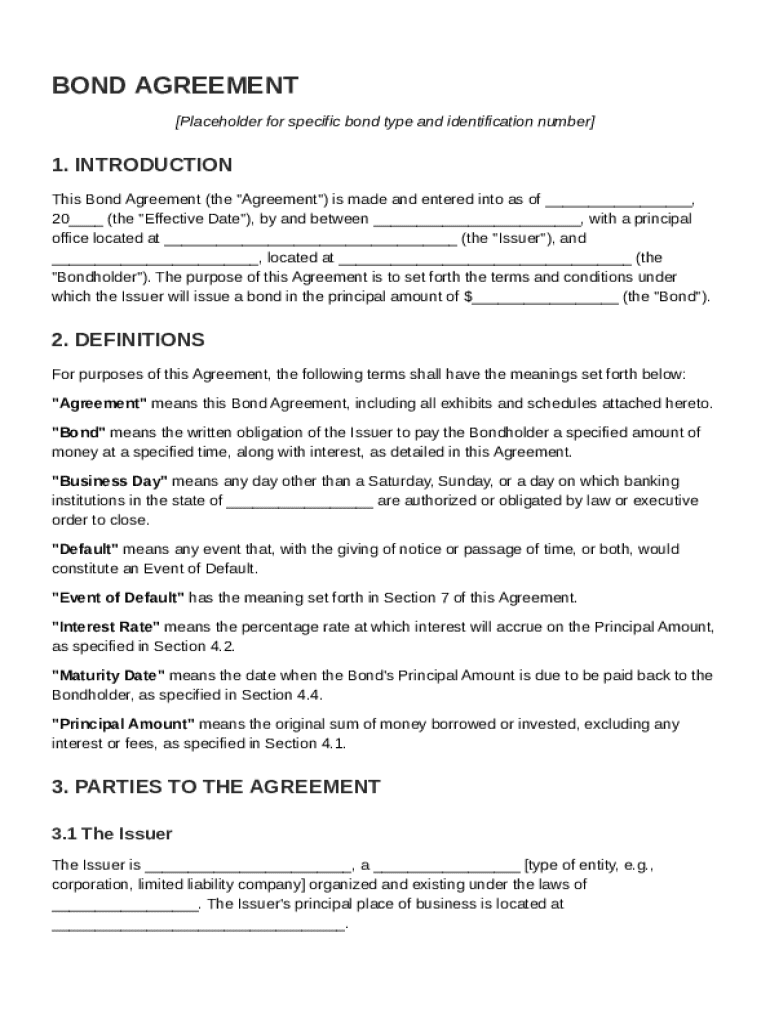
A bond contract template is a predefined document structure that outlines the standard terms and conditions for a bond agreement between an issuer and a bondholder. This template provides a comprehensive framework for detailing the bond's principal amount, interest rates, payment schedules, maturity date, and other pivotal facets of the bond issuance. The template not only assists in formalizing the legal obligations of both parties involved in the bond transaction but also ensures consistency and clarity across bond agreements. By utilizing a bond contract template, parties can efficiently navigate complex financial terms and formalize their agreement through a tested structure.
Key Elements of the Bond Contract Template
The bond contract template consists of several key elements, integral to the functionality and comprehensiveness of the agreement:
-
Principal Amount: This is the total amount that the bond issuer promises to repay the bondholder at maturity. Precise specification of this amount is necessary for understanding the bond's valuation.
-
Interest Rate: The interest rate, or coupon rate, delineates the rate at which interest is paid to the bondholder. Typically, this is expressed as an annual percentage, providing insights into the expected returns.
-
Payment Schedule: Detailed timelines indicating when interest payments will be made, and when the principal amount will be repaid. This clarity helps bondholders manage their cash flow expectations.
-
Maturity Date: The maturity date marks the end of the bond term, at which point the principal amount is due to be repaid. Inclusion of this element in the template fosters planning and financial forecasting.
-
Covenants: These are conditions or restrictions imposed on the issuer to protect the interests of bondholders. Clearly defined covenants maintain the issuer's financial and operational discipline.
-
Representations and Warranties: Statements of fact made by both parties, ensuring that prerequisites for the contract's validity are met. This section secures the integrity and enforceability of the agreement.
-
Default and Remedies: Conditions under which the bondholder can take action if the issuer fails to fulfill their obligations, and corresponding remedies available to the bondholder.
Steps to Complete the Bond Contract Template
To complete a bond contract template effectively, follow these steps, ensuring that all critical information is accurately represented:
-
Identify Parties: Clearly state the issuer's and bondholder's names and addresses, establishing the parties involved in the contract.
-
Fill in Financial Details: Populate the template with the principal amount, interest rate, and maturity date, ensuring data aligns with the agreed terms.
-
Outline the Payment Schedule: Detail the specific dates for interest payments and principal repayment to avoid ambiguity.
-
Detail Covenants and Obligations: Specify any covenants and obligations the issuer must adhere to throughout the bond term.
-
Include Representations and Warranties: Incorporate all necessary statements from both parties, confirming compliance with legal and financial prerequisites.
-
Define Default Scenarios and Remedies: Clearly articulate what constitutes a default and outline the steps available to the bondholder in such events.
-
Review and Validate: Ensure comprehensive accuracy across all elements, and have both parties review the document to confirm mutual understanding and agreement.
Legal Use of the Bond Contract Template
The legal use of a bond contract template extends to facilitating the formalization of bond agreements in compliance with applicable laws and regulations. Deploying a legally vetted template ensures that the agreement is robust, enforceable, and meets the standards set forth by financial and regulatory institutions. Parties involved in bonds must adhere to various statutory obligations, requiring meticulous adherence to the contract terms outlined. In the United States, the adherence to criteria stipulated by acts such as the Trust Indenture Act provides cohesion and clarity. Proper utilization of a template underscores compliance, aligning bond transactions with established legal frameworks.
State-Specific Rules for the Bond Contract Template
Bond agreements may be subject to varying rules depending on the specific state where the transaction takes place. The template should adapt to recognize differences in:
-
Taxation Policies: State-specific tax treatments can influence the returns on bonds and affect the net income generated from bond earnings.
-
Regulatory Bodies: States may have unique financial regulatory authorities, and compliance with their guidelines ensures the legality of the bond issuance.
-
Dispute Resolution Mechanisms: States may impose different mandatory procedures for resolving disputes arising from bond contracts, which can affect how parties seek recourse in instances of conflict.
Understanding these variances helps in tailoring the bond contract template to align with the respective jurisdiction’s requirements.
Examples of Using the Bond Contract Template
The utilization of a bond contract template spans a variety of scenarios and can be employed under different real-world conditions:
-
Corporate Bond Issuance: A manufacturing company issuing bonds to raise capital for expansion may use a template to clearly define interest payments, maturity, and bondholder rights.
-
Municipal Bonds: A local government may use a specialized bond contract template to record terms for financing public projects, ensuring transparency and accountability among taxpayers.
-
Green Bonds: In the increasingly important environmental sector, bond contract templates outline terms for projects with sustainability objectives, reflecting the issuer's commitment to eco-friendly investments.
These scenarios exemplify how bond contract templates provide structured, clear frameworks for documentation across varied financial landscapes.
Important Terms Related to Bond Contract Template
Understanding certain critical terms is crucial when dealing with bond contract templates:
-
Issuer: The entity that issues the bond and is obligated to pay the bondholder both interest and principal.
-
Coupon Rate: This rate, often fixed, determines the bond's return rate over its lifespan and has significant implications for bondholder returns.
-
Yield: Yield represents the effective return on a bond, factoring in the interest payments and current market price.
-
Callable Bond: A bond type that allows the issuer to repay the bond before its maturity, generally executed when interest rates drop.
-
Zero-Coupon Bond: Unlike standard bonds, these accrue and compound interest until maturity, where principal and compounded interest are fully paid.
Understanding these terms ensures precise communication and enhances comprehension when engaging with bond contract terms.
Who Typically Uses the Bond Contract Template
The use of bond contract templates spans a diverse audience, including:
-
Corporations: Businesses seeking to finance operations or expansions may use bonds as a means of raising capital, requiring a formal contract to manage obligations.
-
Government Entities: State and local governments frequently issue bonds to finance large infrastructure projects, relying on templates to standardize agreements clearly.
-
Financial Institutions: Banks and investment firms may utilize such templates for bonds issued to clients or as intermediaries in various bond transactions.
-
Investment Firms: These entities, dealing in currency or investor resources, often craft and manage bond agreements as central to their investment portfolios.
Using bond contract templates, these groups maintain a structured, legally sound basis for issuing and managing bond commitments.


Filing Deadlines and Important Dates
When managing bond contract obligations, keeping track of important dates is critical:
-
Interest Payment Dates: Regular interest dispersion schedules must be adhered to as part of fulfilling the bond issuer’s obligations.
-
Maturity Date: This marks when the principal is due to be returned to investors, making it critical for both planning and compliance.
-
Regulatory Filing Deadlines: Both federal and state-level reporting requirements may mandate specific disclosures related to bond activity.
Staying aware of these significant dates prevents lapses in compliance and supports timely fulfillment of bond contractual obligations.