






Definition and Meaning
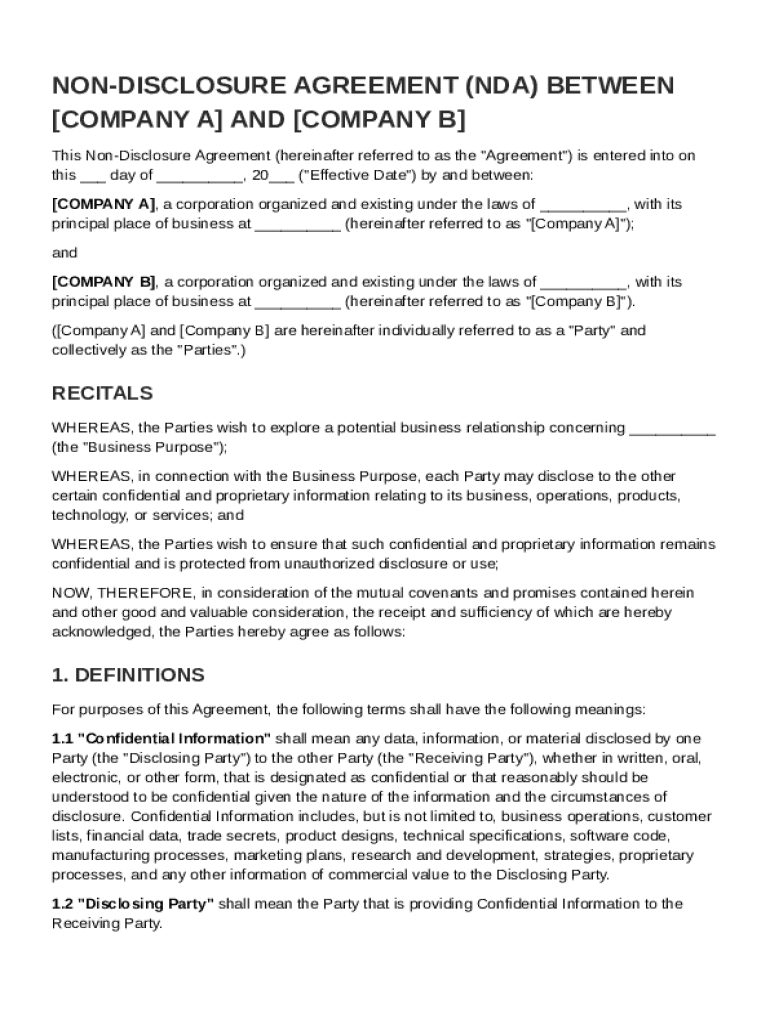
The Non-Disclosure Between Two Companies Agreement Template is a legal document designed to safeguard confidential information exchanged between two corporate entities during discussions about a potential business relationship. This template helps outline the parameters for confidentiality, ensuring that sensitive data shared is appropriately protected. It becomes particularly relevant when entities share proprietary information, trade secrets, or strategic plans that could impact competitive advantage if disclosed.
- Confidential Information: The agreement typically defines what constitutes confidential information, including but not limited to business strategies, financial data, customer lists, and proprietary technologies. This makes it clear to both parties what information should remain undisclosed.
- Duration of Confidentiality: The template outlines how long the confidentiality obligations last, which may extend beyond the term of the business relationship itself.
Key Elements of the Non-Disclosure Between Two Companies Agreement Template
The template includes several essential elements that ensure comprehensive coverage of confidentiality concerns.
- Obligations of the Receiving Party: This section details the responsibilities of the party receiving the information, restricting use, and preventing disclosure to unauthorized third parties.
- Return or Destruction of Materials: Once the business relationship concludes or the agreement terminates, this clause mandates that all confidential materials be returned or destroyed, eliminating the risk of information leakage.
- Dispute Resolution Mechanisms: The agreement provides methods for resolving disputes that may arise due to alleged breaches of confidentiality. This might include mediation or arbitration clauses that offer non-litigious resolutions.
- Miscellaneous Terms: Includes clauses related to jurisdiction, amendment procedures, and the full agreement's enforceability.
Steps to Complete the Non-Disclosure Between Two Companies Agreement Template
Completing this template involves several critical steps to ensure all necessary legal considerations are addressed.
- Identify the Parties Involved: Clearly mention the legal names and addresses of the companies entering into the agreement.
- Define the Scope of Confidentiality: Specify what information is deemed confidential and any exceptions, such as publicly available information.
- Set the Duration of Obligations: Decide on the time period for which the confidentiality obligations are applicable.
- Customize Dispute Resolution Clauses: Agree on and document how any disputes will be handled.
- Review Legal Language: Ensure all terms are clear and legally binding, seeking legal advice if necessary.
Important Terms Related to the Non-Disclosure Between Two Companies Agreement Template
Understanding specific legal terminology within the template is crucial for accurate and enforceable agreements.
- "Confidential Information": A broad term covering all non-public data shared between the parties.
- "Disclosing Party" and "Receiving Party": The parties involved in providing and receiving the confidential information, respectively.
- "Non-disclosure": The prohibition of sharing protected information with unauthorized individuals.
Examples of Using the Non-Disclosure Between Two Companies Agreement Template
Real-world scenarios highlight the practical applications of this template.
- Tech Collaborations: Two tech firms working on joint projects may use this agreement to protect proprietary algorithms and source code.
- Joint Ventures: When companies explore potential partnerships, they often share sensitive financial data and strategic plans, requiring a robust NDA.
- Supplier Relationships: Manufacturers might need to safeguard prototype designs shared with suppliers to ensure competitive advantage.
Who Typically Uses the Non-Disclosure Between Two Companies Agreement Template
This template finds use across diverse industries and business types.
- Corporations Entering Joint Ventures: They require confidentiality assurances before sharing strategic plans.
- Startups Seeking Investment: Entrepreneurs share business models with potential investors under an NDA to secure their ideas.
- Research Institutions Collaborating with Commercial Entities: Protects intellectual property when developing new technologies.


Digital vs. Paper Version of the Non-Disclosure Between Two Companies Agreement
The transition to digital agreements offers significant advantages.
- Efficiency: Digital templates allow for rapid customization and dissemination via email, increasing efficiency.
- Security: Tools like DocHub provide secure electronic signature options, maintaining legal compliance and enforceability.
- Environmentally Friendly: Eliminates the need for physical document storage, reducing paper waste.
Business Types That Benefit Most from the Non-Disclosure Between Two Companies Agreement Template
Certain business types see more pronounced benefits from using this kind of agreement.
- Technology Firms: Protect intellectual properties such as software code and hardware designs.
- Pharmaceutical Companies: Secure research data and proprietary formulations.
- Consultancies: Guard client information and strategic insights during collaborations.
Legal Use of the Non-Disclosure Between Two Companies Agreement
Proper legal usage is central to enforcing the terms set out in the agreement.
- Compliance: Aligns with legal standards, such as the Uniform Trade Secrets Act or international equivalents, ensuring enforceability.
- Tailored Clauses: Customizable to include local state laws or international regulations when applicable.
- Enforceability: Requires correct and complete execution, typically involving signatures from authorized representatives of each company.
By understanding and implementing these components, businesses can effectively secure their confidential information and foster secure partnerships.