




01. Edit your form online
Type text, add images, blackout confidential details, add comments, highlights and more.

Type text, add images, blackout confidential details, add comments, highlights and more.

Draw your signature, type it, upload its image, or use your mobile device as a signature pad.

Send it via email, link, or fax. You can also download it, export it or print it out.
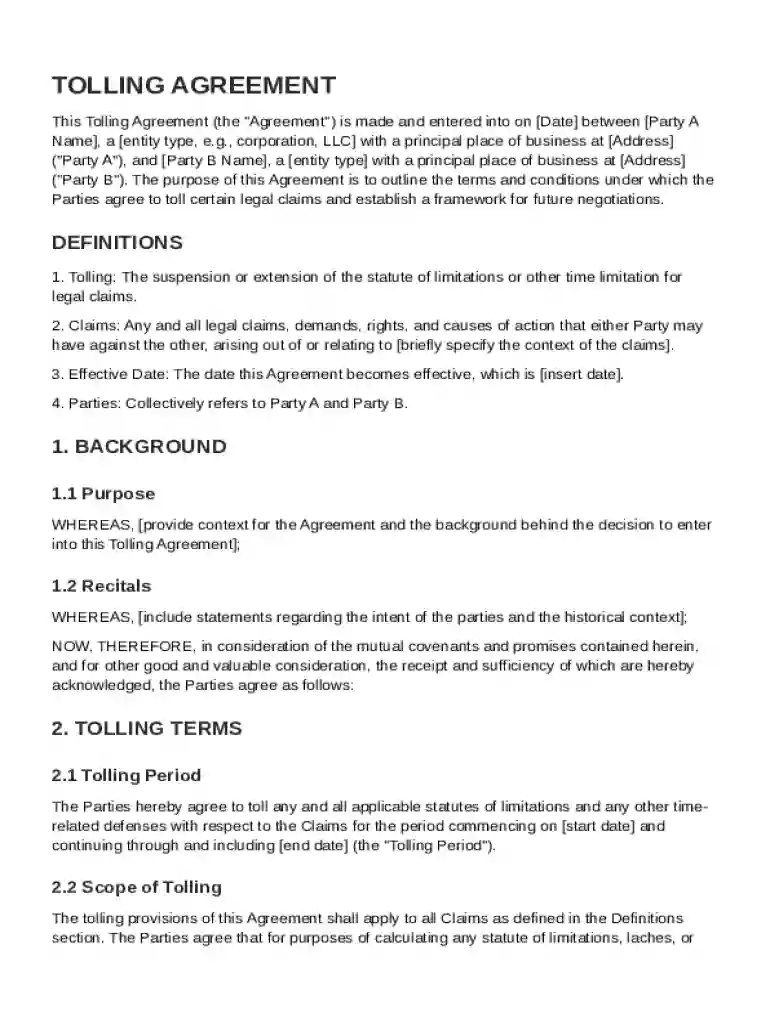
A Tolling Agreement Template is a legal document used to pause or suspend the statute of limitations on a legal claim, allowing the parties involved more time for negotiation or settlement without the pressure of an impending deadline. The statute of limitations dictates the timeframe within which a lawsuit must be filed after the occurrence of an event. This agreement ensures that both parties—the claimant and the defendant—agree to toll, or temporarily stop, the running of this statutory period. Typically, it is used during the pre-litigation phase when parties prefer to negotiate rather than proceed to immediate legal action.
A comprehensive tolling agreement will include several critical components to ensure clarity and enforceability:
Identification of parties: Clearly define all the parties involved in the agreement. This typically includes the claimant and the defendant or any other relevant parties.
Effective date and duration: Specify when the tolling period begins and ends. A provision for extension should also be considered if additional time is needed.
Scope of claims: Outline the specific legal claims or causes of action that are subject to tolling. This ensures that both parties are aware of which issues are involved.
Non-admission clause: State that entering into the tolling agreement does not constitute an admission of liability by any of the parties involved.
Termination provisions: Include conditions under which the agreement may be terminated before the expiration date, such as the initiation of litigation or further mutual agreement to end tolling.
Using a Tolling Agreement Template effectively involves several steps:
Customization: Tailor the template to fit the specifics of the legal scenario, including the particular claims and parties involved.
Review by legal counsel: It is advisable for each party to have the document reviewed by legal counsel to ensure that their interests are adequately protected.
Execution: Once the template is customized and reviewed, all parties should sign the document to demonstrate their acceptance and agreement to the terms.
Monitoring: Keep track of the tolling period and any actions necessary if an extension is required to avoid any unintentional expiration.
The legal application of a tolling agreement is primarily within the pre-litigation context, serving various strategic purposes:
Extended negotiation time: It allows parties to negotiate settlements or reach resolutions without the looming deadline of a statute of limitations.
Prevents filing of hasty lawsuits: Often, parties enter into these agreements to avoid the costs and adversarial nature of litigation while seeking mutually agreeable solutions.
Maintains legal rights: While the agreement provides more time for negotiation, it ensures that the parties' legal rights concerning the statute of limitations are maintained and not inadvertently waived.
The template is typically used by:
Individuals in disputes: In personal or contractual disputes where an impending statute of limitations may otherwise force a quick filing of a lawsuit.
Businesses and corporations: Companies facing potential legal claims may use these agreements to manage potential litigation risks.
Attorneys: Legal professionals use the document as a strategic tool for managing client cases and exploring settlement avenues without the immediacy of litigation.


Gather necessary information: Collect all relevant details about the legal claims, involved parties, and circumstances that necessitate tolling.
Draft the agreement: Use the template to draft the agreement, inserting specifics about the parties, claims, and the desired tolling period.
Negotiate terms: Discuss and reach an agreement on terms like the length of the tolling period and potential for extensions.
Review and finalize: Make sure all parties review the finalized document ensuring that all legal requirements are met.
Execute the agreement: Signatures from all parties provide legal validity, and the agreement becomes effective as per the stipulated commencement date.
Different states may have specific rules concerning the process and enforceability of tolling agreements. It is essential to:
Consult local laws: Verify if state laws or judicial precedents impact the application of tolling in the jurisdiction where the agreement is executed.
Incorporate state-specific language: Tailor the agreement to reflect nuances or requirements that may be mandatory by state laws.
Understanding these variations ensures that the agreement serves its intended purpose effectively across different jurisdictions.
The application of tolling agreements can vary significantly from one state to another, influenced by differing statutes and court interpretations. Considerations include:
Divergent statutes of limitations: Each state may have unique statutes of limitations for various types of claims, influencing how a tolling agreement should be structured.
State court precedents: Court rulings in one state might impact the interpretation and enforcement of tolling agreements differently than in another.
General contract law: Variations in state contract laws can affect how tolling agreements are drafted and enforced, necessitating local legal counsel's input.
At DocHub, your data security is our priority. We follow HIPAA, SOC2, GDPR, and other standards, so you can work on your documents with confidence.


Aug 7, 2013 Standard contract size: 50MW. Western US: - Peak bucket is 6x16 (M-Sat 7AM to 11PM). - Offpeak (the offpeak wrap) is the complement.
Jul 10, 2016 Toll is collected based on a contract, which include the terms and conditions of issuance of Passes to the residents of nearby areas and


