Definition & Meaning
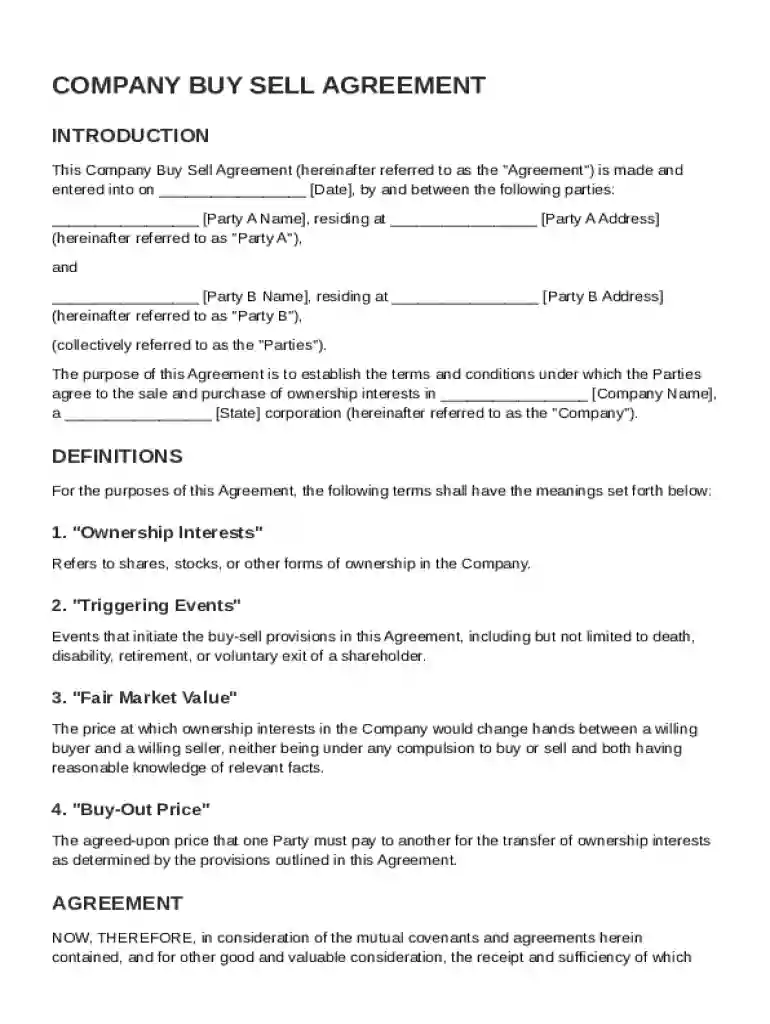
A Company Buy Sell Agreement is a legal document outlining the terms and conditions for the sale and purchase of ownership interests between parties within a company. It typically includes clauses on 'Ownership Interests', 'Triggering Events', and 'Fair Market Value'. Used primarily to facilitate smooth transitions of ownership upon events such as death, disability, or voluntary exit, this agreement is crucial for maintaining operational continuity. For example, if a partner in a limited liability company (LLC) decides to retire, a buy-sell agreement will guide the buy-out process, ensuring fairness and clarity for all involved parties.
Key Elements of the Company Buy Sell Agreement Template
A well-structured Company Buy Sell Agreement Template should incorporate several fundamental components to provide comprehensive coverage:
- Ownership Interests: Defines the precise ownership stakes of each party involved.
- Triggering Events: Situations prompting the sale or purchase, such as retirement, death, or incapacity.
- Valuation Methods: Processes and benchmarks used to ascertain fair market value, which might include financial metrics or third-party valuations.
- Payment Terms: Illustrate how the purchase will be financed, including any installment plans or down payments.
- Dispute Resolution: Outlines procedures for resolving potential disagreements, possibly through mediation or arbitration.
- Confidentiality Obligations: Ensures all parties maintain discretion concerning the transaction details.
These elements are essential for protecting the interests of all stakeholders and ensuring that the process is conducted equitably and transparently.
Steps to Complete the Company Buy Sell Agreement Template
Completing a Company Buy Sell Agreement Template involves several critical steps to ensure accuracy and legal compliance:
- Identify Parties Involved: Clearly list all individuals or entities participating in the agreement.
- Define Ownership Interests: Specify the shares or stakes held by each party.
- Determine Triggering Events: Outline scenarios that would initiate the buy-sell process.
- Select Valuation Methods: Agree on how the business's value will be calculated.
- Establish Payment Terms: Define how the transaction will be financed and settled.
- Include Dispute Resolution Methods: Determine how conflicts will be managed.
- Review and Finalize: Conduct a thorough review with legal advisors to ensure the agreement meets legal standards.
These steps should be meticulously followed to draft a robust agreement that safeguards all parties' interests.
Who Typically Uses the Company Buy Sell Agreement Template
This template is widely used by various types of business entities seeking to manage ownership transitions effectively:
- Partnerships: To address buy-out situations when a partner exits.
- Limited Liability Companies (LLCs): To secure operations when an owner relinquishes their ownership interest.
- Corporations: For structuring stock transitions in the event of shareholder changes.
- Family-Owned Businesses: To facilitate succession planning and prevent disputes during generational transitions.
These entities rely on buy-sell agreements to maintain stability and order during ownership changes.

Important Terms Related to Company Buy Sell Agreement Template
Understanding key terms related to the Company Buy Sell Agreement Template is essential for ensuring clarity and legal effectiveness:
- Fair Market Value: The estimated price at which the business would change hands between a willing buyer and seller.
- Right of First Refusal: A provision allowing existing shareholders the first opportunity to purchase shares before outsiders.
- Put Option: Allows a shareholder to sell their interest back to the company.
- Call Option: Permits the company or remaining owners to buy an outgoing shareholder's interest.
These terms are fundamental in structuring coherent and enforceable agreements.
Legal Use of the Company Buy Sell Agreement Template
Utilizing this template involves various legal considerations to ensure its enforceability and compliance:
- State-Specific Regulations: Adapting the agreement to comply with state laws governing business transactions.
- Drafting by Legal Professionals: It is advisable to have the agreement drafted or reviewed by legal counsel to ensure its validity.
- Contractual Obligations: Understanding that once executed, the agreement becomes a binding contract.
Legal advice is crucial to navigating these elements effectively, ensuring that the agreement is watertight and protects all parties.
State-Specific Rules for the Company Buy Sell Agreement Template
State laws can significantly influence the structuring and enforcement of buy-sell agreements:
- Community Property States: In states like California and Texas, ownership agreements may need to reflect community property laws affecting share distribution upon the owner's death or divorce.
- Jurisdiction-Specific Valuation Norms: States may have unique valuation guidelines or tax implications on ownership transfers.
- Dispute Resolution Practices: Certain states might favor specific methods such as arbitration over mediation.
Adjusting elements to adhere to state-specific guidelines is critical for ensuring the agreement's legal integrity.
Examples of Using the Company Buy Sell Agreement Template
Practical application of the Company Buy Sell Agreement Template illustrates its versatility and importance:
- Case Study - Succession Planning in an LLC: A mid-size LLC uses the buy-sell agreement to structure a partner's retirement, facilitating a seamless transition of ownership to the remaining partners without disrupting operations.
- Scenario - Death of a Shareholder in a Corporation: The agreement specifies terms for the corporation to buy back shares from the deceased shareholder's estate, thus consolidating ownership among the existing leadership.
- Example - Voluntary Exit in a Family Business: A family-run business integrates a buy-sell agreement to manage the planned departure of an owner, outlining terms for the sale to the next generation.
These examples underscore the agreement's utility in diverse business environments.