




Understanding the Mutual Service Agreement Template
Definition and Purpose
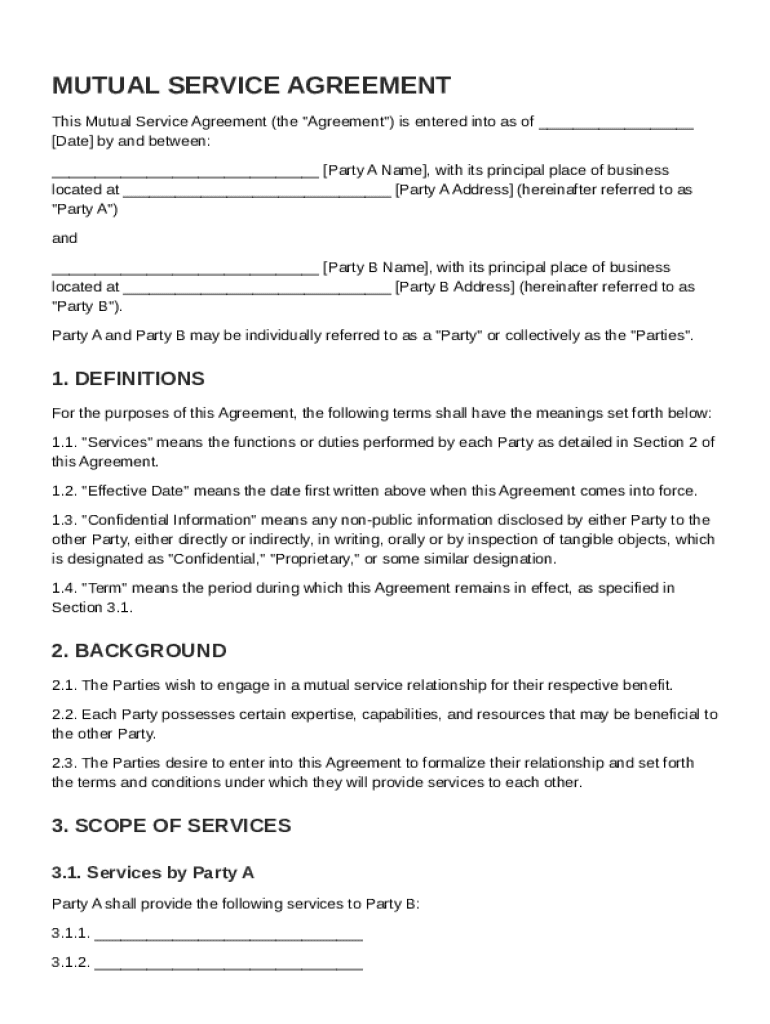
The Mutual Service Agreement Template establishes the framework for a cooperative arrangement where two parties, Party A and Party B, agree to exchange services. This document outlines the obligations, duties, and expectations for each party, ensuring clarity and mutual understanding. It serves not only to formalize the partnership but also to safeguard the interests of both parties through defined terms and conditions.
Key Elements of the Agreement
-
Scope of Services
- Clearly defines what services each party will provide.
- Outlines timelines, deliverables, and performance standards.
-
Responsibilities and Obligations
- Details the duties each party is expected to fulfill.
- Includes provisions for resource allocation, timelines, and communication protocols.
-
Confidentiality Obligations
- Specifies how proprietary and sensitive information will be protected.
- Includes terms regarding non-disclosure and data security measures.
-
Liability and Indemnification
- Limits liability for both parties under specific conditions.
- Outlines the processes for indemnification in cases of breach or negligence.
-
Dispute Resolution Procedures
- Provides a framework for resolving conflicts between parties.
- Includes mediation, arbitration, or legal action protocols.
-
Termination Clauses
- Defines conditions under which the agreement can be terminated.
- Includes notice periods and procedures for disentanglement of services.
Steps to Use the Template
-
Identify the Parties
- Clearly state the legal names and contact information of both parties involved.
-
Define the Services
- Provide detailed descriptions of the services to be exchanged, including any limitations or exclusions.
-
Negotiate Terms
- Discuss and finalize key terms such as payment, timelines, and resource commitments.
-
Review Legal Requirements
- Ensure the agreement complies with local and federal laws, particularly if the services span multiple jurisdictions.
-
Draft and Review
- Draft the agreement using the template as a guide.
- Have legal counsel review the document for enforceability and completeness.
-
Sign and Execute
- Once both parties are satisfied, sign the document.
- Keep copies for your records and establish a schedule for regular reviews.
Legal Use and Compliance
The Mutual Service Agreement Template is legally binding and must adhere to U.S. federal and state laws. Parties should consult with legal professionals to ensure compliance with any sector-specific regulations, such as those specific to healthcare, financial services, or technology.
Practical Examples of Use
-
Small Business Partnerships: A marketing firm (Party A) and a graphic design company (Party B) might create a mutual service agreement to collaborate on joint projects, specifying how leads and profits will be shared.
-
Technology Collaborations: In software development, two firms may exchange proprietary technology and resources under a mutual service agreement, detailing rights to intellectual property created during the collaboration.
Who Typically Uses the Template
This type of agreement is used by businesses across various sectors, including technology, marketing, legal services, and any field where professional services are exchanged. It is particularly beneficial for small to medium enterprises (SMEs) looking to leverage mutual expertise and resources without merging operations.

Important Terms Related to the Agreement
-
Indemnification: A contractual obligation of one party to compensate the loss incurred by another party due to the acts of the indemnitor or any other party.
-
Mediation: A voluntary process in which a neutral third-party assists in resolving disputes between parties.
-
Force Majeure: A clause that frees both parties from liability or obligation when an extraordinary event or circumstance beyond their control prevents one or both parties from fulfilling their obligations.
Variations and Alternatives
Mutual Service Agreements can vary based on industry-specific needs or jurisdictional requirements. Alternative forms, such as Joint Venture Agreements or Partnership Agreements, may be more aligned with specific business goals where deeper integrations or equity considerations are involved.