






Definition & Meaning
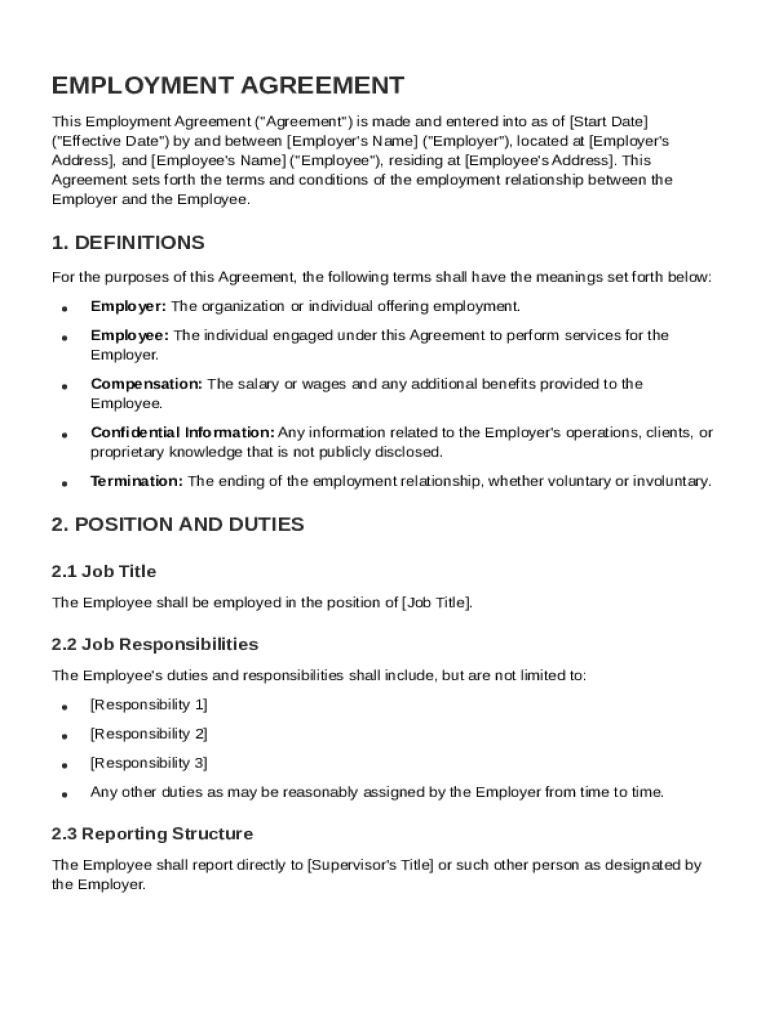
An "Employer Employee Contract Template" is a structured document that outlines the terms and conditions of employment between an employer and an employee. This template serves as a formal agreement to define the working relationship, establish roles and responsibilities, and set parameters for both parties involved. It includes essential elements like job responsibilities, compensation, benefits, confidentiality agreements, termination conditions, and other legal aspects. Using this type of template can help ensure clarity and prevent misunderstandings by providing a written record of the agreement.
Key Elements of an Employer Employee Contract
- Job Responsibilities: Detailed descriptions of the tasks and duties the employee is expected to complete.
- Compensation: Information on salary, bonuses, raises, and pay schedules.
- Benefits: Outline of health care, retirement plans, and other perks.
- Leave Policies: Details on vacation days, sick leave, and other absences.
- Confidentiality Obligations: Provisions to protect sensitive company information.
- Termination Procedures: Conditions under which the employment can be terminated.
- Non-Compete and Non-Solicitation Clauses: Restrictions on the employee's actions post-employment.
- Dispute Resolution Mechanisms: Methods for resolving disagreements, such as arbitration or mediation.
How to Use the Employer Employee Contract Template
Utilizing an Employer Employee Contract Template involves several steps to customize the document for your specific needs. This ensures that the contract reflects the unique aspects of the employment relationship.
Steps to Customize the Template
- Download the Template: Begin by obtaining a digital or printed version of the template from a reliable source.
- Review the Standard Clauses: Understand the predefined sections and what they entail.
- Customize Details: Modify sections related to job role, salary, and specific company policies.
- Add Company-Specific Clauses: Include any additional conditions unique to your organization.
- Legal Review: Have the contract reviewed by a legal professional to ensure compliance with state and federal laws.
- Implementation: Finalize the document with signatures from both the employer and employee.
Practical Examples
- Small Businesses: A startup may need to adapt the contract to include equity arrangements.
- Corporations: A large corporation might focus on comprehensive benefits and detailed non-compete clauses.
Legal Use of the Employer Employee Contract Template
The legal validity of an Employer Employee Contract Template depends on its adherence to applicable labor laws and regulations. A legally binding contract must meet certain criteria.
Legal Considerations
- Mutual Consent: Both parties must agree to the terms voluntarily.
- Clarity and Specificity: The contract should clearly outline rights, responsibilities, and conditions.
- Compliance with Laws: The agreement must comply with federal, state, and local employment laws.
- Capacity to Contract: Both parties must have the legal ability to enter into the contract.
Common Legal Provisions
- Amendment Clause: Procedures for making changes to the contract.
- Governing Law: The state laws that will regulate the contract.
- Severability: Ensures that if one part of the contract is invalid, the rest remains effective.
Important Terms Related to Employer Employee Contract Template
Understanding key terms is crucial when dealing with an Employer Employee Contract Template, as they can significantly impact the interpretation and enforcement of the contract.
Essential Terminology
- Probationary Period: A trial phase at the beginning of employment during which performance is evaluated.
- At-Will Employment: The condition in which either party can terminate employment at any time without cause.
- Gross vs. Net Pay: Gross is the total salary before deductions, while net is post-deductions.
- Exempt vs. Non-Exempt: Classification affecting eligibility for overtime pay.
- Collective Bargaining Agreement (CBA): Terms negotiated by unions on behalf of workers.
Examples of Usage
- At-Will Employment: In some states, employees can be fired without cause, acknowledging at-will employment provisions.
- Non-Exempt Employees: These workers are entitled to overtime pay under the Fair Labor Standards Act (FLSA).
State-Specific Rules for the Employer Employee Contract Template
Employment laws in the United States can significantly vary by state, impacting how an Employer Employee Contract Template should be structured.
Variations by State
- California: Requires specific disclosures regarding harassment policies and wage theft prevention.
- New York: Mandates written notice of pay rates and other statutory requirements.
- Florida: Follows at-will employment but has no state-mandated minimum wage differentials apart from federal guidelines.
Considerations for Compliance
- Research state-specific laws to ensure all relevant requirements are met.
- Adjust contract text to reflect varying state labor practices and protections.
- Regularly review and update contracts to maintain compliance with changing laws.
By effectively using and customizing an Employer Employee Contract Template, organizations can create clear, comprehensive, and compliant agreements that cater to their specific needs while protecting both employer and employee interests.