
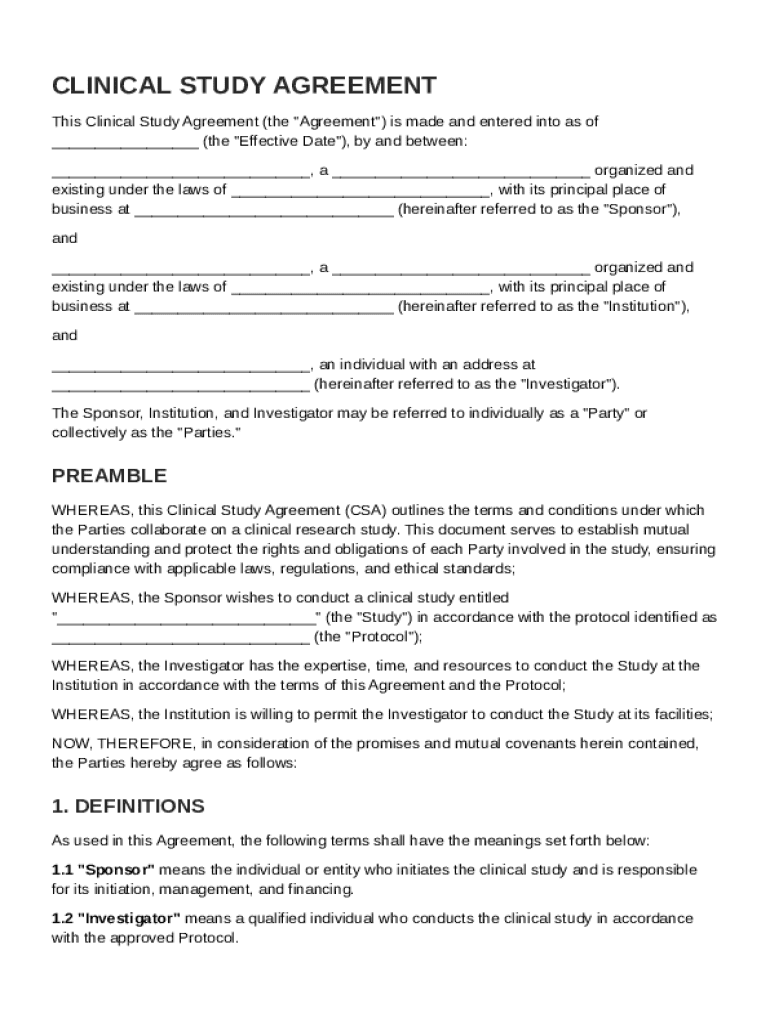







Key Elements of the Clinical Study Agreement Template
A Clinical Study Agreement Template serves as a foundational document for collaborations in clinical research. It meticulously outlines the roles, obligations, and responsibilities of the main parties involved: the Sponsor, Institution, and Investigator. This section details the necessary components that ensure clarity and protect parties involved in a clinical study.
- Study Objectives and Design: Clearly articulates the purpose of the study, including hypotheses, methodologies, and anticipated outcomes. This establishes a unified understanding and delineates expectations among parties.
- Funding and Compensation Arrangements: Details the financial considerations, such as the budget, payment timelines, and resource allocation, essential for executing the study effectively.
- Data Ownership and Confidentiality: Defining ownership rights and protecting sensitive information is critical. Provisions ensure that data is managed ethically and legally, safeguarding intellectual property and participant privacy.
- Indemnification and Liability: Establishing terms for liability protection is vital. This section outlines indemnification clauses to manage potential legal risks and responsibilities.
- Termination Conditions: Key terms for ending the agreement, including criteria for premature termination, enable parties to exit agreements under pre-specified conditions, safeguarding interests and aligning with institutional requirements.
Steps to Complete the Clinical Study Agreement Template
Completing a Clinical Study Agreement Template requires meticulous attention to detail to ensure all relevant aspects are covered.
- Initial Information Gathering: Collect essential details, including participating organizations, principal investigators, and specific study aims.
- Draft Agreement Sections: Begin by drafting each section of the agreement—study description, roles, financials—using input from all parties.
- Review and Edit: Collaboratively review agreements, ensuring compliance with legal standards and alignment with institutional policies.
- Add Specific Clauses: Customize clauses related to data handling, ethics committee approvals, and conflict resolution strategies tailored to study needs.
- Final Review and Signatures: Perform a comprehensive review with legal input to finalize the document, followed by obtaining signatures from all parties.
Important Terms Related to Clinical Study Agreement Template
Understanding the terminology used in Clinical Study Agreements is vital for clarity and ensuring legal compliance among stakeholders.
- Sponsor: The entity or individual that initiates, funds, and oversees the clinical study.
- Institution: The organization where the study is conducted, providing resources and infrastructure.
- Principal Investigator: The lead researcher responsible for conducting the study and ensuring compliance.
- GCP (Good Clinical Practice): An international quality standard for conducting clinical trials ethically and scientifically.
- IRB (Institutional Review Board): Reviews study proposals to safeguard participants' welfare and rights.
Who Typically Uses the Clinical Study Agreement Template
The Clinical Study Agreement Template is utilized by various entities involved in clinical research, each having distinct roles and benefits from using standardized agreements.
- Pharmaceutical Companies: As sponsors, they use these agreements to define study parameters, protect intellectual property, and manage financial investments.
- Research Institutions and Universities: Host clinical trials, ensure compliance with ethical standards, and protect institutional interests through formal agreements.
- Clinical Investigators and Research Teams: Use agreements to understand their roles, responsibilities, and legal protections within the study framework.


Legal Use of the Clinical Study Agreement Template
Navigating the legal landscape of Clinical Study Agreements is crucial to ensuring compliance with relevant laws and ethical standards.
- Ethical Compliance: Agreements must adhere to ethical standards established by authorities like Health and Human Services (HHS) and FDA regulations.
- State Regulations: Variations in state laws can influence confidentiality clauses, data handling, and participant consent requirements, necessitating compliance with state-specific rules.
- International Standards: For multi-national studies, templates must also comply with international guidelines like ICH-GCP to ensure global standards are met.
Examples of Using the Clinical Study Agreement Template
Providing concrete examples of Clinical Study Agreement use cases illuminates their practical applications.
- Case Study: Multi-Site Cancer Trial: Illustrates how a centralized agreement template ensures consistency across multiple research sites, promoting collaborative synergy.
- Scenario: New Drug Application: Highlights the importance of clinical agreements in defining data rights and participant safety measures during FDA submission processes.
- Example: Academic Institution Collaboration: Showcases how standardized agreements facilitate partnerships between universities and industry sponsors, advancing medical research.
Versions or Alternatives to the Clinical Study Agreement Template
Exploring different versions and alternatives of the Clinical Study Agreement Template helps stakeholders choose the most suitable format for their needs.
- Standard vs. Customized Templates: Standard templates offer baseline structures, while customized versions tailor specific sections for unique study requirements.
- Digital Formats: Increasingly, electronic agreements are preferred for ease of distribution and real-time editing capabilities.
- Alternative Agreements: In certain cases, non-disclosure agreements (NDAs) or data-sharing agreements may supplement a study agreement to protect sensitive information.
Application Process and Approval Time
Understanding the timelines involved in finalizing a Clinical Study Agreement is crucial for scheduling and planning purposes.
- Preliminary Discussions: Initial negotiations often take extensive time, as parties seek to align on study specifics and methodologies.
- Drafting and Legal Review: Creating and reviewing the agreement typically involves multiple drafts over several weeks, often requiring layered approvals from legal teams.
- Final Approval and Execution: Once all parties agree, finalizing and signing the agreement can require additional coordination, typically resulting in a total approval time of one to three months.
These comprehensive sections provide in-depth insights into the Clinical Study Agreement Template, covering all pertinent aspects for those involved in clinical research.




