
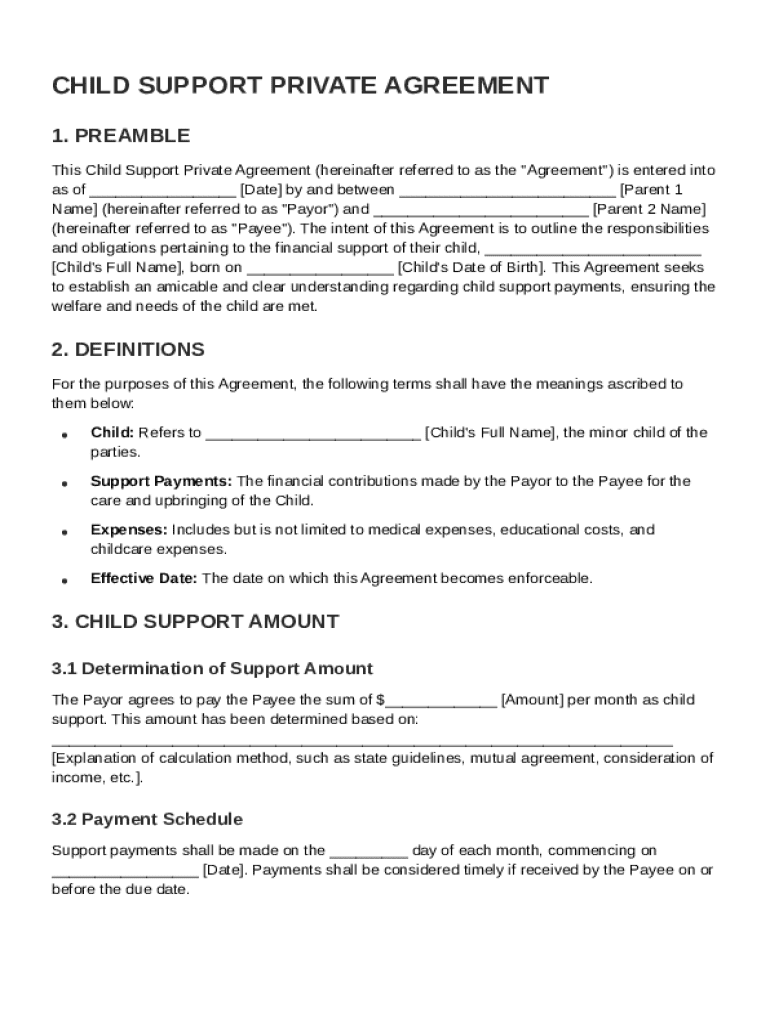







Definition and Meaning of a Child Support Private Agreement
A Child Support Private Agreement is a legal contract between two parents that outlines their obligations regarding child support. This document is significant as it establishes the financial arrangements for a child's upbringing without court intervention. It typically includes the amount payable, frequency of payments, and any additional financial responsibilities, such as medical or educational expenses. The agreement aims to ensure the child's welfare while providing a structured framework for both parents.
- The primary goal is to provide financial stability for the child.
- Agreements must be mutual and voluntary, benefiting both parties.
- It stipulates conditions for revising payment terms if circumstances change.
How to Use the Child Support Private Agreement Template
The Child Support Private Agreement Template is a pre-formatted document that parents can use to draft their agreement. This template serves as a structured guideline, ensuring that all critical areas of child support are covered meticulously. Users complete sections relevant to their situations and customize details like payment amounts and schedules.
- The template includes pre-defined sections to maintain consistency.
- Users can adjust the fields based on specific agreements between parents.
- It's crucial to review the filled template with legal counsel to ensure compliance with local laws.
Steps to Complete the Child Support Private Agreement Template
Completing the Child Support Private Agreement Template involves a comprehensive understanding of both parental responsibilities and legal obligations. Here are the steps typically involved:
- Collect Required Information: Gather personal information of both parents and the child.
- Specify Financial Responsibilities: Clearly define payment amounts and schedules.
- Include Additional Expenses: Add clauses for medical, educational, and extracurricular expenses.
- Detail Modification Conditions: Outline circumstances under which the agreement may be modified.
- Sign and Review: Both parties should review the agreement with a legal advisor before signing.
- Ensure clarity in each section to prevent future disputes.
- Agree on dispute resolution processes in case of disagreements over terms.
Key Elements of the Child Support Private Agreement Template
Every Child Support Private Agreement should include specific elements to be legally binding and effective. These elements ensure both parties are aware of their duties and rights:
-
Payment Details: Clearly state the payment amounts and due dates.
-
Duration of Support: Define how long the support is expected to continue.
-
Additional Expenses: Specify how expenses like healthcare and education will be handled.
-
Dispute Resolution: Include methods for addressing potential disagreements.
-
Both parties should agree on a neutral platform for resolving disputes, like mediation.
-
Detailed schedules for payments and additional costs help maintain transparency.
Legal Use of the Child Support Private Agreement Template
The legal enforceability of a Child Support Private Agreement depends on its adherence to state laws. It must meet certain legal criteria to ensure it can be upheld in court if necessary:
-
The agreement must be in writing and signed by both parties.
-
It should not conflict with any existing child support orders from the court.
-
Both parents must consent voluntarily, without coercion or undue influence.
-
Consider notarizing the agreement to add a layer of authenticity.
-
Consult a lawyer to confirm that the document fulfills all legal requirements.
State-Specific Rules for Child Support Agreements
Child support regulations can vary significantly from state to state, impacting details like minimum payment amounts and acceptable modifications. Important considerations include:
-
State Guidelines Compliance: Ensure the agreement aligns with state-specific child support guidelines.
-
Modifications and Enforcement: Understand state procedures for modifying and enforcing the agreement.
-
Mandatory Disclosures: Some states require specific financial disclosures to accompany the agreement.
-
Familiarize yourself with the child support enforcement agency in your state.
-
Keep updated, as laws and guidelines may change regularly.
Important Terms Related to Child Support Private Agreements
Understanding terminology related to Child Support Private Agreements is crucial for effective communication and agreement drafting. Key terms include:
-
Custodial Parent: The parent with whom the child primarily resides.
-
Non-Custodial Parent: The parent responsible for paying child support.
-
Arrearages: Overdue child support payments that have not been made.
-
Income Withholding: A method to automatically deduct child support from a parent's wages.
-
Clarifying terms at the beginning can avoid confusion later in the process.
-
Discuss definitions with a legal professional for a thorough understanding.
Examples of Using the Child Support Private Agreement Template
Utilizing a Child Support Private Agreement Template can reduce conflicts and misunderstandings between parents. Consider these practical scenarios:
-
Scenario 1: Parents with shared custody who split educational expenses equally.
-
Scenario 2: A non-custodial parent who agrees to pay a portion of the child's health insurance premiums.
-
Scenario 3: A situation where both parties agree on incremental payment adjustments based on income changes.
-
In each scenario, ensure that the written agreement aligns with verbal agreements made between parents.
-
Always review the document in scenarios where one parent's financial situation changes significantly.
Digital vs. Paper Versions: Pros and Cons
Choosing a digital or paper version of the Child Support Private Agreement can influence accessibility and usability:
-
Digital Version: Offers easy edits, quick sharing, and secure online storage.
- Facilitates electronic signatures for fast agreement finalization.
- Promotes eco-friendliness by reducing paper use.
-
Paper Version: Provides a tangible record and familiarity for parties who prefer traditional methods.
- Physical copies can be notarized more conveniently.
- Ideal for parents uncomfortable with digital technology.




