




01. Edit your form online
Type text, add images, blackout confidential details, add comments, highlights and more.

Type text, add images, blackout confidential details, add comments, highlights and more.

Draw your signature, type it, upload its image, or use your mobile device as a signature pad.

Send it via email, link, or fax. You can also download it, export it or print it out.
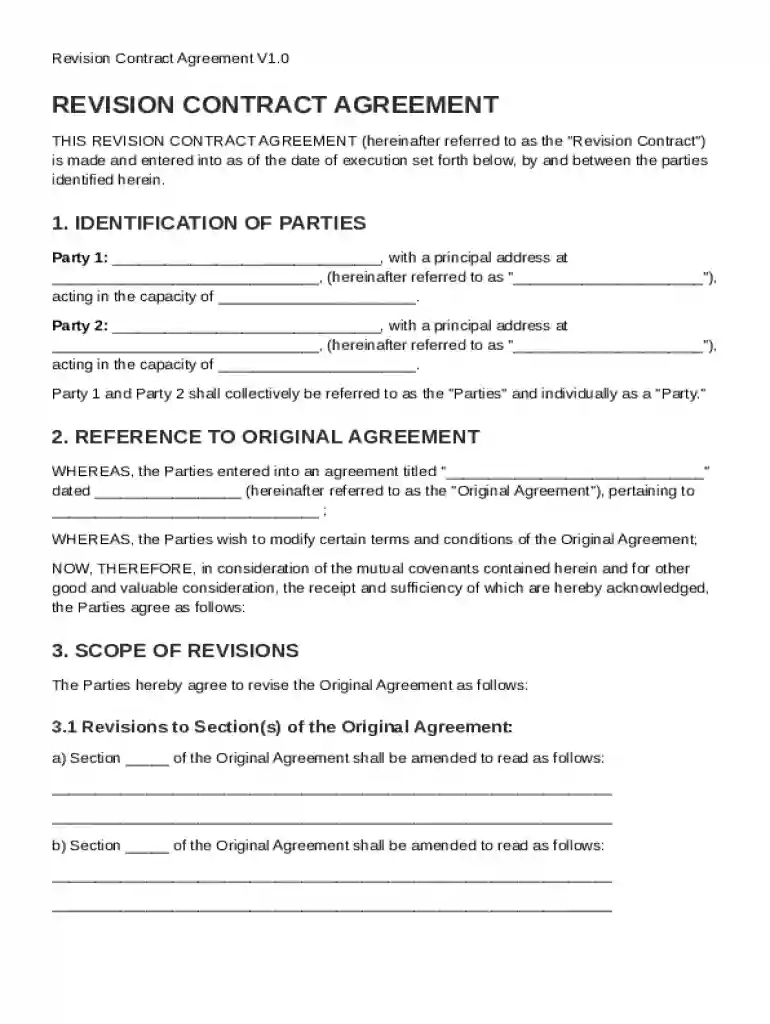
The "Revision Contract Template" is a legally binding document designed to facilitate modifications to an existing agreement between two parties. This form acts as an amendment when parties need to adjust terms such as responsibilities, financial obligations, or timelines. By using this template, involved parties can ensure all changes are documented formally, maintaining clarity and legal integrity. It typically includes sections such as identification of the parties, referenced original agreement, scope of revisions, acceptance, and execution details.
To effectively utilize the Revision Contract Template, follow these structured steps:
Identify the Parties: Clearly name the individuals or entities involved in the agreement.
Reference the Original Agreement: Include details like the title, date, and pertinent terms to ensure there is no ambiguity about the document being modified.
Specify the Revisions: Clearly describe all changes, ensuring all modifications are detailed precisely. This could be additions, deletions, or alterations of terms.
Gather Acceptance: Both parties must express acknowledgment and agreement to the amendments.
Execute the Agreement: Have both parties sign the revised contract to officially implement the changes. A witness or notary may also be required based on jurisdictional law.
Real-world scenario: A company initially hired a contractor for one year but decides to extend the term to two years. They would use the Revision Contract Template to document this change formally.
The Revision Contract Template typically includes:
Filling out the Revision Contract Template involves:
Collect Necessary Information: Gather all relevant details regarding the original agreement and desired modifications.
Fill Out Party Information: Enter the names and contact details of all parties involved in the original and revised agreement.
Detail Revisions: Specify in detail what changes are being made, including precise language on how terms are to be altered. Ensure every change is explicit and clear to avoid any potential misunderstandings.
Set the Effective Date: Indicate when the changes are to go into effect.
Sign and Date: Secure signatures from all parties involved, and possibly a notary depending on legal requirements.
The Revision Contract Template is predominantly used by:
For example, a small business may need to adjust payout terms with a freelance designer due to evolving project demands.


Using the template ensures compliance with legal standards, minimizing the risk of disputes. It recognizes modifications as legitimate and binding when completed accurately and signed by all parties. It adheres to statutory guidelines by providing a written record of changes, crucial for maintaining the enforceability of the original contract under U.S. law. Dispute resolution is often a key part, detailing how disagreements over the revision will be handled, potentially involving mediation or arbitration.
These terms are essential as they guide how modifications should be executed and understood legally.
While the template provides a standardized approach, state laws in the U.S. can affect its implementation. Certain states may have specific requirements regarding:
Understanding state-specific rules helps ensure the revision contract is executed correctly and remains enforceable across different jurisdictions.
Consider a scenario where a small business has a lease agreement with a landlord, and they wish to change the rental payment frequency from monthly to quarterly. Using the Revision Contract Template, they can formally document this change, ensuring both tenant and landlord agree to the new terms, thereby preventing any future misunderstandings. Another case involves adjusting service-level agreements with a software provider where performance metrics need updating due to technological advancements.
At DocHub, your data security is our priority. We follow HIPAA, SOC2, GDPR, and other standards, so you can work on your documents with confidence.


After we receive your signed contract, well kick off your project with a Google Meet to get a deeper understanding of your specific needs and requirements. We
Used to document substantive revisions or extension of termination date of a fully executed agreement. Amendment Interagency Cooperation


