






Definition & Meaning
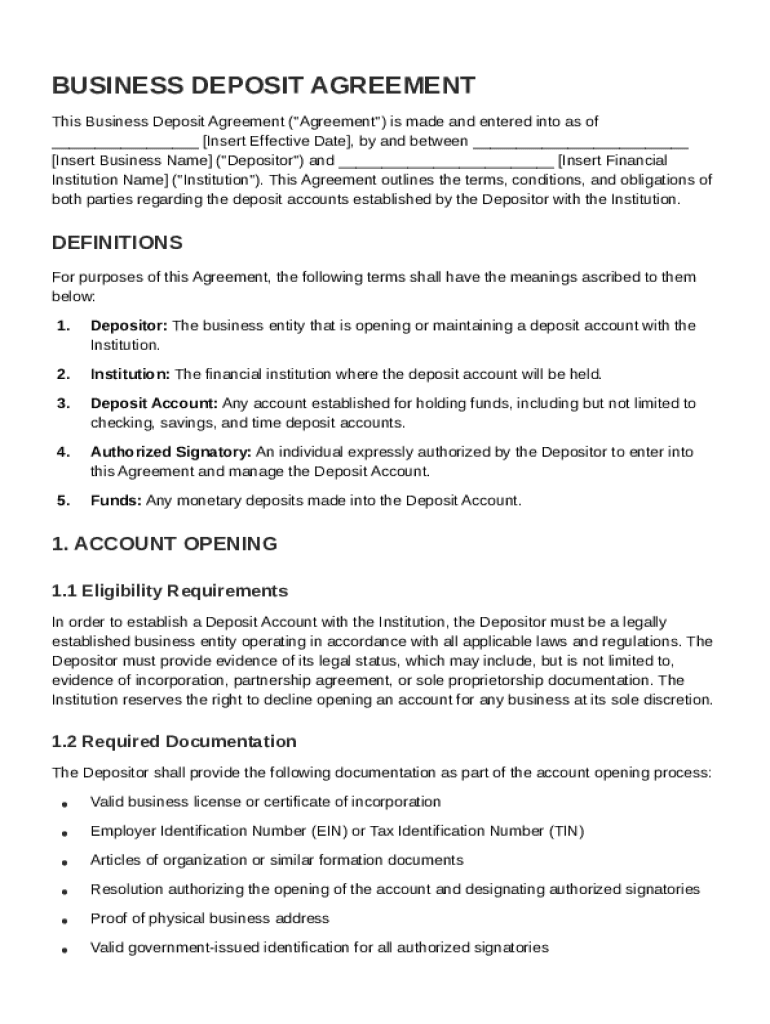
The Business Deposit Agreement Template is a formal document that outlines the terms and conditions between a business entity (Depositor) and a financial institution (Institution) regarding the establishment and management of deposit accounts. This agreement serves as a legal framework that details the responsibilities and rights of both parties involved. It includes comprehensive definitions to clarify terms such as Depositor, Institution, deposit account, and other relevant terminologies commonly used within the document. Understanding these definitions is crucial for the parties to ensure accurate interpretation and execution of their obligations under the agreement.
Importance of Definitions
- Depositor: Refers to the business entity opening the deposit account.
- Institution: The financial institution providing the account services.
- Deposit Account: The specific account set up under this agreement.
- Account Management: Procedures and protocols for account operation.
Including precise definitions helps prevent disputes and ensures both parties share the same understanding of the agreement's terms and provisions.
Key Elements of the Business Deposit Agreement Template
The Business Deposit Agreement Template is constructed with several critical components that form the foundation of the contractual relationship between the depositor and the institution. Key elements include:
Account Management Procedures
- Opening Procedures: Steps and documentation required to open the account.
- Operational Rules: Guidelines on managing the day-to-day operations of the account.
- Signatory Requirements: Designation of individuals authorized to operate the account.
Fees and Charges
- Account Maintenance Fees: Regular costs associated with account upkeep.
- Transaction Fees: Charges that may apply to specific account transactions.
- Penalty Fees: Costs incurred for non-compliance with agreement terms.
Liability and Indemnity
- Depositor Liability: Conditions under which the depositor may be held liable.
- Institution Responsibility: Situations where the institution must bear responsibility.
Each element ensures that both parties are aware of their roles, responsibilities, and potential financial implications during the tenure of the deposit account.
Important Terms Related to the Business Deposit Agreement Template
Grasping the terminology associated with the Business Deposit Agreement Template is vital for compliance and proper execution of the agreement. These terms set the expectations and boundaries for both parties involved.
Common Terms
- Eligibility Requirements: Criteria that must be met for account opening.
- Modification Rights: Conditions under which the agreement can be amended.
- Termination Conditions: Scenarios that may lead to the termination of the agreement.
Practical Examples
- A business failing to meet eligibility requirements due to missing financial statements.
- Revised regulatory policies necessitating modifications to agreement terms.
- Breach of terms leading to the termination of the agreement.
These terms are covered extensively within the agreement to prevent misunderstandings and provide clarity on operational dynamics.
Steps to Complete the Business Deposit Agreement Template
Completing the Business Deposit Agreement Template involves a multi-step process that ensures both parties have fully acknowledged and agreed to the outlined terms.
Stage of Completion
- Review the Agreement: Thoroughly examine all provisions and definitions.
- Gather Required Documentation: Collect necessary documents, such as business registration certificates and financial statements.
- Fill Out the Agreement: Enter all required data including depositor information and account details.
- Sign the Agreement: Ensure authorized signatories from both the depositor and institution endorse the agreement.
Ensuring Compliance
Completing all steps accurately is crucial to solidify the contractual relationship between the depositor and the institution. Any omissions or inaccuracies could lead to legal risks or operational disruptions.
Who Typically Uses the Business Deposit Agreement Template
The Business Deposit Agreement Template is generally utilized by business entities intending to establish a formal relationship with a financial institution for deposit account management.


Typical Users
- Small Businesses: Require structured account management for daily operations.
- Large Corporations: Need formal agreements due to the complexities of their financial transactions.
- Partnership Firms: Utilize templates to clearly define responsibilities of each partner.
Real-World Scenario
A startup company uses the template to open a business checking account that supports their financial operations, accommodating rapid growth while providing clear terms for account use and maintenance.
State-Specific Rules for the Business Deposit Agreement Template
State-specific regulations can influence the creation and implementation of a Business Deposit Agreement. These rules often reflect regional banking laws and financial regulations.
Legal Variations
- State Banking Regulations: Different states may have varying requirements for financial institutions.
- Usury Laws: Limitations on interest rates charged by institutions.
- Documentation Standards: Variances in documentation requirements for account opening.
Example
An institution operating in California may adhere to different usury laws compared to those in Texas, affecting how deposit interest is calculated and managed. Understanding these differences helps in customizing the agreement appropriately.
Legal Use of the Business Deposit Agreement Template
Adhering to the legal framework set out in the Business Deposit Agreement Template is essential for ensuring compliance for both the depositor and institution.
Legal Considerations
- Compliance with Federal Regulations: Adherence to laws such as the ESIGN Act for electronic signatures.
- State-Specific Legal Framework: Alignment with state-specific laws governing banking transactions.
- Enforceability: Ensures the agreement is legally binding and enforceable in a court of law.
Practical Implications
Failure to comply with legal obligations can result in penalties and damage to business reputation. Thus, the agreement serves as a protective mechanism to formalize business deposit relationships within legal parameters.
Software Compatibility for Managing the Business Deposit Agreement Template
Utilizing software tools for drafting and managing the Business Deposit Agreement Template can enhance efficiency and accuracy. Compatibility with popular business software ensures seamless integration.
Tools and Platforms
- PDF Editors: Allow for easy editing and management of agreement templates.
- Cloud Storage: Facilitate secure and accessible storage of agreements.
- Financial Software: Integration with tools like QuickBooks for transaction tracking.
Integration Example
A small business using cloud-based storage can securely store their completed agreement, ensuring easy access for future reference, while integrated financial software aids in tracking related transactions and updates.
Each of these sections provides in-depth insight and guidance on various aspects of the Business Deposit Agreement Template, offering clarity and comprehensive coverage to potential users.