
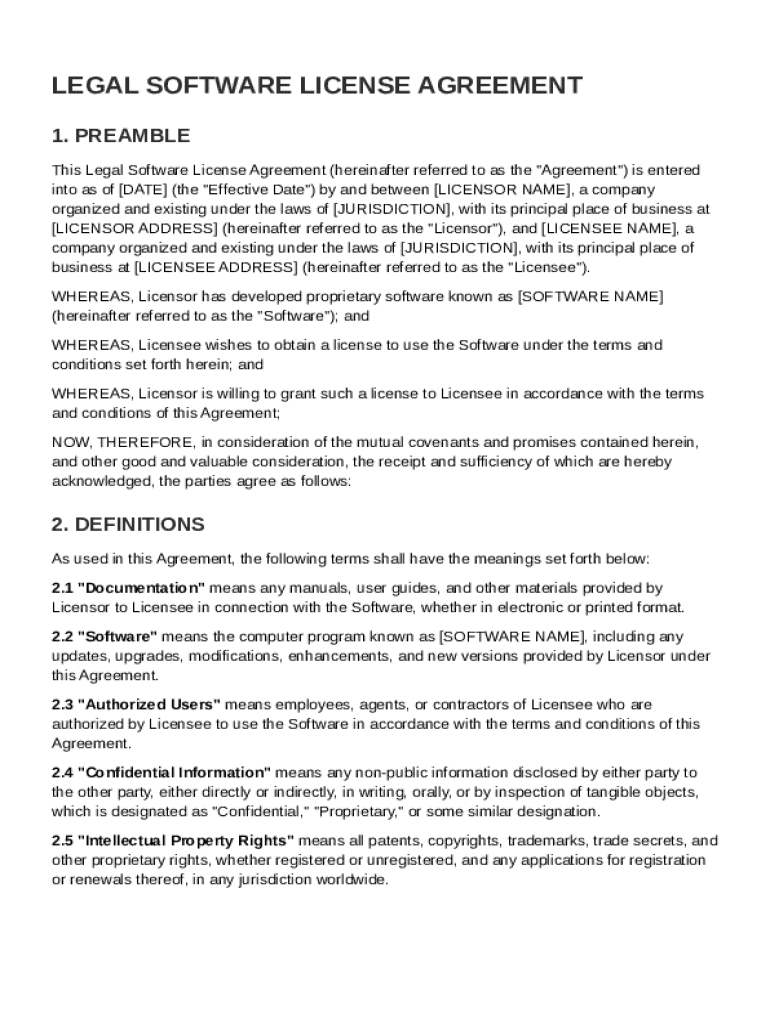







Key Elements of the Legal Software Contract Template
The Legal Software Contract Template provides a structured framework for software licensing agreements. Core elements of this template include definitions, licensing terms, payment obligations, and confidentiality clauses. Clear definitions establish the roles of all parties, frequently identifying the software provider as the Licensor and the user as the Licensee. Licensing terms often outline the scope of the software's use, addressing whether the license is exclusive or non-exclusive and detailing any geographical or functional limitations. Payment obligations cover the cost of licensing, maintenance fees, and payment schedules. Confidentiality clauses protect proprietary information shared between the parties during the agreement.
Licensing Scope and Limitations
- Exclusive vs. Non-Exclusive: Specifies whether the license permits the Licensee exclusive access to use the software or if the Licensor may also grant licenses to other parties.
- Usage Restrictions: Limits the software's application to specific environments or geographical areas, ensuring compliance with agreed terms.
- Modification and Adaptation: Addresses whether the Licensee may modify or adapt the software and under what circumstances.
How to Use the Legal Software Contract Template
Utilizing this template involves several well-defined steps designed to customize the document to fit individual needs. First, identify the parties involved — both the Licensor and Licensee. Next, complete the template by filling in specifics such as licensing fees, terms of use, and restrictions. It's essential to review clauses concerning data security, confidentiality, and liability. After finalizing any specific agreements, both parties should review the final document to ensure mutual understanding. Upon agreement, the contract should be signed by all relevant parties, confirming the terms.
Step-by-Step Customization
- Identify Parties: Accurately record the names and contact details of the Licensor and Licensee.
- Detail Software Use: Clearly stipulate the software's permissible use cases and restrictions.
- Set Financial Terms: Outline payment arrangements, including any upfront fees and ongoing costs.
- Add Security Provisions: Define measures to safeguard data and proprietary information.
- Finalize and Sign: Ensure both parties have reviewed, agreed, and signed the contract.
Important Terms Related to the Legal Software Contract Template
Understanding key terms within the template is crucial as they underscore the legal and operational framework of the agreement. These include "Licensor," representing the party granting the license, and "Licensee," the party obtaining rights to utilize the software. "License Term" refers to the duration for which the software is to be used, while "Territory" defines any geographical restrictions. The "License Fee" consists of the required payment for the use of the software. "Confidential Information" highlights data protected under the agreement.
Core Definitions
- Licensor: The entity providing the rights to use the software.
- Licensee: The recipient of the usage rights.
- License Term: Duration of the agreement.
- Confidential Information: Data that must remain protected and undisclosed.
Steps to Complete the Legal Software Contract Template
Completing this template requires a collaborative approach to ensure all relevant details are captured and agreed upon. Begin by gathering detailed information about both parties and the software product. Follow with comprehensive discussions on the terms of service, including usage restrictions, licensing terms, and payment structures. Each section should be meticulously filled out, reflecting unique agreements reached between the parties. The process concludes with a thorough review and execution of the contract by both parties to solidify the agreement.
Detailed Procedure
- Collect Information: Gather relevant details about the software and parties involved.
- Negotiate Terms: Discuss and agree on key terms such as usage, payments, and limitations.
- Complete Template: Enter all agreed terms systematically into the template.
- Review and Amend: Check for accuracy and make necessary adjustments.
- Execution: Ensure both parties sign the finalized contract.
Who Typically Uses the Legal Software Contract Template
This template is predominantly used by software companies, developers, and businesses that purchase software licenses. It plays a critical role for companies looking to formalize their software usage policies and establish clear agreements with third-party users. Legal departments and contract managers often handle these templates to streamline the agreement process while ensuring compliance with licensing laws. It is also valuable for businesses wishing to protect their proprietary technology during collaborations or when providing software as a service.


Business and Organizational Use Cases
- Software Developers: Protect intellectual property when distributing software.
- Corporate Legal Departments: Ensure compliance with licensing laws.
- Contract Managers: Facilitate clear agreements with software users.
- SaaS Providers: Establish user terms and protect their offerings.
Legal Use of the Legal Software Contract Template
The template serves as a legal document to establish and enforce software usage terms between providers and users. It ensures that both parties understand their rights, roles, and responsibilities, thereby reducing the risk of legal disputes. This contract adheres to regulations under the Electronic Signatures in Global and National Commerce Act (ESIGN) and the Uniform Electronic Transactions Act (UETA), making electronic agreements legally binding within the U.S. context. It also addresses liability issues, indemnification, and the consequences of breaches in its clauses.
Compliance and Legal Framework
- ESIGN Act and UETA: Validates electronic contracts as legally binding.
- Indemnification Clauses: Protect against third-party claims.
- Liability Provisions: Set boundaries for responsibility and repercussions.
State-Specific Rules for the Legal Software Contract Template
Different states within the U.S. may have varying rules affecting software contracts. For instance, states like California have stringent data privacy laws, impacting how data confidentiality is structured in agreements. New York requires clear data breach notification laws, significantly influencing template clauses regarding data security. Additionally, certain states may impose unique tax obligations on software transactions. It's essential to customize the template to comply with specific state laws to avoid legal complications.
Notable State Adjustments
- California: Strong emphasis on data privacy and security.
- New York: Specific data breach notification requirements.
- Texas: Unique software tax and licensing implications.
- Massachusetts: High standards for consumer data protection.
Examples of Using the Legal Software Contract Template
Practical usage scenarios of such templates include software-as-a-service (SaaS) companies licensing their product to enterprises, developers providing custom software solutions, and corporations seeking to purchase large volume licenses for internal use. Each scenario may vary based on the software's purpose, the nature of the provider-user relationship, or unique business needs, requiring tailored terms reflecting these distinct elements. By structuring agreements through this template, organizations ensure efficient, legally sound operations.
Case Study Illustrations
- SaaS Provider to Enterprise: Software license for cloud-based solutions tailored to corporate needs.
- Developer to Client: Custom web application provision with specific usage agreements.
- Corporate License Acquisition: Bulk purchase agreement for productivity software tailored for internal use.
Who Issues the Form
Generally, the Legal Software Contract Template is issued by the software Licensor. This could be a software development firm, a software-as-a-service provider, or an individual developer. The Licensor is responsible for ensuring that the template adheres to all legal requirements and accurately reflects the terms agreed upon with the Licensee. In larger organizations, the legal or compliance department often handles the issuance and customization of these templates to suit specific business transactions.
Issuing Responsibilities
- Software Development Firm: Ensures template adheres to legal norms.
- SaaS Providers: Tailors contracts to service offerings.
- Individual Developers: Customizes contracts per project needs.
- Corporate Legal Teams: Oversees modification for specific transactions.




