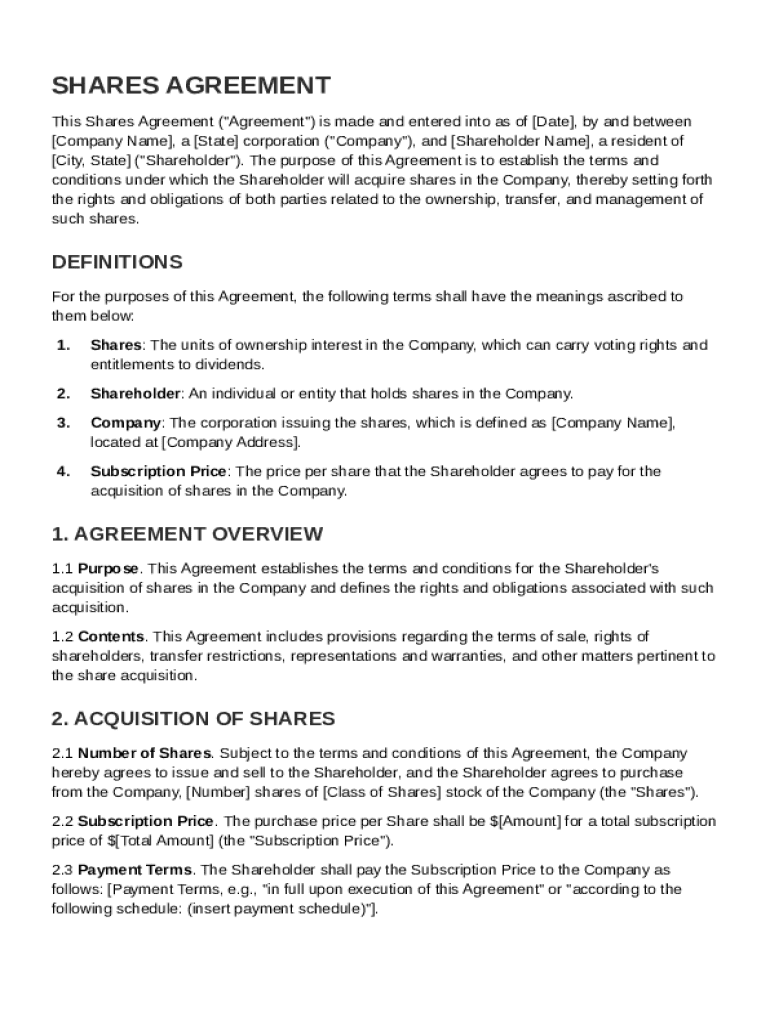







Definition and Purpose of the Shares Agreement Template
The Shares Agreement Template is a critical legal document that outlines the terms and conditions under which a shareholder acquires shares in a company. It serves as a formal contract between the shareholder and the company, delineating the rights and obligations of both parties. Key aspects covered in the template include ownership rights, transfer restrictions, dividend entitlements, voting privileges, corporate governance responsibilities, and indemnification clauses. This agreement ensures clarity and transparency in the share acquisition process, providing a framework that supports the enforceability of the terms agreed upon by the parties involved.
Key Elements of the Shares Agreement Template
The template comprises several essential components that collectively govern the shareholder-company relationship. These elements include:
- Definitions of Key Terms: Clear definitions of crucial terms such as "shares," "shareholder," "dividends," and "transfers."
- Share Acquisition Provisions: Detailed conditions under which shares are acquired, including purchase price and payment terms.
- Voting and Dividend Rights: Specifications of the shareholder’s voting power and entitlement to dividends.
- Transfer Restrictions: Limitations on the sale or transfer of shares to ensure control over company ownership remains within desired parties.
- Corporate Governance Responsibilities: Outlines the shareholder's role in company management and decision-making processes.
- Representations and Warranties: Assurances provided by both parties regarding their authority and capability to enter into the agreement.
- Indemnification Clauses: Provisions that protect parties from losses arising from misrepresentations or breaches of the agreement.
Steps to Complete the Shares Agreement Template
To effectively complete the Shares Agreement Template, follow these comprehensive steps:
- Identify the Parties: Clearly specify the names and details of the shareholder and the company involved in the agreement.
- Define Terms and Conditions: Accurately outline the terms, including the number of shares, price per share, and payment schedule.
- Detail Rights and Obligations: Clearly state the shareholder's rights regarding voting and dividends, and their responsibilities in governance.
- Address Transfer Restrictions: Specify any limitations or conditions for the transfer of shares, including the requirement for company approval.
- Include Legal Provisions: Incorporate necessary legal clauses such as indemnification, governing law, and dispute resolution mechanisms.
- Review and Verify Information: Ensure all details are accurately captured to reflect the intentions and agreements of both parties.
- Formalize with Signatures: Obtain signatures from authorized representatives of both the shareholder and the company to legally bind the agreement.
Legal Considerations for Using the Shares Agreement Template
When utilizing the Shares Agreement Template, it is crucial to consider the legal context specific to the agreement. The template should comply with applicable securities laws and regulations to ensure its enforceability:
- Governing Law Stipulations: Clearly state which jurisdiction's laws will govern the agreement to mitigate disputes and legal ambiguities.
- Compliance with Securities Regulations: Ensure the terms comply with federal and state securities laws to avoid legal penalties.
- Inclusion of Mandatory Clauses: Make certain that indemnification, representations, and warranties are adequately documented for legal protection.
- Consultation with Legal Professionals: Engage with legal experts to review the agreement for potential issues and compliance assurance.
Who Typically Uses the Shares Agreement Template
The Shares Agreement Template is commonly used by various entities involved in the issuance and acquisition of company shares:
- Corporations and Startups: Companies issuing new shares to raise capital or reward key employees.
- Individual Investors: Shareholders acquiring shares as part of a private investment or a public offering.
- Venture Capitalists: Investors seeking equity stakes in startups with high growth potential.
- Legal Advisors: Attorneys drafting agreements tailored to specific transactions for business clients.


Examples of Using the Shares Agreement Template
Several scenarios exemplify the application of the Shares Agreement Template in real-world contexts:
- Initial Public Offerings (IPOs): Corporations use the template to formalize shareholder agreements during IPOs.
- Private Equity Transactions: Private companies allocate shares to new investors or partners through documented agreements.
- Employee Stock Ownership Plans (ESOPs): Businesses utilize the agreement to distribute shares to employees, enhancing retention and motivation.
- Mergers and Acquisitions: During mergers, companies employ the template to outline share exchanges and new shareholder provisions.
Required Documents and Supporting Information
To finalize the Shares Agreement Template, certain documents and details are essential:
- Company’s Articles of Incorporation: To provide background on the company’s legal and operational structure.
- Shareholder Identification Details: Documentation verifying the shareholder’s identity and legal capacity to acquire shares.
- Board Resolutions: Approval documentation from the company's board authorizing share issuance or transfer.
- Securities Filings: Any necessary filings with regulatory bodies confirming compliance with applicable laws.
Form Submission Methods and Process
Completing and submitting the Shares Agreement is an integral part of the share acquisition process:
- Digital Completion: Use platforms like DocHub to fill, sign, and exchange documents electronically, ensuring enhanced efficiency and security through e-signature capabilities and encrypted data transfer.
- Paper Filing: For those preferring traditional methods, prepare printed copies for manual signatures and exchanges.
- Integrated Workflow Solutions: Utilize tools that sync with cloud storage for seamless document management and retrieval, facilitating streamlined interaction with all necessary parties.
State-Specific Guidelines and Adaptations
Shareholder agreements may vary based on state regulations, necessitating adjustments:
- Jurisdictional Requirements: Consult local statutes to ensure the agreement adheres to state-specific legal norms.
- Regulatory Filings: Recognize distinct state securities filings that may be mandatory.
- Tailored Clauses and Provisions: Modify agreement elements like governing law and dispute resolution to comply with regional legal environments, ensuring enforceability across different jurisdictions.