




01. Edit your form online
Type text, add images, blackout confidential details, add comments, highlights and more.

Type text, add images, blackout confidential details, add comments, highlights and more.

Draw your signature, type it, upload its image, or use your mobile device as a signature pad.

Send it via email, link, or fax. You can also download it, export it or print it out.
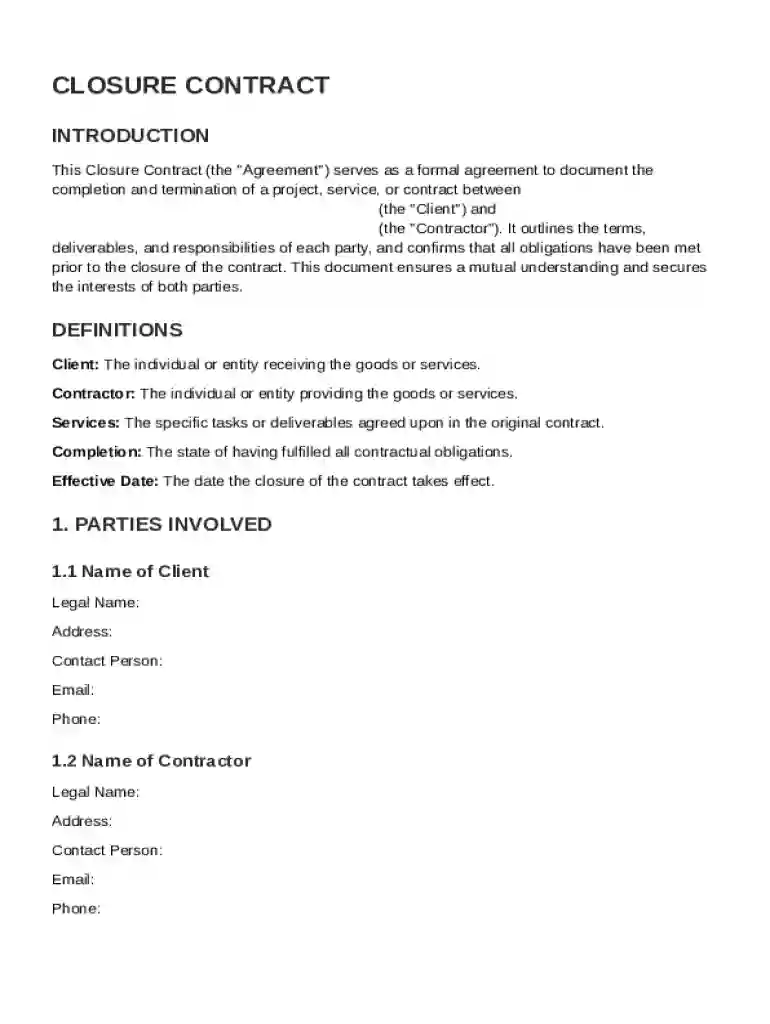
A Closure Contract Template is a formal document designed to record the completion and cessation of a project or service agreement between a client and a contractor. This template serves as an official record, ensuring that both parties acknowledge the successful fulfillment of their respective contractual obligations. It typically includes sections on liabilities, final payments, and confidentiality, thus safeguarding the interests of all stakeholders involved. This robust framework aids in avoiding potential disputes by providing a clear reference point for the project or service's end terms.
These sections ensure both parties are covered legally and financially.
Using the Closure Contract Template involves several steps to ensure that all areas are thoroughly filled and both parties are in agreement. The process generally begins with gathering all documents related to the project or service to review deliverables and verify mutual responsibilities have been fulfilled. Once collated:
Completing a Closure Contract Template is a structured process that involves careful attention to detail to ensure accuracy and compliance. Here are essential steps:
Ensuring each step is executed correctly creates a comprehensive and compliant contract closure process.
The Closure Contract Template is widely used across various industries where projects or services are concluded. This primarily includes:


Implementing a Closure Contract Template offers numerous advantages, mainly through standardization and protection:
The template acts as a strategic instrument to foster smooth transitions to post-project engagements.
Closure Contract Templates, while widely applicable, must conform to regional legal requirements to maintain validity. In the United States, ensuring compliance with:
Legal advisement ensures that the contract meets these criteria, which minimizes risk of invalidity.
Choosing between a digital and a paper version of the Closure Contract Template depends on a project's specific needs. Digital versions, supported by platforms like DocHub, provide:
In contrast, paper versions may suit traditional businesses preferring physical documentation, emphasizing the need for securing hard copies.
Every business or contractor benefits from understanding and adopting the Closure Contract Template in project management. Whether through online tools like DocHub or traditional methods, the template ensures comprehensive documentation of project closure.
At DocHub, your data security is our priority. We follow HIPAA, SOC2, GDPR, and other standards, so you can work on your documents with confidence.


Apr 2, 2024 This section should contain a summary of the projects pain points and the steps taken to mitigate them. 5 Administrative Closure. The following
This form provides a checklist of the most common items and issues that need to be completed before formally closing a contract and provides an auditable
The CCP Terms and Conditions and the. Contract Form(s) are legally binding on both contracting parties. 1.2. Leica Geosystems offers its Customers the following.


