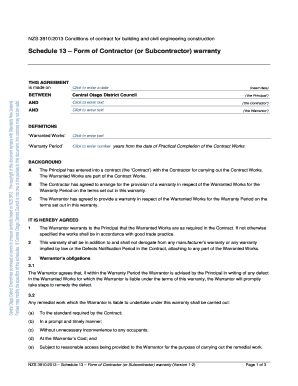
Joint Purchase Agreement Template 2026

Get Form
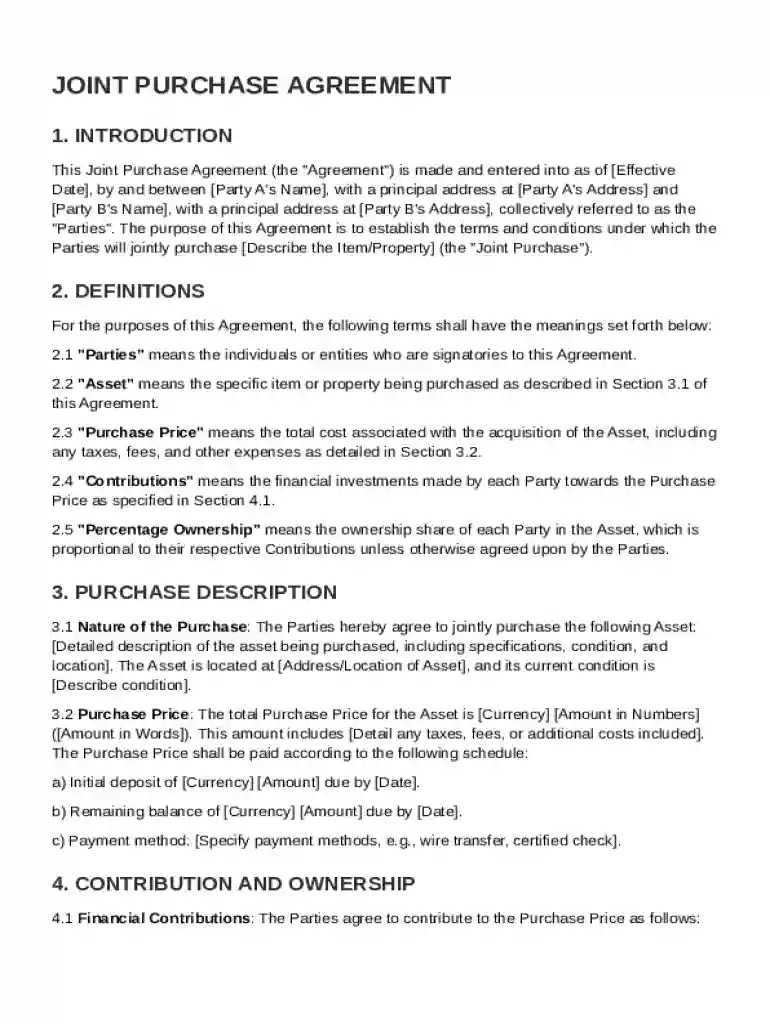
Joint Purchase Agreement Template Preview on Page 1

Here's how it works

01. Edit your form online
Type text, add images, blackout confidential details, add comments, highlights and more.

02. Sign it in a few clicks
Draw your signature, type it, upload its image, or use your mobile device as a signature pad.

03. Share your form with others
Send it via email, link, or fax. You can also download it, export it or print it out.

Definition & Meaning

A Joint Purchase Agreement Template is a legal document that outlines the specific terms and conditions for jointly acquiring an asset by two (or more) parties. This agreement serves as a reference tool for establishing a collaborative venture, defining each party’s financial contributions, and setting rules for ownership percentages, roles, and responsibilities. It plays a critical role in ensuring all involved parties understand their duties and expectations, thereby minimizing potential disputes. Real-world scenarios for deploying this template include co-investing in real estate, purchasing business assets, or sharing ownership of high-value items like art or vehicles.

Key Elements of the Joint Purchase Agreement Template

A Joint Purchase Agreement Template typically includes several core elements essential for a smooth collaboration. These elements are designed to comprehensively cover every aspect of the joint purchasing process:

  • Definitions and Interpretations: This section clarifies terms used throughout the agreement, ensuring there is no ambiguity.
  • Financial Contributions: Detailed breakdown of how each party’s financial input is structured, including timelines, amounts, and any conditions attached.
  • Ownership Percentages: Documents the exact ownership share each party will hold in the asset.
  • Rights and Responsibilities: Specifies each party’s decision-making powers, day-to-day management rights, and obligations.
  • Dispute Resolution Procedures: Outlines the methods for resolving disagreements, such as mediation or arbitration.
  • Termination Conditions: Details under what circumstances the agreement can be dissolved.
  • Indemnification Clauses: Protects parties from liability arising from each other’s actions.

Understanding these elements is crucial for managing the asset while avoiding legal complications.

Steps to Complete the Joint Purchase Agreement Template

Completing the Joint Purchase Agreement Template involves several steps to ensure it is accurately filled out and legally binding:

  1. Identify Parties Involved: Start by listing each party involved in the joint purchase, including full legal names and contact information for accountability.
  2. Detail the Asset: Provide a comprehensive description of the asset being purchased, including specifications, location, and current valuations.
  3. Outline Contributions: Record each party’s financial contributions, specifying how and when these will be made.
  4. Define Ownership Terms: Clearly state the percentages of ownership and any rights each party holds in relation to the asset.
  5. Set Respective Rights and Responsibilities: Clarify each party's role regarding management and decision-making related to the asset.
  6. Establish Dispute Resolution Mechanism: Decide on a method for resolving disputes; include mediation, arbitration, or litigation as agreed upon.
  7. Include Indemnifications and Termination Procedures: Outline the limitations on liabilities and conditions under which the agreement may be terminated.
  8. Finalize and Sign: Ensure all parties review and sign the agreement to ratify it as a legitimate legal document.

How to Use the Joint Purchase Agreement Template

The Joint Purchase Agreement Template can be utilized across various scenarios to formalize joint purchases. Here's how to effectively implement it:

  • Real Estate Joint Ventures: Use for purchasing property collaboratively, ensuring an understanding of shared expenses and profit distribution.
  • Business Partnerships: When acquiring company assets like production equipment, this template helps delineate investment shares and usage rights.
  • Asset Sharing in Families: For assets like vehicles or vacation properties, it outlines usage patterns and maintenance responsibilities.

After filling out the template, review with all stakeholders and legal counsel to ensure its validity and enforceability.

Legal Use of the Joint Purchase Agreement Template

Ensuring the Joint Purchase Agreement Template is legally binding requires attention to several legal considerations:

  • Compliance with State Laws: Since laws vary by state, it’s crucial that the agreement adheres to regional statutes and requirements.
  • Legal Language and Clarity: Use clear, plain language and avoid jargon to ensure all parties understand their commitments.
  • Signed Consents: Make sure all parties have provided written and signed consent to the terms to avoid any claims of coercion or misunderstanding.
  • Notarization Requirements: In some jurisdictions, notarization may enhance the agreement's authenticity.

Working with a legal professional helps reinforce the agreement's legality and fortifies its enforceability.

Who Typically Uses the Joint Purchase Agreement Template

The Joint Purchase Agreement Template is versatile, serving a range of users involved in shared investments. Common users include:

  • Business Partners: Engaging in joint ventures or co-ownership of startups and businesses.
  • Families and Individuals: Parents and children or siblings looking to invest jointly in real estate or significant assets.
  • Investment Groups: Syndicates or co-operatives pooling resources for larger investments.

Each user group benefits from the template’s ability to clearly communicate roles, financial commitments, and operational guidelines.


decoration image ratings of Dochub

Important Terms Related to the Joint Purchase Agreement Template

Understanding the terminology in the Joint Purchase Agreement Template is crucial to prevent misinterpretation. Key terms include:

  • Joint Tenancy vs. Tenancy in Common: Describes how property is co-owned, with implications for survivorship rights.
  • Capital Contribution: The initial investment each party makes towards the joint purchase.
  • Fiduciary Duty: Legal obligation of each party to act in the best interest of the joint enterprise.
  • Arbitration Clause: Agreement to resolve disputes outside courts through arbitration.

Mastering these terms enhances comprehension of the agreement’s legal and operational facets.

State-Specific Rules for the Joint Purchase Agreement Template

Different states may impose specific legal requirements on joint purchase agreements that must be adhered to for validity:

  • Witness and Notarization Requirements: Some states require witnesses or notarization for legal validity.
  • Tax Implications: Varies based on state regulations, affecting property taxation and possible benefits.
  • Property Registry Compliance: Ensures registration of ownership changes, particularly for real estate.

Understanding these regional nuances is essential for ensuring the agreement’s enforceability within a specific state. Consulting local legal resources can provide valuable insights on adhering to these regulations.

be ready to get more

Complete this form in 5 minutes or less

Get form

Got questions?

We have answers to the most popular questions from our customers. If you can't find an answer to your question, please contact us.
Contact us
In a joint venture (JV), two or more businesses decide to combine their resources in order to fulfill an enumerated goal. They are a partnership in the colloquial sense of the word but can take on any legal structure. A common use of JVs is to partner up with a local business to enter a foreign market.
A co-owner buys the share (Transfer of Equity) The most straightforward method is often for one or more of the existing co-owners to buy out your share of the house. This process involves a Transfer of Equity, where the legal and/or beneficial ownership is formally transferred to the remaining owner(s).
Key Components of a Share Purchase Agreement The parties to the agreement. Information on the company selling shares. Purchase price of the shares. Title. Timetable for completion. Warranties. Restrictions following completion. Confidentiality requirements.
Joint ventures do not necessarily have to be formed through an equal 50-50 ownership split. The exact terms can be what the partners decide and negotiate, such as a 60-40 or 70-30 split, with the majority partner typically having more control in decisions and earning a greater share of the profits.
Determine the Right Structure: JVs typically take one of two forms: (1) the JV parties form a new entity to carry out the JV or (2) the JV parties enter a contractual relationship for a particular purpose, such as an agreement to jointly development specific technology.

Security and compliance

At DocHub, your data security is our priority. We follow HIPAA, SOC2, GDPR, and other standards, so you can work on your documents with confidence.
Learn more
ccpa2
pci-dss
gdpr-compliance
hipaa
soc-compliance

People also ask

Crucial Things to Include in a Joint Venture Agreement #1: The Information of the Businesses Involved. #2: Members Information. #3: The Type of Joint Venture / The Purpose of the Joint Venture. #4: Resources to Be Shared. #5: Profits and Loss Allocation. #6: Rights and Duties. #7: Dispute Resolution.
An example of a joint contract is used when two manufacturers collect their products in a single package and agree to sell them.

Related links