




01. Edit your form online
Type text, add images, blackout confidential details, add comments, highlights and more.

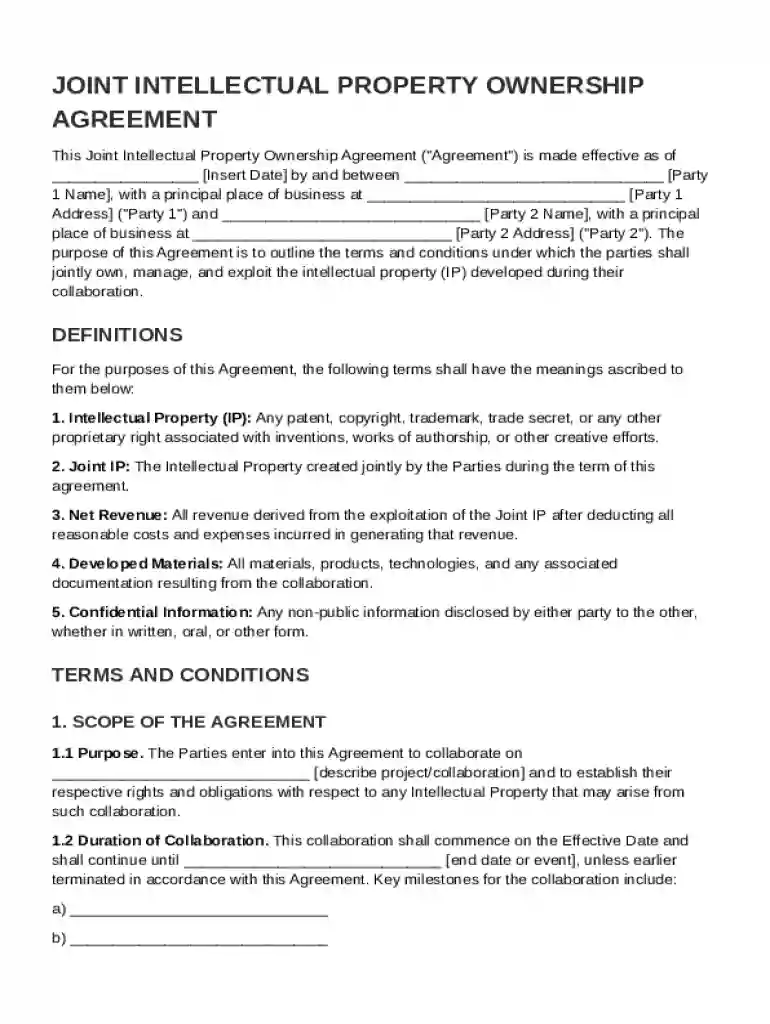
Type text, add images, blackout confidential details, add comments, highlights and more.

Draw your signature, type it, upload its image, or use your mobile device as a signature pad.

Send it via email, link, or fax. You can also download it, export it or print it out.
The Joint Intellectual Property (IP) Ownership Agreement Template is designed to outline the relationship between two parties that jointly own intellectual property. This document is pivotal when both parties collaborate on a project that results in shared IP, ensuring clarity and mutual understanding. It defines how both parties may use, develop, and manage the jointly owned property. For businesses and individuals involved in collaborative innovation or research, this template is crucial in establishing ownership rights, usage guidelines, and profit-sharing arrangements. By clearly defining terms related to ownership percentages and joint management, the template helps to prevent disputes over rights or responsibilities.
Understanding the terminology used in a Joint IP Ownership Agreement is essential for effective usage. Key terms include:
These terms ensure that all parties have a clear understanding of their rights and obligations regarding the IP, facilitating smoother collaborations.
A well-structured Joint IP Ownership Agreement Template includes several key components that ensure a comprehensive understanding and management of shared intellectual property. These elements are crucial in protecting each party's interests and fostering a collaborative environment.
The agreement specifies how ownership of the IP is divided between the parties. It sets out the percentage ownership each party holds, outlining how each can exploit the IP, either for personal use or through licensing. These provisions allow each party to benefit from the intellectual property while respecting the others' rights.
The template delineates how revenue generated from the joint IP will be shared among the parties. This section is vital in avoiding potential conflicts by providing a structured framework for revenue allocation, taking into consideration factors like investment, effort, and risk-bearing.
Filling out a Joint IP Ownership Agreement Template involves several critical steps to ensure that all necessary details are accurately captured:
Identify the Parties: Begin by clearly identifying all parties involved in the agreement, including their legal names and contact information.
Define the IP: Clearly describe the intellectual property in question, including its type, scope, and any pertinent details.
Set Ownership Percentages: Determine and document each party's percentage ownership of the IP.
Detail Revenue Sharing: Specify how net revenue from the IP will be divided, providing a clear formula or percentage breakdown.
Establish Usage Rights: Outline how each party can use the IP, including any restrictions or permissions related to licensing.
Include Confidentiality Clauses: Add clauses pertaining to the protection of confidential information, ensuring sensitive data remains safeguarded.
Dispute Resolution Mechanisms: Incorporate a section detailing methods for resolving any disputes that may arise during the course of the agreement.
By following these steps, parties can ensure that the agreement is comprehensive and avoids potential conflicts or misunderstandings.
Drafting a Joint IP Ownership Agreement involves understanding its legal implications to ensure compliance with relevant laws and regulations. This agreement is typically governed by U.S. contract law, necessitating careful consideration of state-specific rules and federal legislation.
Ensure the agreement complies with applicable laws by specifying governing law and jurisdiction. This establishes which state's laws will apply in interpreting the agreement, providing clarity in the event of a legal dispute.
Legally binding confidentiality clauses protect sensitive information and trade secrets, ensuring parties do not disclose or misuse this information. Including detailed confidentiality obligations is fundamental to safeguarding the intellectual property and associated business interests.
The Joint IP Ownership Agreement Template is highly versatile, catering to a variety of sectors and individuals engaged in collaborative efforts. Common users include:
Businesses and Corporations: Companies often collaborate on R&D projects or technological innovations, necessitating shared ownership agreements to manage resultant IP.
Startups and Entrepreneurs: In the startup ecosystem, co-founders and early collaborators benefit from clear IP agreements, ensuring equitable division of rights and revenues.
Academic and Research Institutions: Universities and research entities frequently engage in joint research projects where the resulting IP needs clear ownership terms.
These users leverage the template to protect their intellectual contributions and ensure a fair allocation of benefits derived from their collaborative efforts.
Customizing the Joint IP Ownership Agreement Template can better align it with specific business needs. While the core elements are consistent, certain clauses might vary depending on the nature of the IP or specific collaboration goals.
By tailoring the template, parties can ensure it fits their precise needs, enhancing its effectiveness in protecting shared intellectual property.
Understanding how to implement the Joint IP Ownership Agreement in real-world scenarios can illuminate its practical value. Consider the following examples:
Tech Company Partnership: Two tech firms collaborate on developing new software, using the template to define ownership rights and distribute profits based on development contributions.
University and Corporate Research: A university partners with a corporation on a research project, stipulating how results will be shared and commercialized.
These scenarios demonstrate the agreement's utility in diverse contexts, showcasing its importance in facilitating structured, fair collaborations.
Finally, understanding state-specific rules is critical for parties operating across different jurisdictions. Some states may have unique requirements that affect how IP ownership agreements can be enacted or enforced.
State Laws and Regulations: Research specific state laws that may influence the enforcement of IP agreements to ensure compliance and legal validity.
Adapting Clauses: Modify clauses to align with regional legal frameworks, ensuring the agreement adheres to all pertinent regulations.
Being mindful of these differences ensures the agreement remains enforceable and effective regardless of geographic location.
At DocHub, your data security is our priority. We follow HIPAA, SOC2, GDPR, and other standards, so you can work on your documents with confidence.



Some Licensed Materials may (i) require licenses from third parties claiming intellectual property rights covering implementation of the Licensed Materials or (
THIS Agreement (AGREEMENT) is between the Board of Regents (BOARD) of The University of. Texas System (SYSTEM), an agency of the State of Texas,


