
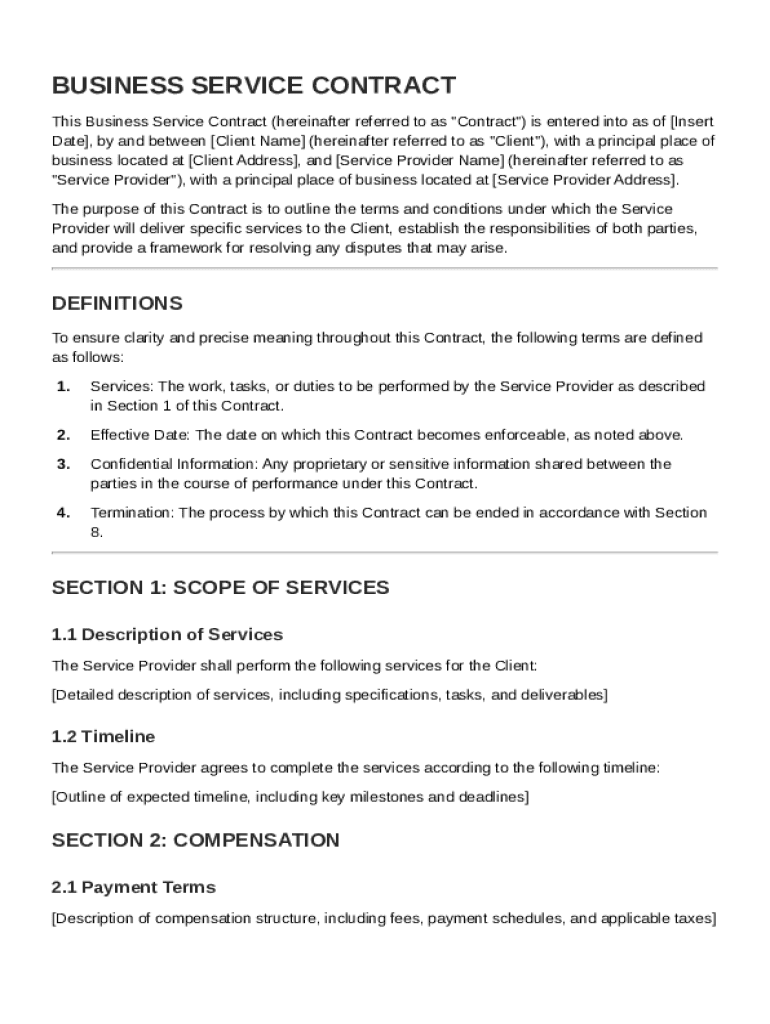







Definition & Meaning
A Business Service Contract Template is a pre-drafted document that establishes the terms of engagement between a client and a service provider. It outlines the nature of the services offered, payment arrangements, and the duties and responsibilities of both parties involved. This template acts as a structured guide to solidify critical terms and ensure all parties are aware of their respective roles, leading to a smooth service execution. By using this document, businesses can mitigate misunderstandings and disputes, while fostering a professional working relationship based on clear expectations.
Key Elements of the Business Service Contract Template
Service Description
- A detailed account of the services to be provided, including scope and limitations.
- Examples: Consulting services, maintenance work, digital marketing initiatives.
Payment Terms
- Specifics about payment rates, methods, frequency, and due dates.
- Penalties for late payments or bonuses for early completions.
Responsibilities of Parties
- Obligations each party must fulfill to sustain the agreement.
- Real-world scenario: A client must provide certain assets, like office space or software access, for the service provider to use during the engagement.
Confidentiality Obligations
- Assurance that sensitive information will not be disclosed without permission.
- Common in IT or financial services contracts where proprietary information is involved.
Duration and Termination
- The contract’s validity period and conditions under which it can be terminated.
- Options for renewal or extensions, and notice period requirements for termination.
Legal Use of the Business Service Contract Template
- Contracts must adhere to applicable laws, such as the Uniform Commercial Code (UCC) or Electronic Signatures in Global and National Commerce Act (ESIGN Act).
- Legal validity through proper signatures and, if necessary, notarization.
- Ensures compliance with regional legislation, such as California’s specific contractor laws.
Steps to Complete the Business Service Contract Template
-
Identify Parties Involved: Clearly list all parties, using legal names and contact information.
-
Define Services: Outline the scope and detail the specifics of deliverables.
-
Determine Payment Details: Choose a payment method and set timelines and milestones for payments.
-
Specify Terms and Conditions: Include assumptions, limitations, and clauses for modifications.
-
Review and Sign: Have legal advisors review the contract, then get it signed by all involved parties to ensure mutual agreement.
Who Typically Uses the Business Service Contract Template
-
Small Business Owners and Startups: Secure external partnerships or outsource tasks.
-
Consultants and Freelancers: Establish ground rules and secure payment structures with clients.
-
Large Corporations: For detailed service contracts with vendors and service providers.


Software Compatibility
DocHub supports numerous file formats beyond PDFs, making it compatible with software tools such as Microsoft Office Suite (Word, Excel), Google Workspace, and other digital platforms. This ensures seamless integration and editing capabilities for users without requiring file conversions, thus enhancing the ease of contract customization and management.
Digital vs. Paper Version
- Digital Contracts: Offer flexibility, ease of distribution, and efficient storage with electronic signing capabilities.
- Paper Contracts: While still used in some sectors, they are more cumbersome due to the necessity of physical signatures and mailing.
State-Specific Rules for the Business Service Contract Template
-
California: Strict stipulations on independent contractor arrangements and required written agreements for work costing over a specified dollar amount.
-
New York: Specific taxation rules and requirements for service contracts involving certain business types, requiring adherence to Ny State Department of Labor guidelines.
Business Types that Benefit Most from Business Service Contract Template
-
LLCs and Corporations: Regularly engage in service contracts to handle professional relationships with third parties.
-
Non-Profit Organizations: Often enter into agreements with independent contractors or vendors to aid in service delivery and fundraising activities.




