






Key Elements of the Vehicle Owner Finance Contract Template
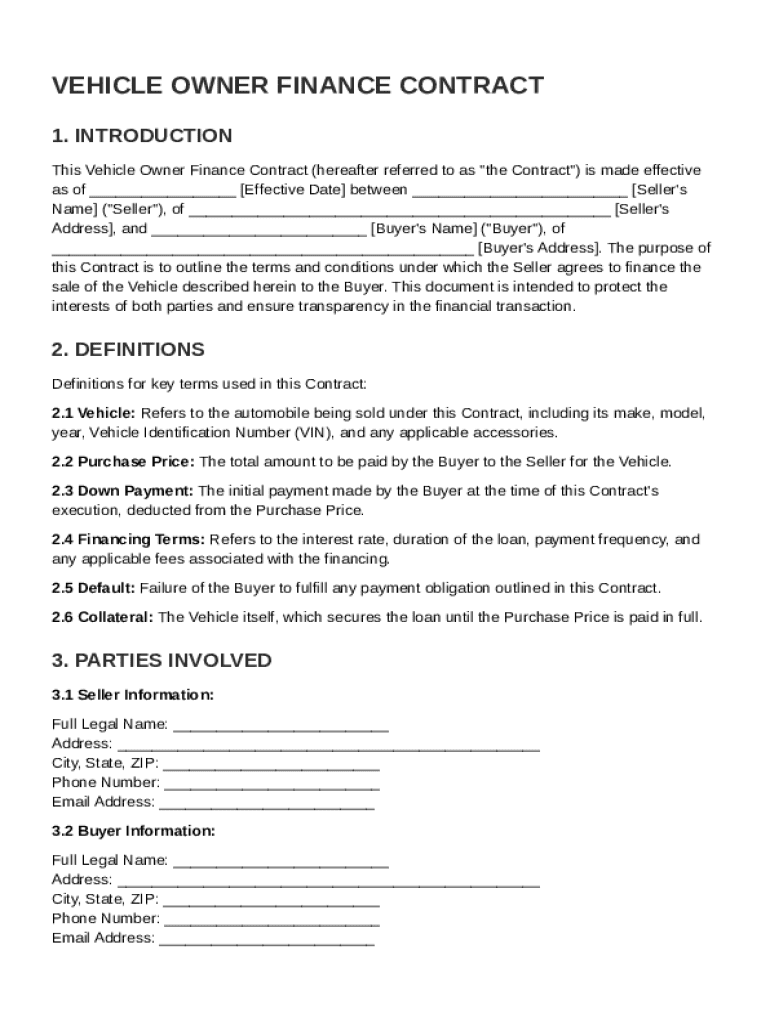
The Vehicle Owner Finance Contract Template is a critical document that outlines all necessary details and stipulations involved in financing a vehicle sale between a seller and a buyer. Important components of the contract include:
-
Definitions of Key Terms: Clearly outlines terminology used throughout the contract. Example: "buyer," "seller," "vehicle," and "payment schedule," ensuring all parties understand their roles and obligations.
-
Vehicle Details: Includes specific information about the vehicle such as make, model, year, Vehicle Identification Number (VIN), and current mileage. This section ensures clarity about the exact automobile being financed.
-
Purchase Price and Payment Terms: Details the total purchase amount and how it will be paid over time, including down payment, installment amounts, payment frequency, and any applicable interest rates.
-
Buyer Obligations: Lists the buyer’s responsibilities, such as timely payments, vehicle maintenance, and insurance requirements. This section safeguards the seller's interests by ensuring the buyer maintains the vehicle’s condition and value.
-
Default Remedies: Describes steps to be taken in case of default by the buyer, such as repossession of the vehicle or acceleration of the remaining balance, providing legal remedies to protect the seller.
-
Governing Law and Miscellaneous Provisions: Specifies the legal jurisdiction under which the contract is governed. Other provisions may include clauses about amendments, severability, and entire agreements.
Important Terms Related to the Vehicle Owner Finance Contract Template
Understanding the terminology used in the Vehicle Owner Finance Contract Template is vital for both parties involved. Key terms include:
-
Amortization Schedule: A table detailing each periodic payment on a loan over time, illustrating the breakdown of principal and interest components.
-
Lien: The legal right of a lender to repossess the vehicle if the buyer defaults on the contract's terms.
-
APR (Annual Percentage Rate): The annual rate charged for borrowing, expressed as a percentage representing the yearly cost of funds over the loan term.
-
Cosigner: An additional individual who agrees to take responsibility for loan payments if the primary borrower defaults, often enhancing the borrower’s creditworthiness.
-
Balloon Payment: An unusually large payment due at the end of the loan term after smaller periodic payments have been made.
Steps to Complete the Vehicle Owner Finance Contract Template
Completing the Vehicle Owner Finance Contract Template involves a series of detailed steps to ensure accuracy and legal compliance:
-
Gather Vehicle and Buyer Information: Collect all necessary details about the vehicle and buyer, including personal identification, vehicle specifics, and financial data.
-
Determine Financial Terms: Agree on purchase price, down payment, installment amounts, interest rate, and payment schedule. Document all agreed financial terms accurately in the contract.
-
Review Buyer Obligations: Ensure the buyer is aware of all responsibilities, such as required insurance coverage and maintenance duties, and understand the consequences of non-compliance.
-
Finalize Default Remedies: Define specific actions for defaults, ensuring both parties understand potential outcomes such as vehicle repossession.
-
Legal Review and Signing: Have the contract reviewed by legal professionals if necessary, and ensure both parties sign the document to validate the agreement.
-
Document Distribution: Provide copies of the signed contract to all parties involved, retaining one for future reference and legal protection.
Legal Use of the Vehicle Owner Finance Contract Template
The legal use of the Vehicle Owner Finance Contract Template ensures both parties are protected and compliant with applicable laws. Key aspects include:
-
Binding Agreement: Once signed, the contract becomes legally binding, enforcing terms outlined within, including payment obligations and dispute resolutions.
-
Consumer Rights Compliance: Adheres to state and federal consumer protection laws, providing transparency and fair lending practices.
-
Enforceability in Court: Provides a legal framework for resolving disputes in court, supported by clearly documented terms and signed commitments.
-
Compliance with State-Specific Regulations: Ensures adherence to state-specific legislation, as finance laws can vary significantly across jurisdictions.
State-Specific Rules for the Vehicle Owner Finance Contract Template
Understanding and adherence to state-specific laws are vital for creating a valid and enforceable contract. Differences may include:
-
Interest Rate Caps: Some states impose limits on the maximum permissible interest rates for vehicle loans.
-
Insurance Requirements: States may have specific insurance coverage requirements that must be maintained throughout the loan term.
-
Repossession Laws: Variations in repossession rights and procedures, with some states offering more protection to consumers in default scenarios.
-
Documentation and Fees: Differences in required documentation or allowable fees in relation to the vehicle financing process.
Who Typically Uses the Vehicle Owner Finance Contract Template
This contract is used by a variety of individuals and businesses involved in vehicle sales:
-
Dealerships: Utilize these contracts for direct financing options offered to buyers, streamlining their sales and finance processes.
-
Private Sellers: Individuals selling vehicles directly to other individuals, especially when offering seller-financed arrangements.
-
Financial Institutions: Banks and credit unions offering auto loans may use a version of this contract to formalize agreements with borrowers.
-
Lease-to-Own Businesses: Companies specializing in lease-to-own vehicle sales may employ this template to outline financial terms and obligations.


State-by-State Differences in Vehicle Owner Finance Contract Template
As state laws can affect the terms of a finance contract, some specific aspects to consider include:
-
Consumer Protection Laws: Varying levels of consumer protection, such as grace periods for late payments and requirements for notifications or disclosures.
-
Contract Language Requirements: Some states may mandate specific language or disclosures be included in the contract to ensure comprehensibility and legal enforceability.
-
Electronic Signature Acceptance: While electronic signatures are federally recognized, certain states may have specific provisions or acceptance criteria.
-
Dealer vs. Private Seller Requirements: Some states differentiate between commercial and private transactions, impacting contract legality and requirements.
Software Compatibility and Integration for Document Management
DocHub offers robust software compatibility features that facilitate managing vehicle finance contracts digitally:
-
Seamless Integration with Google Workspace: Allows users to import and export documents directly from Google Drive and Gmail, streamlining document workflow.
-
Format Support: Supports a variety of file formats, ensuring contracts can be edited without the need for conversion.
-
Electronic Signatures: Legally binding electronic signature capabilities that adhere to the ESIGN Act, simplifying signatory processes.
-
Security Measures: Employs 256-bit SSL encryption and OAuth 2.0 authentication for secure document handling and data protection.
Real-time synchronization and collaboration features further enhance productivity, allowing multiple users to access and modify documents efficiently.