Definition and Meaning
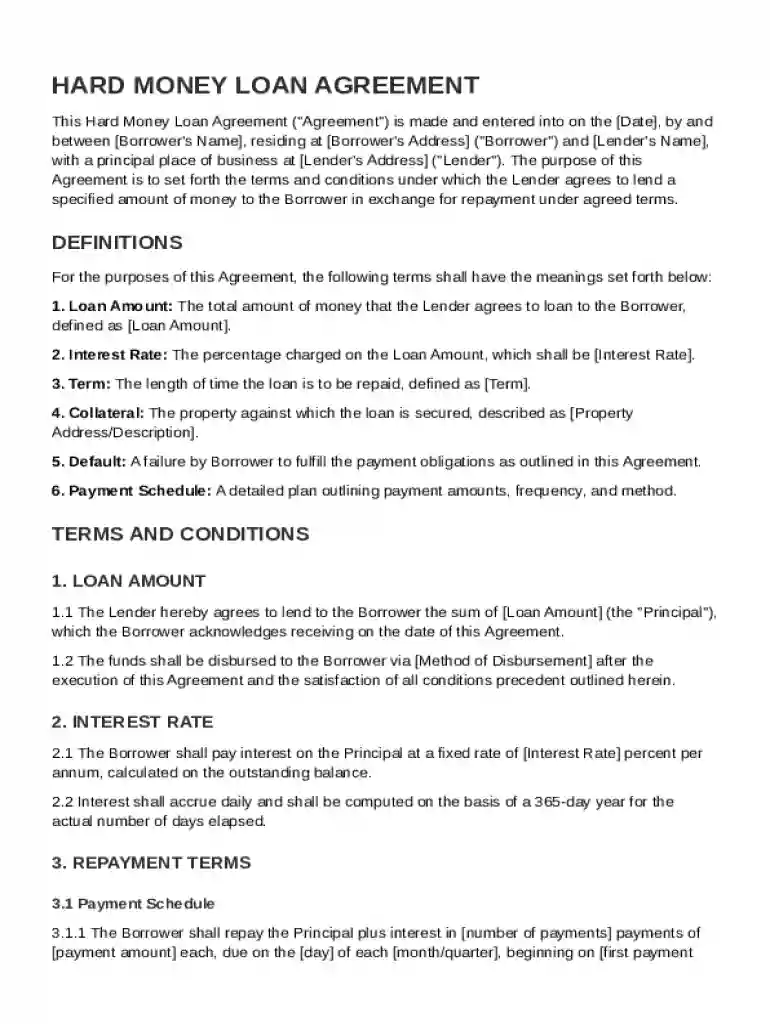
A hard money loan agreement template is a pre-formatted document utilized to formalize the lending process between a lender and a borrower. This type of loan usually involves property as collateral and is a short-term funding solution often used by real estate investors. The agreement details the conditions under which the loan is issued, such as loan amount, interest rates, terms of repayment, and collateral details. It serves as a legal framework governing the responsibilities and rights of both parties involved in the transaction.
Features of a Hard Money Loan
- Collateral Requirement: Hard money loans are asset-based, typically secured by real estate property.
- Short-term Solution: These loans are generally for shorter periods, ranging from six months to a few years.
- Higher Interest Rates: Due to the increased risk, interest rates for hard money loans are often higher than traditional bank loans.
- Faster Processing: The process is more streamlined compared to conventional loans, making it appealing for those needing quick funding.
Key Elements of the Hard Money Loan Agreement Template
The hard money loan agreement template covers several critical components that outline the agreement between the lender and borrower.
Loan Details
- Loan Amount: Specifies the principal amount the borrower is obligated to repay.
- Interest Rates: Outlines the percentage rate applied to the loan, affecting overall repayment cost.
- Repayment Schedule: Details the timeline and frequency of repayments, such as monthly or quarterly.
Collateral Specification
- Property Description: Clearly describes the property being used as collateral, including its location and value.
- Lien Position: Indicates the lender's priority in claiming the property if the borrower defaults.
Default Remedies and Amendments
- Default Conditions: Defines what constitutes a breach of the agreement, such as missed payments.
- Default Remedies: Details the actions a lender can take if the borrower defaults, including foreclosure.
- Amendment Clause: Specifies how the agreement can be modified post-execution.
Steps to Complete the Hard Money Loan Agreement Template
Completing a hard money loan agreement template involves several steps, each crucial to ensuring the document serves its legal purpose effectively.
- Gather Information: Collect necessary borrower and lender information, including identification and contact details.
- Outline Loan Terms: Clearly define the loan amount, interest rates, repayment schedule, and other terms.
- Describe Collateral: Provide detailed information about the collateral property, ensuring it's accurately valued.
- Review and Adjust Terms: Both parties must review the draft, ensuring all terms are clear and agreeable.
- Sign and Notarize: Once agreed upon, the document should be signed by both parties and notarized if required to ensure its enforceability.
Legal Use of the Hard Money Loan Agreement Template
Hard money loan agreement templates must comply with state and federal laws to be legally binding. They serve as a protective measure for both parties, particularly in case of disputes or defaults.
Compliance with Laws
- Usury Laws: Ensure the interest rates comply with state-specific usury laws to avoid financial penalties.
- Real Estate Regulations: Abide by real estate laws governing property transactions and mortgages.
Importance for Parties
- Lender Protection: Safeguards the lender’s investment by outlining forfeiture consequences in case of default.
- Borrower Security: Protects the borrower’s rights by clearly detailing repayment terms and conditions.
State-Specific Rules for the Hard Money Loan Agreement Template
Hard money loan agreements may differ based on state-specific legal requirements. These regulations can impact various aspects of the loan process, from maximum interest rates to foreclosure procedures.
Variability Across States
- Interest Rate Caps: Some states impose caps on interest rates that must be adhered to within the agreement.
- Foreclosure Laws: The process and requirements for foreclosing vary, affecting how quickly a lender can reclaim collateral.
- Documentation Requirements: States might have unique documentation standards, affecting the form's content.
Important Terms Related to the Hard Money Loan Agreement Template
Understanding the terminology associated with the hard money loan agreement is fundamental to its proper execution and comprehension.
Glossary of Terms
- Principal: The original sum of money borrowed or the amount of the loan.
- Lien: A legal right or interest that a lender has in the borrower's property, used as collateral.
- Foreclosure: Legal process wherein the lender attempts to recover the loan balance from a borrower who has stopped making payments.
- Amortization: The process of spreading payments over multiple periods, typically used to pay off loan interest and principal.
Examples of Using the Hard Money Loan Agreement Template
Practical scenarios in which a hard money loan agreement template is employed can shed light on its typical use cases and advantages.
Real-World Applications
- Real Estate Investors: Use these agreements when purchasing distressed properties with the intent to renovate and resell quickly.
- Commercial Property Loans: Businesses might opt for hard money loans when traditional bank loans are either unavailable or too slow to process.
- Bridge Financing: Investors needing temporary funding to close on a property while awaiting approval of longer-term financing.
These examples highlight the template’s flexibility and suitability for distinct financial circumstances.
Business Types That Benefit Most from the Hard Money Loan Agreement Template
Certain types of businesses are more likely to utilize hard money loan agreement templates due to their specific operational needs and financial strategies.
Beneficiary Business Profiles
- Flipping Enterprises: Businesses focused on buying, renovating, and selling homes can benefit from the quick funding and short-term nature of hard money loans.
- Small Development Firms: Developers engaged in small residential or commercial projects often rely on these agreements for expedited capital access.
- Entrepreneurial Ventures: Startups with limited credit histories might consider hard money loans when traditional borrowing is not viable.