






Definition & Key Features
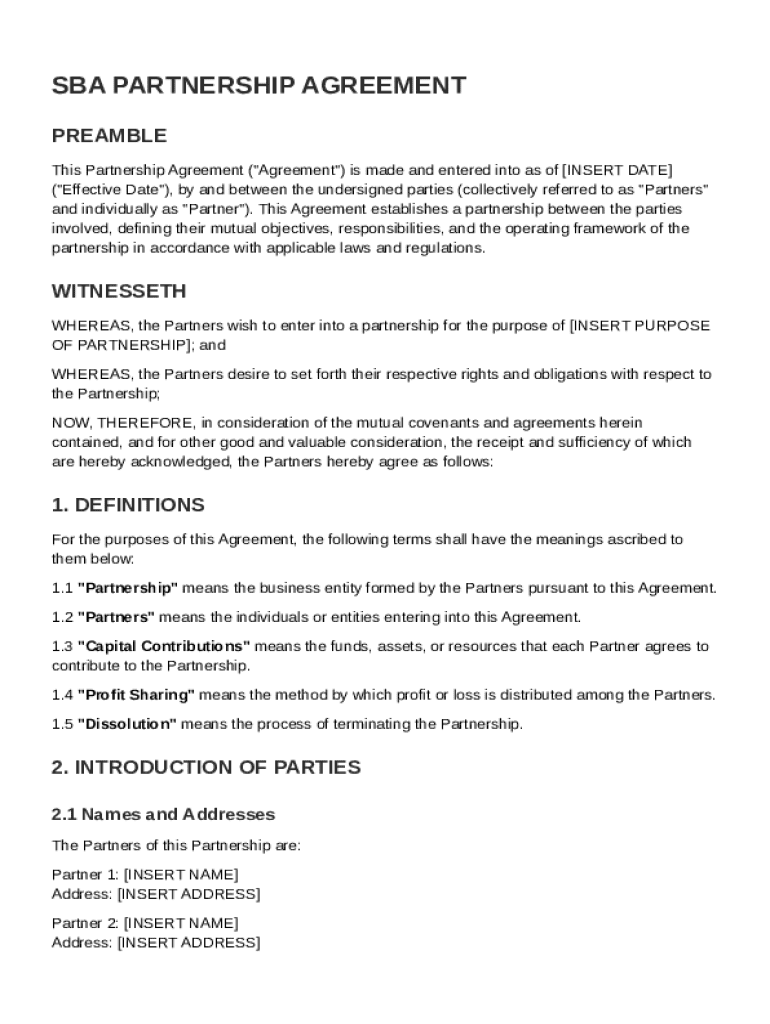
The SBA Partnership Agreement Template is a legal document that outlines the specific terms and conditions for forming a partnership under the Small Business Administration's guidelines. It typically includes detailed sections such as definitions of key terms, roles and responsibilities of each partner, capital contributions, and profit and loss distribution. Understanding these provisions is crucial for ensuring the partnership operates smoothly within legal constraints and aligns with both partners' expectations.
- Definitions: Clarifies essential terms used throughout the agreement.
- Roles and Responsibilities: Specifies each partner’s duties and management roles within the partnership.
- Capital Contributions: Documents the initial financial and material investments made by the partners.
- Profit and Loss Distribution: Describes how profits and losses are to be shared among partners.
Steps to Complete the SBA Partnership Agreement Template
Completing the SBA Partnership Agreement Template involves several detailed steps to ensure thoroughness and accuracy:
- Gather Required Information: Collect personal and business information of all partners involved.
- Define Partnership Structure: Clearly outline whether the partnership is general, limited, or limited liability.
- Draft Financial Details: Include specifics on capital contributions and anticipated financial arrangements.
- Include Dispute Resolution Terms: Define processes for conflicts to maintain healthy professional relationships.
- Review Legal Requirements: Check compliance with local and federal laws, amending sections where necessary.
Important Terms and Clauses
Understanding the important terms within the SBA Partnership Agreement Template enhances the robustness and legality of the document:
- Non-Compete Clauses: Restrictions on partners from engaging in competitive businesses during and after their tenure.
- Confidentiality Obligations: Mandates maintaining the secrecy of proprietary business information.
- Governing Law: The jurisdiction under which the agreement will be governed and interpreted.
- Amendment Procedures: Processes for making future changes to the partnership terms.
Legal Use and Compliance
The partnership agreement ensures legal compliance with state and federal regulations. It helps mitigate disputes by clearly documenting each aspect of the partners' relationship and expectations, reducing ambiguities that could lead to legal conflicts:
- Legality: Ensures all business activities align with SBA and legal standards.
- Enforceability: Provides legally-binding commitments that can be upheld in court.
- Protection: Guards against internal and external disputes through documented expectations.
Who Typically Uses the SBA Partnership Agreement Template
The SBA Partnership Agreement Template is commonly used by a variety of business entities, typically those involving two or more individuals aiming to combine resources and expertise:
- Small Business Owners: Entrepreneurs establishing a partnership to optimize capital and operational capacity.
- Consulting Firms: Teams pooling resources and clients to expand service offerings.
- Real Estate Partnerships: Investors joining forces to finance and manage property developments.


Key Elements to Include
The following components are critical in a comprehensive partnership agreement to ensure clarity and mutual understanding between partners:
- Management Operations: Detailed outline of how the partnership will be governed and decisions made.
- Profit and Loss Allocation: Clear indication of financial expectation and commitments.
- Termination Procedures: Specifications on how the partnership can be dissolved or terminated.
- Confidentiality and Non-Compete: Clauses to protect business interests and proprietary information.
State-Specific Rules and Considerations
It's crucial to tailor the SBA Partnership Agreement Template according to state-specific regulations which can affect the partnership's operation:
- Registration Requirements: Varying criteria for registering partnerships across different states.
- Tax Obligations: State tax laws, including those related to income, sales, and employment, should be considered.
- Permit and Licensing Requirements: Specific industry-related permits that might be needed depending on the state.
Digital vs. Paper Versions
In the modern digital age, many opt for electronic versions of the partnership agreement due to their convenience and security features, though traditional paper formats remain viable:
- Digital Versions: Allow for quicker revisions and electronic signatures; beneficial for remote partners.
- Paper Versions: Favorable in traditional or less tech-dependent environments for physical record-keeping.
Each format should ensure it meets legal standards for validity and enforceability, especially concerning signatures and notarization if required.