Valuation Contract Template 2026

Get Form
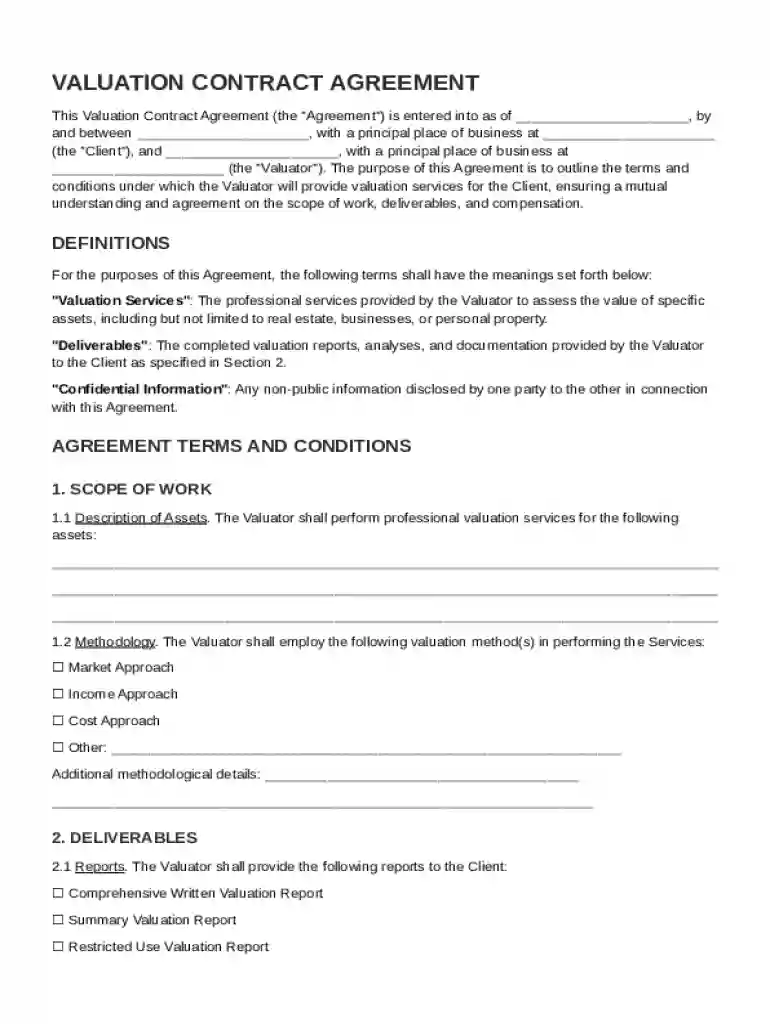
Valuation Contract Template Preview on Page 1

Here's how it works

01. Edit your form online
Type text, add images, blackout confidential details, add comments, highlights and more.

02. Sign it in a few clicks
Draw your signature, type it, upload its image, or use your mobile device as a signature pad.

03. Share your form with others
Send it via email, link, or fax. You can also download it, export it or print it out.

Understanding the Valuation Contract Template

The Valuation Contract Template is a formal document used to establish a clear agreement between a client and a professional valuator. Its primary purpose is to delineate terms and expectations related to valuation services. The document includes detailed descriptions of valuation services, deliverables, and methodologies used in assessing the value of properties or businesses. Its thorough nature aims at ensuring that both parties have a comprehensive understanding of the process and the expected outcomes.

  • Valuation Services and Deliverables: It's crucial to define what constitutes valuation services and the expected deliverables. Whether it involves a market analysis or a detailed financial projection, the scope of work should be clearly outlined.
  • Methodologies: Different valuation methodologies might be applied depending on the assets being valued. These can include market approach, income approach, or cost approach.
  • Confidentiality Obligations: The template often contains clauses that emphasize the importance of maintaining the confidentiality of sensitive information shared during the valuation process.

How to Use the Valuation Contract Template

Using the Valuation Contract Template involves several steps to ensure that it's accurately tailored to the specific context of the engagement. The process typically requires understanding the client's needs and the scope of the evaluation.

  1. Determine the Scope of Work: Identify what assets or properties need to be valued and the expected deliverables.
  2. Customize the Template: Adjust the template to reflect the specific terms negotiated with the client concerning timelines, methodologies, and fees.
  3. Detailed Review: Conduct a thorough review with all stakeholders to ensure clarity and mutual agreement on the terms.
  4. Signatures: Once both parties are in agreement, ensure that both the client and the valuator sign the contract to make it legally binding.

Key Elements of the Valuation Contract Template

A robust Valuation Contract Template will contain several critical components designed to protect both parties involved.

  • Compensation Structures: Clearly defined payment terms, whether a fixed fee or based on specific milestones.
  • Timelines: Specific timeframes for the delivery of valuation reports and other services.
  • Liability Limitations: Terms that outline the extent of the valuator’s responsibility in case of errors.
  • Termination Rights: Clausal language allowing either party to terminate the agreement under specific conditions.

Important Terms Related to the Valuation Contract Template

Understanding the terms commonly used within the valuation contract is essential for both parties to set expectations correctly.

Valuation Services

These are professional services aimed at providing an estimation of the value for specific assets or properties. The definition can vary based on the asset type and the client's needs.

Deliverables

These are the final products or reports that result from the valuation service, which might include a written report, oral presentation, or both, depending on the client's requirements.

Steps to Complete the Valuation Contract Template

Complete the Valuation Contract Template by following these guidelines:

  1. Input Basic Information: Include the names and contact details of both the client and the valuator.
  2. Define Scope and Methodologies: Provide a detailed account of the services to be provided and the approach to be employed.
  3. Set Financial Terms: Clarify the compensation structure and payment schedule.
  4. Include Legal Clauses: Ensure clauses covering confidentiality, liability, and termination are standard in the agreement.
  5. Review for Completeness: Conduct a final review to check that all critical points are fully addressed.

Legal Use of the Valuation Contract Template

The enforceability of the Valuation Contract Template depends on its compliance with legal standards. Ensure that:

  • Governing Law: The contract specifies which state laws apply in interpreting the contract terms.
  • Legally Binding Terms: Ensure all clauses included in the contract are enforceable under applicable federal and state laws in the U.S.

State-Specific Rules for the Valuation Contract Template

Different states may have varying requirements or regulations affecting the applicability of valuation contracts. It's critical to:

  • Research Specific Requirements: Check for any state-specific mandates that could influence the content of your contract.
  • Adjust the Template Accordingly: Incorporate any additional clauses or alterations required to comply with local laws.

Examples of Using the Valuation Contract Template

Real-world applications of the Valuation Contract Template can illustrate its utility in diverse scenarios.

  • Real Estate Valuations: Assessing the value of residential or commercial properties before a sale or purchase.
  • Business Valuations: Used during mergers, acquisitions, or in assessing future investment potentials.
  • Asset Valuations in Divorce Settlements: Determining the value of shared assets in legal separations.

These examples underscore the importance of having a comprehensive and custom-tailored contract to manage expectations and responsibilities effectively.

be ready to get more

Complete this form in 5 minutes or less

Get form

Got questions?

We have answers to the most popular questions from our customers. If you can't find an answer to your question, please contact us.
Contact us
There are a number of ways to determine the market value of your business. Tally the value of assets. Add up the value of everything the business owns, including all equipment and inventory. Base it on revenue. Use earnings multiples. Do a discounted cash-flow analysis. Go beyond financial formulas.
At its core, contract value is the total monetary worth of a contract over its entire lifespan. Think of it as the total financial commitment one party is making to another. While the concept is simple, the business world relies on two key metrics to measure it: Total Contract Value (TCV): This is the big one.
For example, if your service business makes $100,000 in annual profit, its estimated value might range between $200,000 and $300,000. However, if that same profit came from a technology company with rapid growth, it might be worth $600,000 to $1 million.
The typical professional business valuation report uses the following format: Salutation and acknowledgment of the clients (owner or CEO) valuation request. Table of contents. Introduction. Business identification and description. Executive summary. Business financial analysis. Economic and industry analysis.
So, if the entrepreneur is asking $100,000 with 10% equity, $100,000 is 10% of the companys valuation which in this case is $1 million ($100,000 x 10).

Security and compliance

At DocHub, your data security is our priority. We follow HIPAA, SOC2, GDPR, and other standards, so you can work on your documents with confidence.
Learn more
ccpa2
pci-dss
gdpr-compliance
hipaa
soc-compliance

People also ask

So, if the entrepreneur is asking $100,000 with 10% equity, $100,000 is 10% of the companys valuation which in this case is $1 million ($100,000 x 10). This is how it works on the show real life investors dont necessarily use a formula.
This course examines in detail the five key property valuation methods: comparison, investment, residual, profits, and cost-based.
The Sharks will usually confirm that the entrepreneur is valuing the company at $1 million in sales. The Sharks would arrive at that total because if 10% ownership equals $100,000, it means that one-tenth of the company equals $100,000, and therefore, ten-tenths (or 100%) of the company equals $1 million.

Related links