






Key Elements of the Restricted Stock Agreement Template
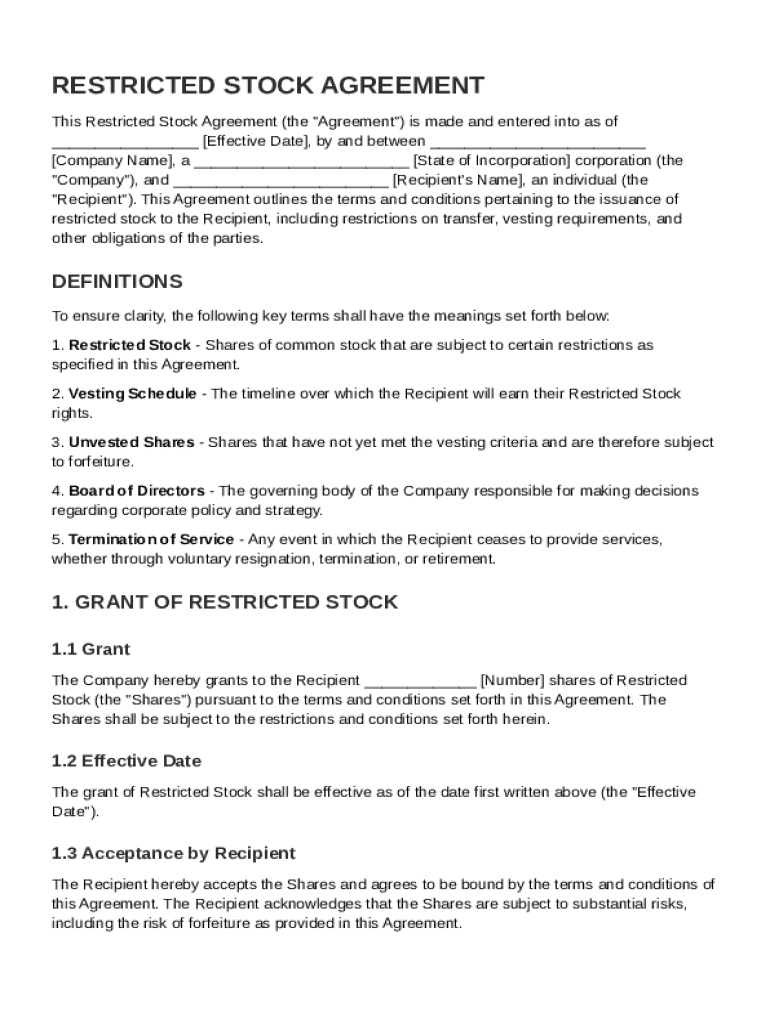
The Restricted Stock Agreement Template encompasses a range of critical elements designed to clearly define the terms and conditions for issuing restricted stock. Central to this structure are the vesting schedules, which outline how and when stock shares become available to the recipient. This section also details any potential acceleration due to specific events, such as a change of control within the company or the termination of employment due to death or disability.
The agreement lays out transfer restrictions, which are essential to maintaining control over who can own stock and under what conditions shares can be sold or transferred to another party. In addition, the template specifies the rights as a stockholder, which may include voting rights and dividend entitlements, ensuring recipients understand their privileges and responsibilities.
How to Use the Restricted Stock Agreement Template
Utilizing the Restricted Stock Agreement Template involves several careful steps to customize it according to the specific circumstances of the stock grant. Start by reviewing the template to understand each section and its implications fully. Make necessary modifications to the grant conditions based on the company’s compensation structure, ensuring that the vesting schedule aligns with corporate policies and strategic goals.
Next, adjust the tax liabilities section to reflect the company's approach to handling taxation on stock grants. The template should be tailored to include relevant state and federal tax obligations, making sure the recipient acknowledges any withholding requirements.
Steps to Complete the Restricted Stock Agreement Template
Completing the Restricted Stock Agreement Template involves a structured process to ensure all essential components are accurately addressed.
- Review and Customize Key Sections: Begin by examining the sections on grant conditions and vesting schedules. Customize these areas to align with corporate policies.
- Include Transfer Restrictions: Clearly outline the conditions under which shares can be transferred or sold, safeguarding the company’s interests.
- Define Stockholder Rights: Detail the rights granted to the recipient as a stockholder, including voting and dividend rights.
- Address Tax Liabilities: Specify the tax obligations and responsibilities of both the company and the recipient, ensuring compliance with applicable laws.
- Review and Finalize: Have both legal and compliance teams review the completed document to ensure its thoroughness and accuracy before being signed by all parties involved.
Important Terms Related to Restricted Stock Agreement Template
Several key terms are central to understanding and utilizing the Restricted Stock Agreement Template effectively.
- Vesting Schedule: The timeline over which restricted stock becomes fully owned by the recipient.
- Grant Date: The specific date when the stock is awarded to the recipient.
- Fair Market Value: The stock’s value as determined by current market conditions at the time of grant.
- Change of Control: A condition that might accelerate vesting tied to shifts in company ownership.
- Tax Withholding: The company’s obligation to withhold taxes on the fair market value of the stock as it vests.
Examples of Using the Restricted Stock Agreement Template
Several scenarios highlight the utility of the Restricted Stock Agreement Template. For instance, a technology startup may use this template to incentivize its employees, providing vesting based on performance metrics crucial to its growth. Alternatively, an established manufacturing company might incorporate change-of-control provisions to ensure executives remain committed during transitions.
Another example involves a large corporation issuing restricted stock to align the interests of its leadership team with long-term company performance. This strategy can help integrate retention incentives for critical team members while simultaneously managing stockholder interests.
Legal Use of the Restricted Stock Agreement Template
The legal application of the Restricted Stock Agreement Template requires adherence to both federal and state regulations. This template must be reviewed to comply with the Securities and Exchange Commission (SEC) regulations concerning the issuance of stock. Additionally, specific terms must be tailored to conform with local employment laws, ensuring that all stock grants are legally valid and enforceable.
Employers must ensure that their agreement template aligns with the Employee Retirement Income Security Act (ERISA) and Internal Revenue Code (IRC) sections relevant to stock compensation, maintaining a legally compliant position when offering equity to employees.
Required Documents for the Restricted Stock Agreement Template
Several documents are critical when drafting and executing the Restricted Stock Agreement Template. The primary document is the executed agreement itself, which must be signed by both the issuer and the recipient. Additionally, supporting documents such as a copy of the company’s stock incentive plan and any board resolutions authorizing the stock grant should be retained.
It is also recommended to include a stockholder rights agreement detailing the rights attached to the shares and a vesting confirmation statement that will track the fulfillment of the vesting conditions outlined in the template.
Who Typically Uses the Restricted Stock Agreement Template
The Restricted Stock Agreement Template is widely used across various types of businesses, particularly those looking to attract and retain talent through equity compensation. Common users include technology companies, which often use stock grants to supplement lower startup salaries, publicly traded corporations that issue stock to align executives’ and managers’ performance with shareholder interests, and late-stage startups looking to transition from venture-backed funding to public markets, incentivizing key employees to stay throughout their growth and public offering processes.