






Definition and Meaning
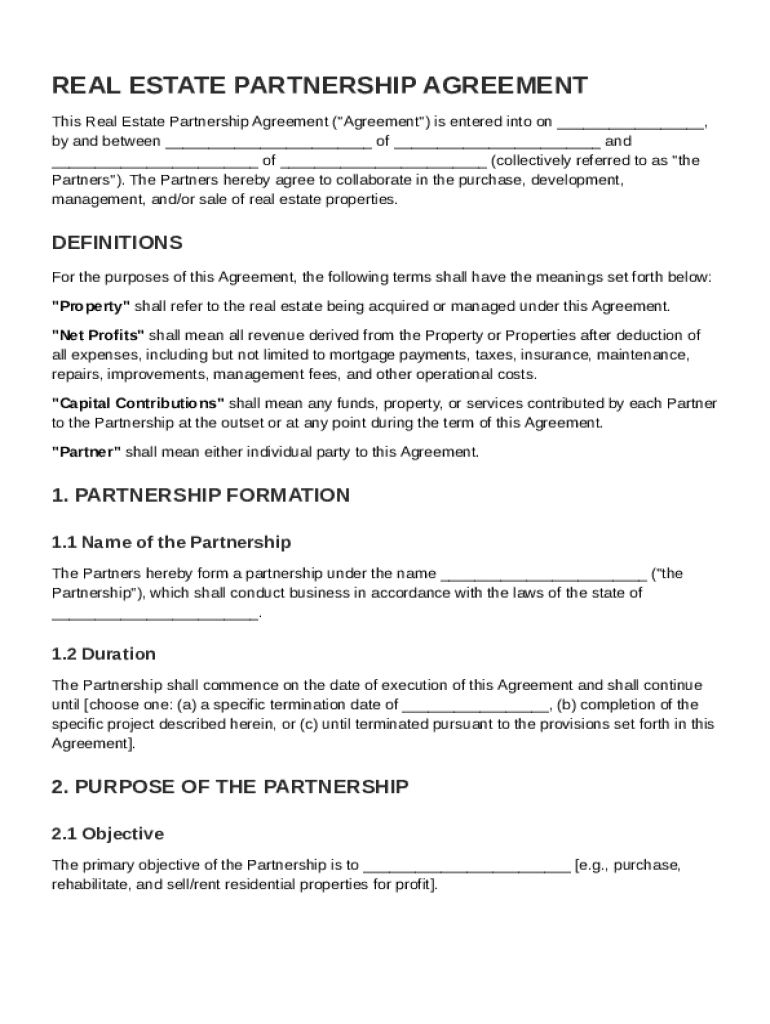
A Real Estate Partnership Agreement Template is a legally binding document used to delineate the specific terms and conditions under which two or more parties collaborate in the realm of real estate transactions. These agreements are vital for establishing clear roles, responsibilities, and expectations among partners involved in a partnership. The template typically covers various aspects such as the partnership’s objectives, profit and loss distribution, management structure, capital contributions, and termination conditions. By using a standardized template, partners can ensure that their agreement is comprehensive, legally compliant, and tailored to address the needs of their specific venture.
Key Elements of the Real Estate Partnership Agreement Template
To effectively protect the interests of all parties involved, a Real Estate Partnership Agreement Template should include several key elements:
- Partnership Name and Purpose: Clearly define the partnership’s name and the primary objectives it aims to achieve.
- Capital Contributions: Detail each partner’s financial contribution, as well as any subsequent funding arrangements or requirements.
- Profit and Loss Distribution: Outline how profits and losses will be shared among partners based on their contributions or a pre-determined arrangement.
- Management Roles and Responsibilities: Specify the management structure, decision-making processes, and the duties each partner will assume.
- Duration: Indicate the expected duration of the partnership and any conditions for extension or dissolution.
- Dispute Resolution: Establish protocols for resolving disagreements, including mediation or arbitration clauses.
- Miscellaneous Provisions: Include any additional terms relevant to the partnership, such as restrictions on transferring partnership interests.
How to Use the Real Estate Partnership Agreement Template
Using a Real Estate Partnership Agreement Template effectively involves a series of steps to ensure that the final document meets the needs of all parties:
- Download the Template: Access a reliable source, such as a legal document service, to obtain the template in a compatible format (DOC, PDF, etc.).
- Review and Customize: Carefully read through the template to understand its provisions. Customize sections to reflect the specific goals, contributions, and roles of each partner.
- Consult with Legal Experts: Engage a lawyer to review the customized agreement to ensure it aligns with legal requirements and adequately protects each partner’s interests.
- Negotiate Terms: Discuss the terms with all partners, making adjustments as necessary to ensure consensus and clarity.
- Finalize and Sign: Once all partners agree, finalize the document and arrange for all parties to sign, thus legally binding their agreement.
Steps to Complete the Real Estate Partnership Agreement Template
Completing the template requires careful attention to detail to ensure accuracy and compliance:
- Gather Necessary Information: Collect all relevant information, including partner names, financial contributions, and intended partnership goals.
- Fill Out Template Sections: Enter the gathered information into the respective sections of the template, paying close attention to the key elements outlined previously.
- Review for Completeness: Ensure all sections are complete and reflect the partners’ intentions accurately.
- Verify Legal Compliance: Check that the agreement complies with local and federal laws, including any state-specific requirements.
- Signature Collection: Secure signatures from all partners to formalize the agreement. This can be facilitated digitally using e-signature services if necessary.
Who Typically Uses the Real Estate Partnership Agreement Template
This template is commonly used by individuals or entities engaging in real estate ventures that require collaboration. This includes:
- Real Estate Investors: Frequently enter partnerships to pool resources for property acquisition, development, and management.
- Real Estate Development Firms: Utilize agreements to clarify the roles and contributions between developers and other stakeholders.
- Joint Ventures: Parties forming a joint venture for a specific real estate project often require a robust partnership agreement.
- Property Management Companies: Engage partners to oversee different aspects of property operations under a structured agreement.


Important Terms Related to the Real Estate Partnership Agreement Template
Understanding key terms within the agreement is crucial for clarity and legal compliance:
- Net Profits: Refers to the total profits of the venture after deducting all operational expenses.
- Capital Contributions: The amount of money or property invested by each partner to initiate or support the partnership.
- Indemnification: A provision that protects partners from certain liabilities, transferring risk.
- Dissolution: Outlines the process for winding up the partnership’s affairs if it ends.
- Fiduciary Duty: A legal obligation for partners to act in the best interest of the partnership.
Legal Use of the Real Estate Partnership Agreement Template
The template must be used in a manner that ensures legal enforceability:
- Adhere to State and Federal Laws: The agreement should comply with all relevant jurisdictional laws where the partnership operates.
- Familiarize with Partnership Acts: Understand applicable laws such as the Uniform Partnership Act or its state adaptations.
- Maintain Good Faith: Partners must negotiate and execute the agreement honestly and with mutual respect.
- Regular Updates: Review and amend the agreement as necessary to reflect changes in the partnership's structure or industry regulations.
Examples of Using the Real Estate Partnership Agreement Template
Real-world scenarios illustrate how this template can facilitate successful partnerships:
- Case Study 1: Two real estate investors form a partnership to purchase and renovate multi-family properties. The agreement outlines profit-sharing based on each partner’s initial investment and specific renovation responsibilities.
- Case Study 2: A real estate developer enters into a partnership with a construction firm to develop a commercial property. The template clarifies timelines, financial responsibilities, and dispute resolution mechanisms.
- Case Study 3: An international investor partners with a local real estate agent, leveraging the agreement to define roles in market analysis and property acquisition, ensuring smooth execution of cross-border transactions.
By considering these facets, the Real Estate Partnership Agreement Template serves as an essential tool for structuring partnerships in real estate, ensuring transparency and protecting the interests of all involved parties.