




01. Edit your form online
Type text, add images, blackout confidential details, add comments, highlights and more.

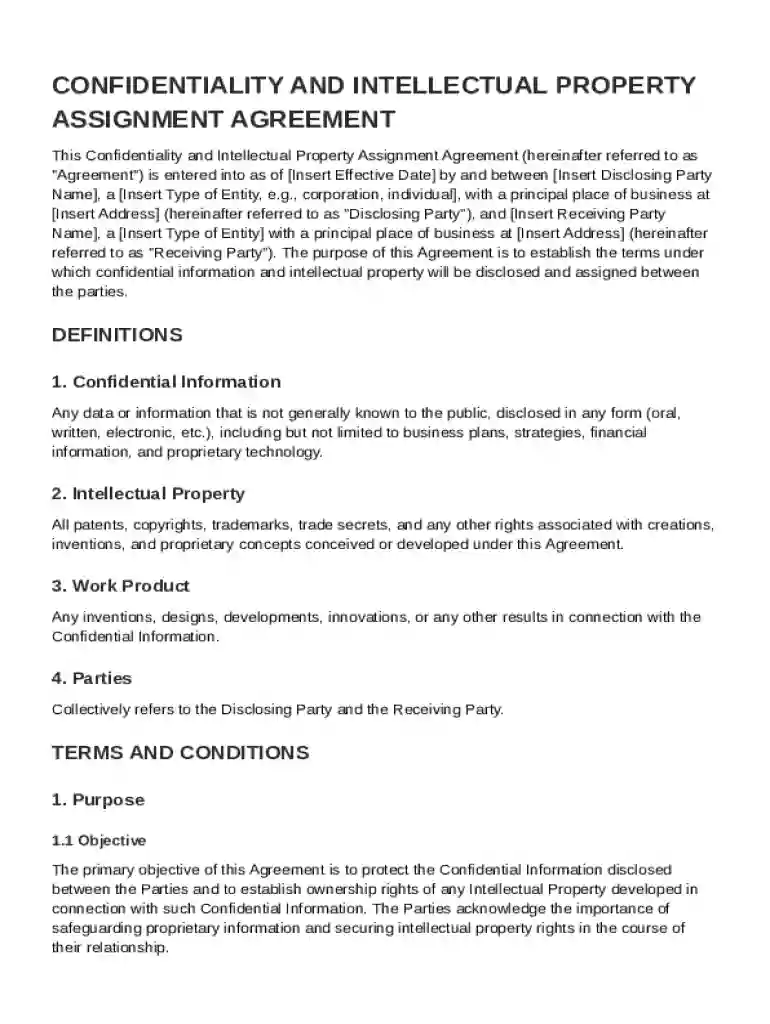
Type text, add images, blackout confidential details, add comments, highlights and more.

Draw your signature, type it, upload its image, or use your mobile device as a signature pad.

Send it via email, link, or fax. You can also download it, export it or print it out.
The "Confidentiality and Intellectual Property Assignment Agreement Template" is a legal document designed to protect the proprietary information and intellectual property associated with a business arrangement. It is commonly used to define and outline the terms under which confidential information is shared between parties and to ensure that any intellectual property (IP) developed within the scope of the agreement is owned by a predetermined entity, typically the disclosing party. This agreement is critical in safeguarding innovations and proprietary information in collaborations that involve sharing sensitive information.
This template offers a structured framework that can be tailored to specific business needs. To utilize it effectively:
Identify Parties: Clearly specify the Disclosing Party and the Receiving Party. This establishes the relationship and obligations from the get-go.
Define Scope: Highlight the type of information that will be considered confidential and specify the intellectual property covered under the assignment.
Customization: Adjust any clauses to fit the specific requirements of the collaboration, such as the duration of confidentiality obligations or particular exclusions from confidentiality.
Legal Review: It is wise to consult with a legal expert to ensure that all customized elements meet legal standards and provide the necessary protection.
Enter Relevant Information: Fill out the fields pertaining to party names, effective dates, and addresses.
Specify Confidential Information: Enumerate the types of information deemed confidential, including technical data, business methods, and any unpublished patents.
Outlining IP Assignment: Clearly state which intellectual property rights will be assigned and retained by the disclosing party.
Set Duration and Obligations: Define how long the confidentiality obligations will last and detail the responsibilities of both parties.
Signature and Execution: After filling out the necessary sections, both parties must sign the document to formalize the agreement.
Definitions: Clearly outlines the terms such as "Confidential Information" and "Intellectual Property" to avoid ambiguity in interpretation.
Obligations of Confidentiality: Details the responsibilities of the Receiving Party to protect and maintain the confidentiality of the shared information.
Intellectual Property Rights: Specifies the assignment process for any IP developed during the contractual period, ensuring rightful ownership transfer.
Exclusions from Confidentiality: Lists scenarios where the obligations of confidentiality do not apply, such as information already in the public domain.
Remedies for Breach: Describes the legal consequences of breaching the agreement, including possible injunctive relief and damages.
It is imperative that this agreement complies with U.S. laws governing confidentiality and intellectual property rights. Key legal aspects include:
State Laws: This template should be reviewed in the context of state-specific laws as they can affect the enforceability of certain clauses.
Federal Compliance: Ensures adherence to federal laws, including the Defend Trade Secrets Act, which provides a federal cause of action for misappropriation of trade secrets.
Legal Enforceability: The template should be executed with clear intention to create binding obligations to ensure it is enforceable in a court of law.
Startups and Technology Firms: These businesses frequently use such agreements to safeguard technological innovations and proprietary processes during collaborative projects or when hiring new employees.
Consultants and Contractors: Independent consultants often have access to sensitive information and thus use this agreement to define the scope of confidentiality obligations clearly.
Research and Development Teams: R&D departments leverage these templates when collaborating with external partners to protect emerging innovations.
Each U.S. state has its nuances and regulations that may affect the terms within the agreement. Businesses must consider:
Variations in IP Ownership Laws: Different interpretations exist across states regarding who owns the IP created during employment; contracts should be drafted accordingly.
Statute of Limitations: States may vary on the duration one can wait to bring a claim for breach, influencing how long confidentiality must be maintained.
Employee Onboarding: Upon hiring a new engineer to work on a software project, the company uses this agreement to ensure that any inventions made by the employee are assigned to the company.
Collaborative Research Projects: Universities collaborating with private corporations might use the template to protect mutually beneficial research findings from unauthorized disclosure.
Consulting Engagements: A marketing consultancy firm engages with a new client and signs the agreement to ensure their proprietary strategies are not shared with competitors.
Digital agreements offer dynamic benefits over traditional paper versions, such as:
Ease of Distribution: Digital templates can be easily shared and executed electronically across different locations.
Efficiency in Record Keeping: Retain and document revisions and versions efficiently through digital storage solutions.
Digital platforms, like DocHub, facilitate the seamless editing and signing of these agreements, enhancing both security and accessibility.
At DocHub, your data security is our priority. We follow HIPAA, SOC2, GDPR, and other standards, so you can work on your documents with confidence.


Confidential Information means all written information related to the Project marked as confidential, required in order to fulfill the purpose of the Project
Dec 1, 2015 Subject to the terms and conditions of this LLA, ST hereby grants You under intellectual property rights owned by or licensed to ST, a non-


