






Definition & Meaning
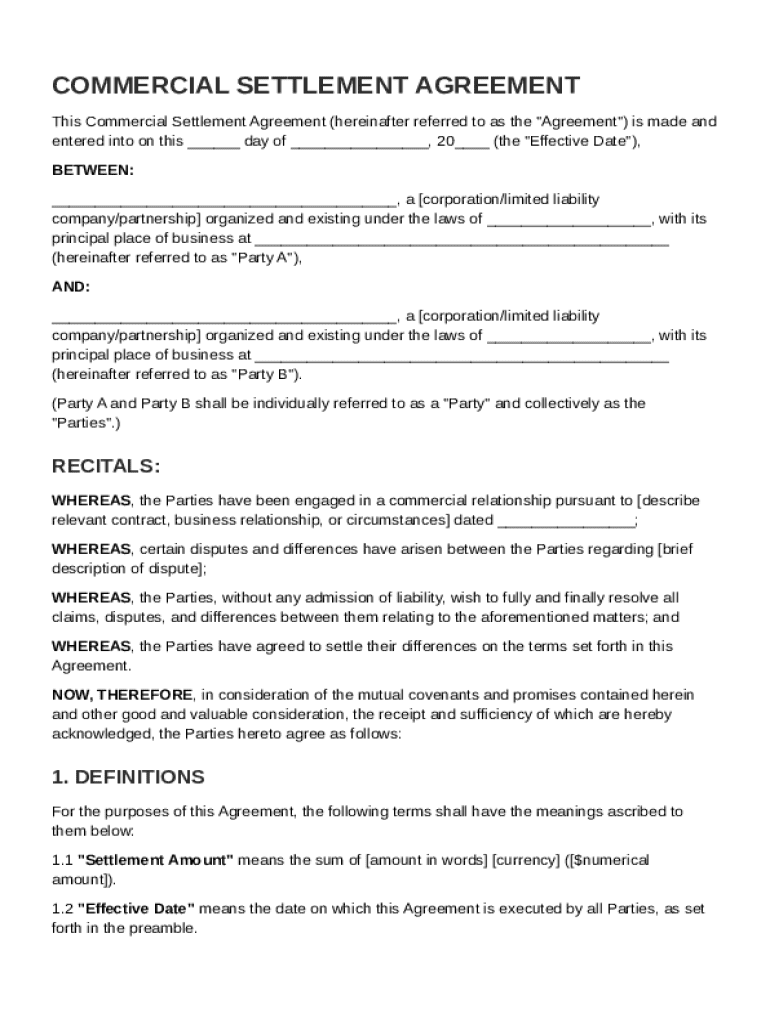
A Commercial Settlement Agreement Template is a legally binding document used to amicably resolve disputes between two commercial parties, typically referred to as Party A and Party B. It outlines specific terms that both entities agree upon, such as payment amounts, schedules, and other pertinent obligations, thereby officially ending any litigation or dispute between them. The completion of this form indicates a mutual agreement to resolve conflicts without admission of liability, thereby fostering a cooperative atmosphere for potential future interactions.
Key Features of a Commercial Settlement Agreement
- Payment Terms: Specifies how much will be paid by one party to the other, and under what schedule.
- Release of Liability: States that both parties waive any future claims related to the dispute.
- Confidentiality Clauses: Ensures that terms of the agreement remain private.
- Governing Law: Identifies which state's laws will dictate the execution of the agreement.
- Amendment Clauses: Outlines how any changes to the agreement should be documented and verified.
Key Elements of the Commercial Settlement Agreement Template
The template is designed to be comprehensive, covering all necessary aspects to ensure clarity and enforceability. Key elements typically found in this form include:
Payment Details
- A clear statement of the total settlement amount.
- Schedule for payment installments, if applicable.
- Method of payment, such as bank transfer or check.
Confidentiality Requirements
- Terms under which the settlement details must be kept confidential.
- Penalties for breaches of confidentiality.
Legal Considerations
- Clauses detailing the law governing the agreement, usually aligned with the location of the parties involved.
- Provisions for resolving future disputes, often through arbitration or mediation rather than litigation.
Legal Use of the Commercial Settlement Agreement Template
This document is primarily used to legally formalize a settlement between commercial disputes. The legality of its contents is supported by the ESIGN Act, ensuring that electronic signatures within the agreement are binding and enforceable in a court of law. The template assists businesses in avoiding protracted legal battles by settling disputes outside of court, with terms that both parties find agreeable.
Context for Legal Validity
- Must be signed by authorized representatives of both parties.
- Should be reviewed by legal advisors to ensure compliance with relevant laws.
- May require notarization in certain jurisdictions to be enforceable.
Steps to Complete the Commercial Settlement Agreement Template
Completing a Commercial Settlement Agreement Template involves several detailed steps to ensure all legal and procedural elements are appropriately covered.
- Identify the Parties: Clearly define Party A and Party B, with full legal names and addresses.
- Detail the Dispute: Provide a concise description of the dispute's nature, including any pertinent historical context.
- Outline Settlement Terms: Specify payment amounts, timelines, and any non-monetary agreements.
- Include Legal Provisions: Integrate confidentiality clauses, governing law, and dispute resolution mechanisms.
- Finalize the Agreement: Ensure all sections are completed, then proceed with signatures from the authorized individuals.
Who Typically Uses the Commercial Settlement Agreement Template
Primarily, businesses and legal professionals utilize the Commercial Settlement Agreement Template when resolving disputes stemming from commercial interactions. Various company types, such as corporations, LLCs, and partnerships, frequently rely on this document to avoid prolonged litigation and secure amicable resolutions.


Examples of Typical Users
- Corporate Entities: Resolve disputes over contractual breaches or service delivery failures.
- LLCs and Partnerships: Settle issues related to business operations, asset division, or fiduciary responsibilities.
- Legal Professionals: Use the template to draft agreements that will withstand legal scrutiny.
Important Terms Related to the Commercial Settlement Agreement Template
Understanding the lexicon associated with the Commercial Settlement Agreement Template helps in accurately completing and interpreting its contents.
Commonly Used Terms
- Arbitration: A process where a neutral third-party resolves disputes outside of court.
- Indemnification: Protection from potential losses or damages stipulated within the agreement.
- Counterparty: The other party with whom the agreement is being settled.
Why Should You Use the Commercial Settlement Agreement Template
Utilizing a Commercial Settlement Agreement Template offers multiple advantages in resolving disputes effectively and without litigation.
Notable Benefits
- Efficiency: Streamlines dispute resolution processes, minimizing time and resources spent.
- Cost-effectiveness: Reduces costs associated with legal proceedings by providing a predefined structure for settlements.
- Flexibility: Allows for tailored solutions that accommodate unique circumstances surrounding individual disputes.
State-Specific Rules for the Commercial Settlement Agreement Template
While the template can be broadly applied, it is vital to adjust it according to state-specific regulations governing commercial settlements.
Considerations by State
- States may have varying laws on whether notarization is required.
- Statutes of limitation impacting dispute claims could differ.
- States might have unique regulations on what constitutes a legally binding agreement.