
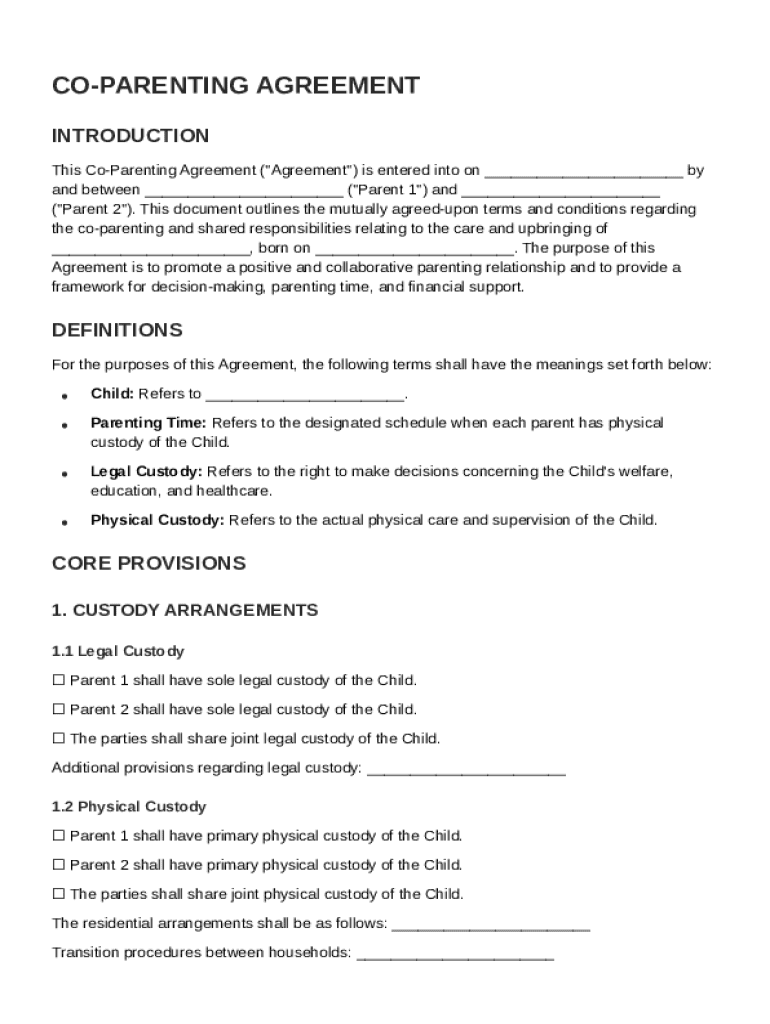







Definition and Purpose of a Co-Parenting Agreement Template
A Co-Parenting Agreement Template is a detailed document designed to outline the responsibilities and roles of both parents in shared parenting arrangements. This template is instrumental in establishing clear guidelines and expectations, reducing conflicts, and prioritizing the child's well-being. It facilitates structured communication regarding legal custody, parenting time schedules, decision-making processes, and financial obligations. The agreement serves as a strategic framework to help parents maintain a cooperative relationship post-separation, benefiting the child by providing consistent care and support.
Key Components
- Legal Custody: Specifies which parent has the authority to make decisions regarding the child's education, healthcare, and religious upbringing.
- Physical Custody: Outlines where the child will live and the logistics of parental visitation.
- Parenting Schedules: Details the regular schedule for when the child will spend time with each parent, including holidays and vacations.
- Financial Responsibilities: Specifies contributions for child support and other related expenses.
- Conflict Resolution: Provides a mechanism for resolving disputes without resorting to court proceedings.
How to Use the Co-Parenting Agreement Template
To effectively use the Co-Parenting Agreement Template, both parents need to collaborate on completing the form, ensuring all relevant details are accurately reflected. The template serves as a guide to structure the conversation and document the intricacies of each parent's duties and rights. Here’s how to proceed:
Step-by-Step Process
- Review Each Section: Familiarize yourself with the template's sections to understand the required information.
- Gather Necessary Information: Ensure both parents have access to relevant legal documents and financial records.
- Complete Sections Collaboratively: Fill out each part of the agreement, addressing all areas from custody to financial responsibilities.
- Seek Legal Advice: Consider consulting a legal professional to ensure that the agreement meets local legal standards.
- Finalize and Sign: Both parents should review the finalized document for accuracy before signing.
Key Elements of the Co-Parenting Agreement Template
The template includes several critical elements that ensure a comprehensive co-parenting plan:
Essential Clauses
- Decision-Making Process: Establishes procedures for major decisions affecting the child's welfare.
- Communication Guidelines: Outlines acceptable communication channels between parents regarding parenting matters.
- Parenting Logistics: Details transportation responsibilities and the exchange of the child between parents.
- Health Care Arrangements: Specifies how medical decisions will be made and costs shared.
- Educational Commitments: Details involvement in the child’s academic life, such as attending meetings and school events.
Legal Use of the Co-Parenting Agreement Template
In legal contexts, a Co-Parenting Agreement can be essential for establishing standardized arrangements between parents. This document is often used to support court motions or serve as a standalone contract between parents.
Legal Considerations
- Binding Nature: While not always legally binding, it can be enforced by the court if incorporated into a formal custody order.
- Court Approval: For additional legal weight, parents should consider having the agreement approved by a family court.
- Modifications: The agreement should include terms for modification, allowing flexibility if circumstances change.
Steps to Complete the Co-Parenting Agreement Template
Filling out a Co-Parenting Agreement requires careful attention to detail and communication between both parties:
Detailed Steps
- Initial Meeting: Schedule an initial discussion where both parents can agree on the scope and vision for the co-parenting arrangement.
- Draft Initial Agreement: Begin with a draft based on the template, covering each aspect of parenting and logistics.
- Negotiate Terms: Discuss and negotiate terms for any areas of contention or complexity.
- Review for Completeness: Ensure that all essential elements are included and fully detailed.
- Finalize Document: Once both parents are satisfied, add signatures and any additional witnesses if necessary.
Examples of Using the Co-Parenting Agreement Template
Various scenarios can illustrate the practicality of using a Co-Parenting Agreement:
Practical Scenarios
- Equal Responsibility Scenario: Both parents share equal custody, and the agreement divides time and responsibilities to avoid overlap.
- Long-Distance Parenting: One parent resides in another state, necessitating clear travel arrangements and scheduled digital communication.
- High-Conflict Relationships: In cases where parents struggle to cooperate, the agreement helps mediate discussions and reduce tensions.
Importance of Understanding State-Specific Rules
When creating a Co-Parenting Agreement, state-specific rules and regulations must be considered to ensure compliance. Laws affecting custody, child support, and modification procedures vary significantly by state.
State-Specific Considerations
- Legal Standards: Each state has distinct legal requirements influencing custody and visitation agreements.
- Support Calculations: Child support formulas can vary, affecting financial responsibilities outlined in the agreement.
- Enforcement and Modifications: Procedures for court enforcement and modifications of agreements differ across jurisdictions.
Important Terms Related to Co-Parenting Agreement Template
Familiarity with key terminology can aid in the process of creating a Co-Parenting Agreement:
Relevant Terms
- Custodial Parent: The parent who has the primary day-to-day care of the child.
- Non-Custodial Parent: The parent who does not have primary custody but typically has visitation rights.
- Visitation Schedule: The planned timetable for the non-custodial parent’s time with the child.
- Parental Responsibility: The obligations parents have in raising their child, such as emotional and financial support.
By focusing on these elements within the "Co-Parenting Agreement Template," both practical utilization and legal safeguards can be effectively enhanced, ensuring a cohesive and structured parenting strategy.




