
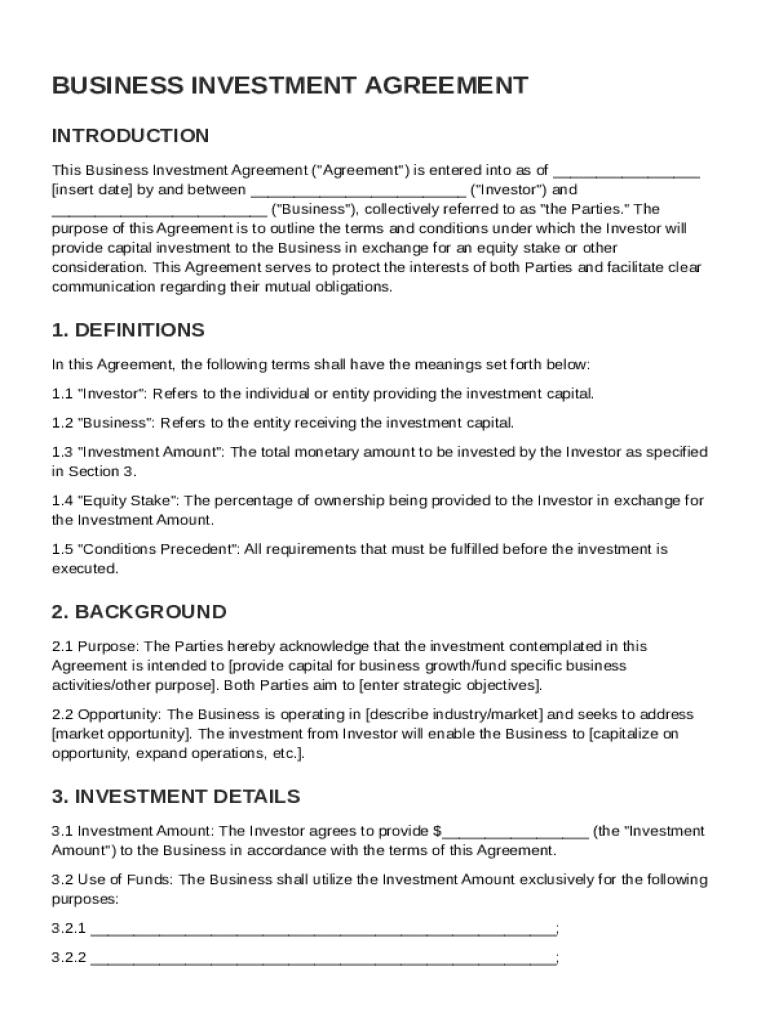







Definition & Meaning
The Business Investment Agreement Template is a legal document that outlines the terms under which an investor provides capital to a business in exchange for equity or other financial considerations. It serves as a formal agreement between the investor and the business entity, documenting essential aspects such as definitions, investment details, and conditions precedent. This template ensures both parties are aware of their rights and responsibilities, facilitating clear communication about the investment's implications.
Key Components
- Investors and Business Representation: Identifies involved parties, specifying their roles, rights, and obligations.
- Investment Details: Captures the amount of capital, equity percentage, or terms of the return on investment.
- Definitions and Terminologies: Covers specific language that may have distinct legal implications, ensuring both parties have a uniform understanding.
How to Use the Business Investment Agreement Template
Utilizing the Business Investment Agreement Template involves understanding the structure and integrating specific details to suit your transaction.
- Identify Participants: Clearly list the investor(s) and business entity, incorporating full legal names and contact information.
- Specify Terms: Detail the exact terms of investment, including the amount, form of investment (equity, loan, etc.), and any profit-sharing arrangements.
- Review Legal Terms: Familiarize yourself with legal terminologies within the template to avoid misunderstandings.
Practical Example
Consider a startup securing a $200,000 investment. Using the template, both parties can specify that the investor receives a 15% equity stake in exchange for the funds within the document's structured format.
Steps to Complete the Business Investment Agreement Template
Completing the Business Investment Agreement Template involves several detailed steps to ensure accuracy and comprehensiveness.
- Due Diligence: Conduct thorough research on the business’s financial status and operational history.
- Template Customization: Adjust standard clauses to fit the unique aspects of your investment.
- Lawyer Consultation: Seek legal advice to verify that the customized agreement complies with state and federal laws.
- Negotiation and Finalization: Both parties should negotiate terms, if necessary, before finalizing and signing.
Sample Steps
- Initial Review: Carefully read the entire template to map out areas requiring customization.
- Amend Clauses: Modify sections such as termination conditions based on mutual agreements.
- Sign and Seal: Once agreed upon, both parties sign the document with witnesses or notarial acknowledgment when needed.
Key Elements of the Business Investment Agreement Template
This template encapsulates several crucial elements that safeguard the interests of both parties involved in the investment.
- Conditions Precedent: Conditions that must be met before the agreement becomes effective.
- Covenants: Ongoing promises both parties commit to during the agreement's lifespan.
- Termination Conditions: Conditions under which the agreement could be ended, whether voluntarily or due to breaches.
In-depth Considerations
- Miscellaneous Provisions: Often overlooked but essential for ensuring clarity around procedural or unforeseen circumstances.
- Representations and Warranties: Both parties provide assurances regarding their capability and legal standing to engage in the investment.
Legal Use of the Business Investment Agreement Template
The template is instrumental for formalizing investment agreements, ensuring compliance with legal standards that protect both investor and business interests.
Compliance and Legitimacy
- Adherence to State Laws: Conforms to regulations that can vary significantly between states concerning investments, taxes, and business operations.
- ESIGN Act Compliance: Ensures that electronic agreements and signatures are legally binding, facilitating digital operations.
Case Study
A tech company in California uses this template to outline bylaws, mitigating potential legal disputes by ensuring all conduit channels are honestly documented.
Important Terms Related to Business Investment Agreement Template
Understanding these terms is critical to navigating the complexities of investment agreements effectively.
- Equity Stake: The percentage of ownership interest awarded to the investor.
- Valuation: The estimated worth of the business during the investment decision.
- Dilution: Refers to the decrease in existing shareholders’ ownership percentage due to new share issuance.
Practical Terminology Application
An investor receiving a 10% equity stake would need to comprehend potential dilution effects as the company might issue additional shares later.
Who Typically Uses the Business Investment Agreement Template
The template is commonly used by various stakeholders in business and investment realms.


Intended Users
- Startups: Often utilize this template when raising seed or venture capital.
- Investors: Use it to formalize terms and protect their investments in new business ventures.
- Legal Professionals: Lawyers may assist clients by customizing the template for specific transactions.
Example
A venture capital firm investing in multiple startups would use this template to uniformly apply investment terms while accommodating unique elements of each deal.
State-Specific Rules for the Business Investment Agreement Template
Different states may have varying legal regulations governing investment agreements, demanding specific adaptations of the template.
Variations by State
- California: Stringent disclosure requirements to protect investors.
- Texas: Simplified procedural norms but heavy emphasis on compliance with local investment laws.
Impact on Agreement
Businesses in New York might need to incorporate additional sub-clauses to tackle specific compliance mandates, altering the standard template structure.
Examples of Using the Business Investment Agreement Template
Practical applications of the template showcase its versatility and efficiency in documenting investment agreements.
Real-World Scenarios
- Tech Startup: A Silicon Valley firm raising capital through equity-based crowd-funding.
- Biotech Company: Seeking seed funding to conduct initial research and development phases.
Using specific, tailored examples helps stakeholders visualize how the template can be effectively implemented across diverse industries.




