
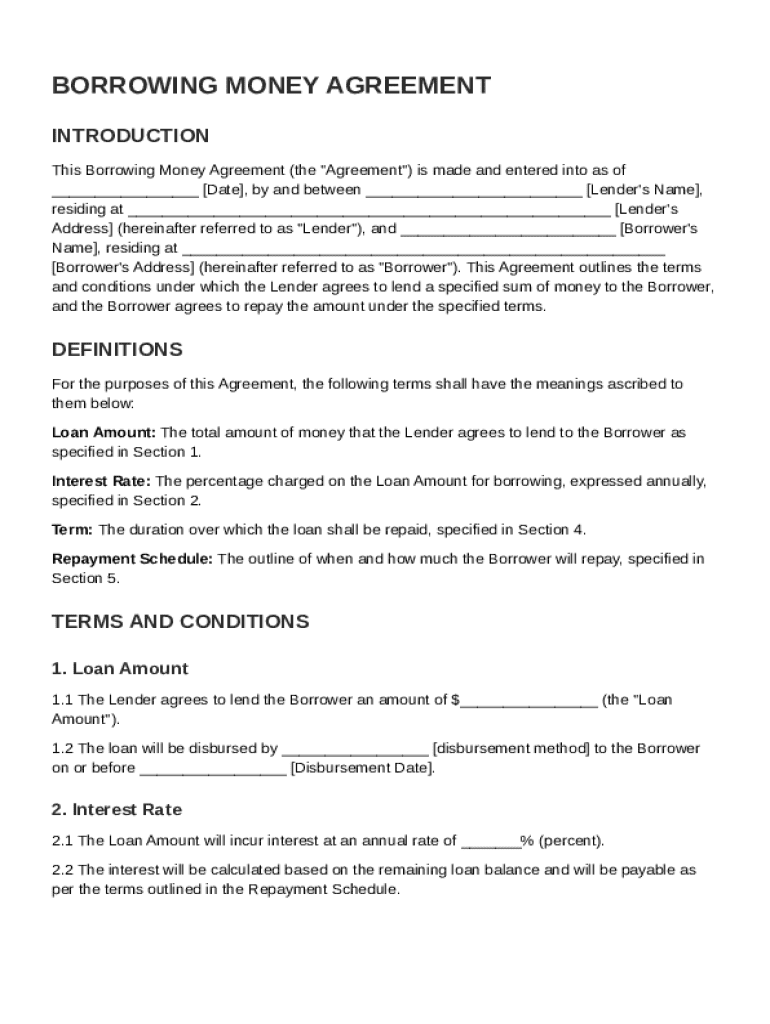







Definition & Meaning
The Borrowing Money Agreement Template is a formal document that specifies the terms under which a lender provides a loan to a borrower. This agreement includes critical details such as the loan amount, interest rate, repayment schedule, and conditions for default. It establishes a legal framework that governs the loan, offering protection and clarity to both parties involved. By requiring signatures from both lender and borrower, the agreement becomes a binding contract, ensuring all parties are accountable to the outlined terms.
Key Elements of the Borrowing Money Agreement Template
A comprehensive Borrowing Money Agreement Template should include several essential components to ensure clarity and enforceability:
- Loan Amount: Specifies the principal amount being borrowed.
- Interest Rate: Details the cost of borrowing expressed as a percentage.
- Repayment Schedule: Outlines the payment plan, including frequency and amounts.
- Security for Loan: Indicates whether collateral is involved and details of such collateral.
- Default Conditions: Defines what constitutes a breach of the agreement and potential penalties.
- Signatures: Finalizes the agreement through signed consent from both parties.
These elements ensure both parties have a clear understanding of their obligations and what to expect throughout the loan's lifespan.
How to Use the Borrowing Money Agreement Template
Using the Borrowing Money Agreement Template involves several steps to ensure it is properly completed and legally binding:
- Gather Information: Collect all necessary details, including the lender and borrower information, loan terms, and any collateral involved.
- Customize the Template: Modify the template to reflect specific agreement details, adjusting sections as needed for relevance.
- Review Terms: Both parties should thoroughly review the terms to ensure mutual understanding and agreement.
- Add Signatures: Ensure the agreement is signed by both the lender and borrower, and any witnesses if required.
- Store Safely: Keep copies of the signed document securely, in both physical and digital formats, for future reference or potential legal inquiries.
Steps to Complete the Borrowing Money Agreement Template
Completing the Borrowing Money Agreement Template involves a step-by-step process:
- Identify the Parties: Clearly state the names and contact information for both the borrower and the lender.
- Specify the Loan Details: Include the loan amount and terms, such as interest rate and repayment schedule.
- Outline Repayment Plan: Define deadlines for each payment installment and any late fees.
- Address Collateral: If applicable, provide details on any security being offered.
- Set Default Terms: Clearly state what actions will be taken in case of non-payment or breach of terms.
- Append Parties' Signatures: Both parties, alongside any required witnesses, must sign and date the document.
- Review for Accuracy: Double-check information for accuracy and completeness.
Legal Use of the Borrowing Money Agreement Template
In the United States, the Borrowing Money Agreement Template is legally binding if it meets the state's statutory requirements. Tailor each agreement to reflect applicable state laws, which may affect terms related to interest rates, loan amounts, and repayment schedules. Legal advice might be necessary to ensure compliance with these state-specific regulations and prevent any contract disputes in future.
Who Typically Uses the Borrowing Money Agreement Template
Both individuals and businesses employ the Borrowing Money Agreement Template to formalize loan arrangements. Common users include:
- Individuals: Those lending to or borrowing from friends or family members to formalize personal loans.
- Small Business Owners: Entrepreneurs seeking capital to fund their business ventures.
- Corporates: Companies securing financing for operations, acquisitions, or expansions.
These users benefit from the template's capacity to define terms clearly and mitigate misunderstandings or legal disputes.


State-Specific Rules for the Borrowing Money Agreement Template
Each state in the U.S. may impose specific regulations concerning lending agreements. Key state-specific considerations include:
- Usury Laws: Limits on the interest rate that can be charged on loans.
- Document Requirements: Additional disclosures or terms that must be included in the agreement.
- Witness Requirements: Certain states may require witnesses or notarization for the agreement to be enforceable.
Understanding and incorporating these state-specific rules are essential for creating a valid borrowing money agreement.
Important Terms Related to the Borrowing Money Agreement Template
Familiarity with specific terms aids in comprehension and effective use of the Borrowing Money Agreement Template:
- Principal: The original loan amount before interest.
- Amortization: The process of repaying a loan through regular installments over time.
- Collateral: An asset offered as security for the loan.
- Usury: Charging interest at rates exceeding legal limits.
- Default: Failure to repay the loan under agreed terms.
These terms form the foundational language of loan agreements and are crucial for anyone involved in drafting or signing such a document.




