






Definition & Meaning
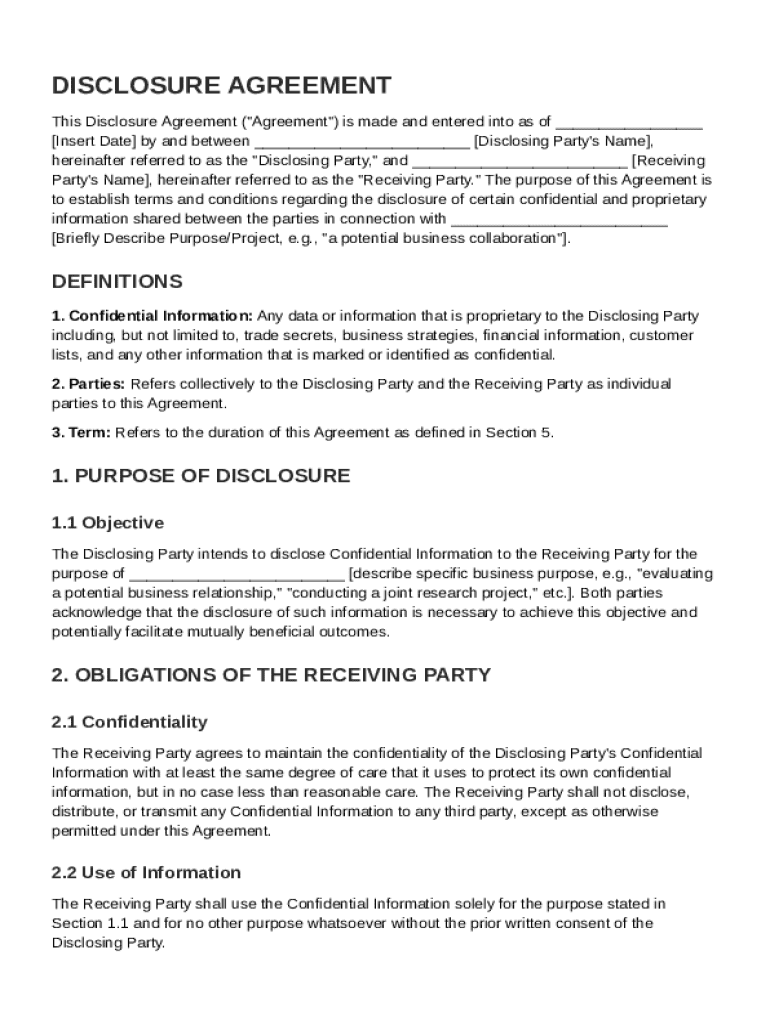
The Disclosure Agreement Template is a formal legal document that establishes the framework for sharing confidential information between a Disclosing Party and a Receiving Party. This agreement is crucial for entities evaluating potential business collaborations, as it delineates the types of information considered confidential and sets the guidelines for usage. The template typically defines 'Confidential Information,' outlines the responsibilities of both parties regarding confidentiality, and specifies the terms under which the information can be disclosed. This agreement is pivotal in protecting intellectual property and sensitive business data from unauthorized disclosure.
Key Elements of the Disclosure Agreement Template
Confidential Information
The cornerstone of any Disclosure Agreement is the precise definition of what constitutes 'Confidential Information.' This section may include technical data, trade secrets, business strategies, client lists, or any proprietary details crucial to the Disclosing Party. Clearly enumerating these elements helps prevent ambiguity and ensures the Receiving Party understands what information is protected under the agreement.
Obligations of the Receiving Party
An essential component is outlining the obligations of the Receiving Party. These obligations usually include maintaining the confidentiality of the disclosed information, using it solely for the agreed-upon purpose, and taking reasonable measures to protect it from unauthorized access. By detailing these responsibilities, the agreement holds the Receiving Party accountable for any breach of confidentiality.
Exclusions from Confidentiality
The agreement should also specify what information does not fall under the auspices of confidentiality. Common exclusions are that information is already publicly available, was independently developed by the Receiving Party without reference to the Disclosing Party's confidential information, or is disclosed by a third party without breach of any obligation of confidentiality.
Steps to Complete the Disclosure Agreement Template
-
Gather Required Information: Collect all necessary details about the parties involved, including names, addresses, and any specific designations within their respective organizations.
-
Define Confidential Information: Explicitly list what will be classified as confidential. This step is crucial to ensure both parties have a mutual understanding of what information needs protection.
-
Detail Responsibilities and Obligations: Outline the responsibilities of the Receiving Party, ensuring clarity on how the information can be used and stored.
-
Specify Duration: Determine how long the confidentiality obligations will remain in force. This period could vary from one year to indefinitely, based on the nature of the relationship and information shared.
-
Review and Adjust State-Specific Requirements: If applicable, modify the template to align with any state-specific legal requirements which might affect the terms of confidentiality.
-
Finalize and Sign: After reviewing all sections for accuracy and completeness, both parties should sign the document to formalize the agreement, making it legally binding.
Legal Use of the Disclosure Agreement Template
In the U.S., Disclosure Agreements are legally enforceable, governed by state and federal laws. They are particularly vital in business environments where proprietary information is exchanged, ensuring that such exchanges do not result in unauthorized disclosure or misuse. The agreement acts as a contract, which, if breached, could lead to legal actions, including injunctions or financial damages. The specific legal protections afforded by these agreements typically fall under the framework provided by legislation like the Uniform Trade Secrets Act.
Who Typically Uses the Disclosure Agreement Template


Business to Business Interactions
Companies often use Disclosure Agreements when exploring partnerships, mergers, or acquisitions. They ensure that shared business models, strategic plans, and other critical documents remain confidential during negotiations.
Startups and Investors
Startups frequently rely on these agreements when pitching ideas to potential investors. It provides assurance that novel concepts and business strategies remain protected while funding discussions are underway.
Employees and Contractors
Employees and independent contractors may be required to sign a Disclosure Agreement to protect sensitive company information accessed during their tenure. Ensuring such legal protections prevents the unauthorized sharing of company data post-termination of their relationship with the entity.
Important Terms Related to Disclosure Agreement Template
-
Non-Disclosure Clause: A section within the agreement that explicitly prohibits the Receiving Party from revealing the Disclosing Party’s confidential information to third parties.
-
Term and Termination: Refers to the duration during which the confidentiality obligations persist and under what conditions the agreement can be terminated prematurely.
-
Remedies Clause: Specifies the legal remedies available to the Disclosing Party in the event of a breach, which might include monetary damages or specific performance.
Variations and Edge Cases
While many Disclosure Agreements follow a standard template, certain scenarios may call for custom provisions. These might include expanded non-compete clauses, specific duration extensions unique to the industry, or explicit third-party disclosures under regulatory compliance.
Business Types That Benefit Most from Disclosure Agreement Template
Technology Companies
Given that tech companies often deal with cutting-edge research and development, protecting proprietary information through Disclosure Agreements is critical. It safeguards innovations and technological advances from being shared prematurely.
Pharmaceutical and Biotech Firms
These industries rely heavily on research data, making confidentiality paramount during drug development and trials. Disclosure Agreements help protect sensitive data and intellectual property during collaboration with contract research organizations or joint ventures.
Digital vs. Paper Version
The advent of digital document processing platforms like DocHub provides the flexibility of handling Disclosure Agreements in both digital and paper formats. A digital version allows real-time sharing, ease of editing, and secure electronic signing, making it highly suitable for remote or geographically dispersed teams. Conversely, a paper version might be preferred in circumstances where digital access is limited or for traditional record-keeping practices.