
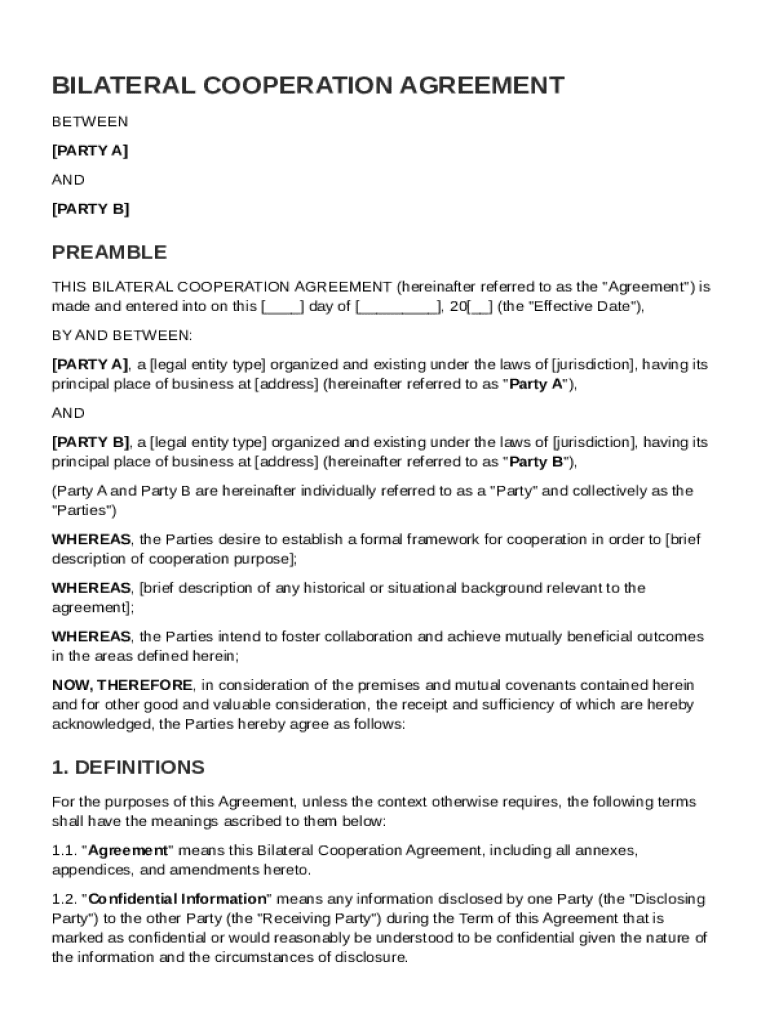







Definition and Meaning
A Bilateral Agreement Template serves as a foundational document for agreements between two parties intending to work together. It outlines the terms and conditions of the collaboration, covering critical aspects like the roles and responsibilities of each party, the scope of cooperation, and financial arrangements. This template is pivotal for creating formal partnerships to ensure clarity and mutual understanding. Bilateral agreements are used in various contexts, including business, legal, and international relations, ensuring both parties have a clear and enforceable understanding of their mutual commitments.
Key Elements of the Bilateral Agreement Template
Understanding the key components within a Bilateral Agreement Template helps in effectively drafting and executing the document. These elements include:
- Definitions: Clearly define terms used throughout the agreement to avoid ambiguities.
- Scope of Cooperation: Outline the specific areas and objectives of collaboration between the parties.
- Roles and Responsibilities: Specify what each party is expected to deliver and their respective duties.
These components are essential in avoiding disputes, ensuring each party understands their duties, and providing a framework for measuring performance against agreed objectives.
Steps to Complete the Bilateral Agreement Template
Completing a Bilateral Agreement Template is a structured process that requires attention to detail:
- Initial Draft: Begin by filling in general information about the parties involved.
- Outline Scope and Objectives: Clearly articulate the purpose of the agreement and what each party intends to achieve.
- Define Terms and Conditions: Specify responsibilities, timelines, and financial obligations.
- Review and Revise: Both parties should review the draft and suggest revisions to ensure mutual understanding.
- Approval and Signatures: Once both parties agree to the terms, proceed with obtaining signatures for finalization.
This systematic approach ensures that the final agreement is robust, comprehensive, and aligned with the parties' interests.
Legal Use of the Bilateral Agreement Template
Legally, a Bilateral Agreement Template binds the parties to comply with stipulated terms, providing a legal framework for resolving potential disputes. By adhering to the ESIGN Act, electronic signatures used in the agreement carry the same weight as handwritten ones. The document reinforces legal commitments and offers a foundation for legal protections, should either party default. Understanding these legal implications is crucial for both entities, ensuring the agreement stands enforceable in a court of law.
Important Terms Related to Bilateral Agreement Template
Certain terms within the Bilateral Agreement Template are crucial for clarity and legal compliance:
- Confidentiality Clauses: Protect sensitive information exchanged during the agreement.
- Dispute Resolution Mechanisms: Outline processes for addressing disagreements, such as mediation or arbitration.
- Intellectual Property Rights: Define ownership and usage rights for any intellectual property resulting from the collaboration.
Grasping these terms ensures that the agreement comprehensively covers and protects the interests of all parties involved.
Who Typically Uses the Bilateral Agreement Template
The template is widely used by:
- Corporate Entities: For partnerships or joint ventures across various industry sectors.
- Governmental Bodies: In establishing international or inter-agency collaboration.
- Non-Profit Organizations: When formalizing partnerships with other non-profits or sponsoring entities.
These entities utilize bilateral agreements to establish clear terms of cooperation and to guide their collaborative efforts towards successful outcomes.


Examples of Using the Bilateral Agreement Template
Real-world applications of the Bilateral Agreement Template include:
- A technology company collaborating with a university to develop new software solutions.
- Two countries drafting agreements on resource sharing.
- Non-profit organizations allying for a community development project.
These examples illustrate the template's versatility in accommodating diverse partnerships, reinforcing its utility across different organizational landscapes.
Versions or Alternatives to the Bilateral Agreement Template
Different versions or alternatives might exist based on specific needs:
- Multilateral Agreements: Involve more than two parties and are suitable for consortiums or multinational collaborations.
- Memorandum of Understanding (MOU): Less formal than a binding agreement and often precedes the development of a formal bilateral agreement.
Understanding these variations aids in selecting the most appropriate document template for specific partnership goals.
Software Compatibility with Bilateral Agreement Template
DocHub provides seamless integration with popular digital platforms, making it easy to draft, edit, and finalize Bilateral Agreement Templates. Users can:
- Import and export documents to and from Google Drive and other cloud services.
- Use various formats such as DOC and PDF for compatibility with different software programs like Microsoft Word or Adobe Acrobat.
This flexibility ensures the template can be accessed, edited, and shared conveniently, facilitating efficient collaboration between parties.
Business Types that Benefit Most from Bilateral Agreement Template
The use of a Bilateral Agreement Template is highly beneficial for:
- Startups and Small Enterprises: Establishing partnerships to leverage resources or market reach.
- International Corporations: Structuring joint ventures or strategic alliances internationally.
- Technology Firms: Collaboratively developing innovations or sharing technical expertise.
Understanding the types of businesses that benefit most can guide organizations in leveraging these agreements to achieve strategic goals.




