01. Edit your form online
Type text, add images, blackout confidential details, add comments, highlights and more.

Type text, add images, blackout confidential details, add comments, highlights and more.

Draw your signature, type it, upload its image, or use your mobile device as a signature pad.

Send it via email, link, or fax. You can also download it, export it or print it out.
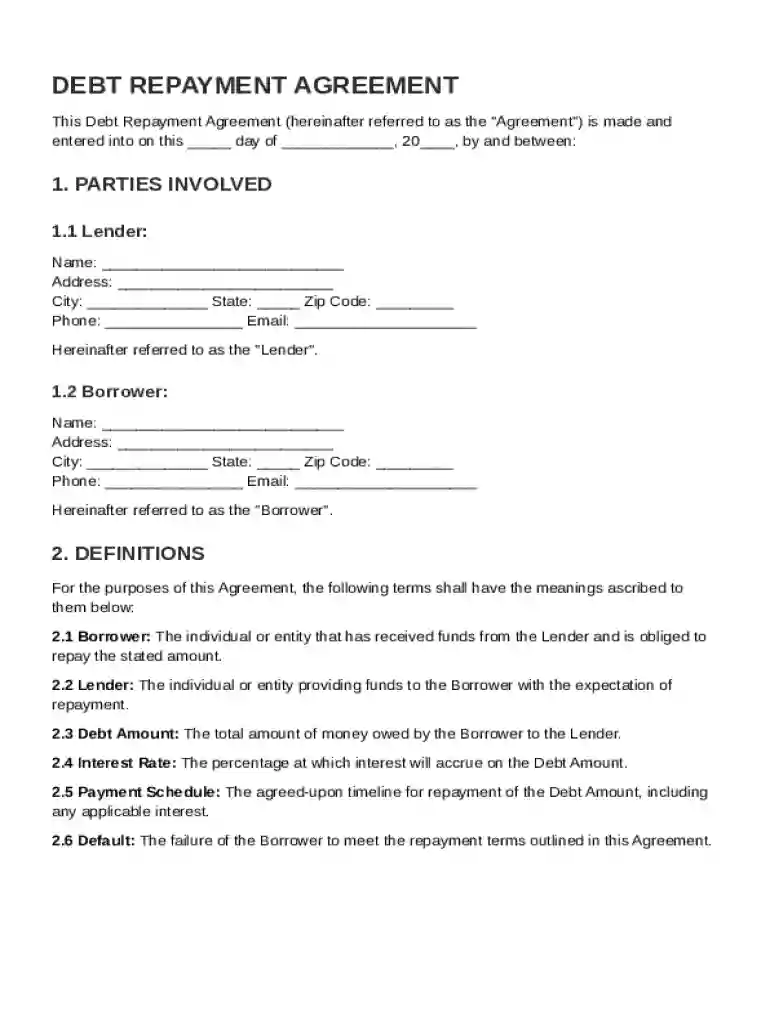
A Debt Repayment Agreement is a legal document designed to outline the terms between a lender and a borrower regarding the repayment of a specified debt amount. This agreement typically includes critical details such as the total debt amount, interest rates, payment schedules, and conditions for default. By clearly detailing the obligations of both parties, it serves as a comprehensive framework to ensure clarity and enforceability in the repayment process.
The Debt Repayment Agreement Template includes several essential components that ensure the contract's comprehensiveness and applicability:
Principal Amount: The total amount of money owed by the borrower.
Interest Rate: The agreed-upon rate at which interest on the debt will accrue.
Repayment Schedule: Specific dates and amounts for each payment, ensuring a structured repayment plan.
Methods of Payment: Acceptable forms of repayment, such as bank transfer, check, or digital payment platform.
Default Conditions: Conditions and penalties that will apply if the borrower fails to meet payment obligations.
Governing Law: The legal framework under which the agreement is enforceable, often dictated by state laws.
Amendments Clause: Details on how the agreement may be modified, ensuring mutual consent for any changes.
To effectively utilize the Debt Repayment Agreement Template, follow these steps:
Gather Information: Collect all necessary details, including the lender and borrower’s names, the principal loan amount, and interest rates.
Customize the Template: Enter the gathered information into the template, making adjustments for any unique circumstances of the agreement.
Review Legal Requirements: Ensure all included terms comply with legal standards applicable in the agreement’s jurisdiction.
Seek Legal Advice: For added assurance, consult a legal professional to review the completed agreement for accuracy and compliance.
Finalize the Agreement: Once everything is reviewed and agreed upon by both parties, the document can be signed electronically or physically.
Completing the template requires careful attention to detail to ensure all terms are clear and enforceable:
Identify Parties Involved: Clearly state the names and contact information of both the lender and the borrower.
Detail the Principal and Interest Rates: Specify the amount of debt and any interest rates that apply.
Outline Payment Structure: Define the frequency and amount of each payment.
Describe Default Terms: Include specifics on what constitutes a default and the subsequent repercussions.
Add Amendment Provisions: State how changes to the agreement can be made.
Document Signatures: Include space for signatures from both parties and any witnesses.
In the United States, the Debt Repayment Agreement is subject to federal and state laws ensuring the legality of its provisions:
Comprehensiveness: Each agreement must be complete and include all necessary legal elements.
Adherence to Usury Laws: Interest rates should not exceed legal limits, which vary by state.
Binding Nature: Once signed by both parties, the agreement becomes a legally binding contract.
Confidentiality: The agreement should protect sensitive information and specify confidentiality terms if necessary.
The Debt Repayment Agreement Template is versatile and can be utilized by various parties:
Individual Lenders and Borrowers: For personal loans between individuals.
Financial Institutions: As part of loan documentation.
Business Partnerships: To formalize loans made within business contexts.
Family Loans: When documenting informal loans between family members to prevent misunderstandings.


Consider these scenarios where a Debt Repayment Agreement is advantageous:
Personal Loan between Friends or Family: Provides a formal structure to ensure repayment and maintain relationships.
Business Loan for Startups: Clearly outlines repayment terms, which is crucial for maintaining investor trust.
Refinancing Agreements: When consolidating existing debts, this agreement can help restructure and clarify terms.
Understanding specific terminology within the agreement is essential:
Principal: The original sum of money borrowed.
Amortization Schedule: A table detailing each periodic payment on a loan, showing principal and interest.
Collateral: Asset pledged as security for the repayment of a loan.
Grace Period: A set time post-due date where payment can be made without penalty.
Prepayment Penalty: A fee imposed on a borrower if they pay off the debt before the agreed schedule.
At DocHub, your data security is our priority. We follow HIPAA, SOC2, GDPR, and other standards, so you can work on your documents with confidence.