
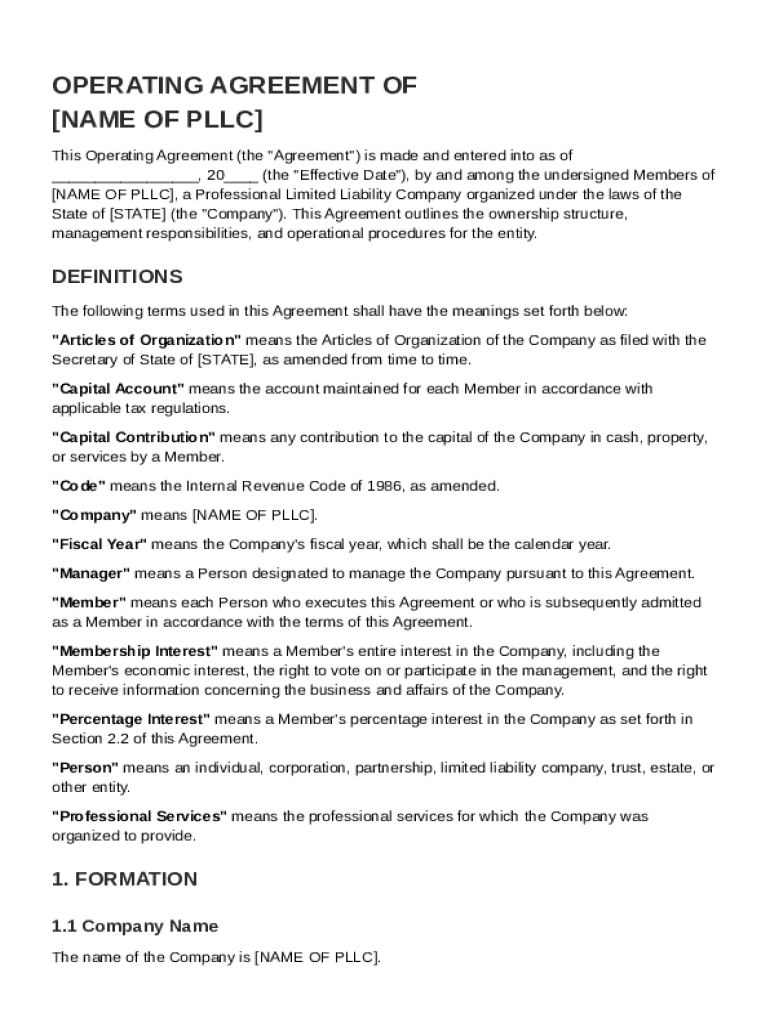







Definition and Meaning
A PLLC Operating Agreement Template is a foundational legal document tailored for Professional Limited Liability Companies (PLLCs). This agreement outlines the ownership structures, management responsibilities, and operational procedures of the company. It is essential for ensuring that all members of the PLLC are on the same page regarding their rights, obligations, and responsibilities. Such agreements are especially crucial in industries requiring professional licenses, such as law or medicine, to delineate boundaries and maintain compliance with industry standards.
Purpose of the PLLC Operating Agreement
- Govern member relationships: The agreement serves to clearly define the relationships among members to prevent disputes.
- Define ownership and contributions: Clarity on capital contributions and ownership percentages is established.
- Outline decision-making processes: Establish protocols for decision-making within the company.
- Ensure compliance: Helps the PLLC comply with state-specific laws and regulations.
Key Elements of the PLLC Operating Agreement Template
An effective PLLC Operating Agreement Template should include several critical elements. These elements help ensure that all aspects of the company's operations and governance are covered comprehensively.
Membership and Capital Contributions
- Member roles: Define roles and responsibilities for each member.
- Initial capital contributions: Detail the financial contributions made by each member at the outset.
- Future contributions: Outline how additional capital needs will be addressed.
Management Structure
- Management roles: Specify who will manage the PLLC and what their specific powers are.
- Voting rights: Describe how voting rights are allocated among members.
- Meetings: Outline the frequency and nature of official meetings.
Financial Matters
- Profit distribution: Explain how profits and losses will be divided among members.
- Banking: Cover procedures for handling company bank accounts.
- Taxes: Discuss how taxes will be managed and what kind of tax treatment the PLLC will opt for.
Steps to Complete the PLLC Operating Agreement Template
Creating a solid PLLC Operating Agreement involves several steps to ensure that all necessary information is thoroughly covered.
- Collect Member Information: Gather names, addresses, and professional credentials.
- Define Company Purpose: Clearly state the primary purpose of the PLLC.
- Assign Roles and Responsibilities: Determine who will hold managerial roles and their scope of authority.
- Establish Meeting Procedures: Define how often meetings will be held and the protocol for making decisions.
- Outline Financial Contributions: Detail initial and future capital contributions from each member.
- Set Guidelines for Amending the Agreement: Provide a process for amending the operating agreement as needed.
Important Considerations
- Unanimous approval: Ensure all members agree on the final draft.
- Legal review: Seek legal advice to guarantee compliance with state laws.
- Record keeping: Document all versions and amendments for future reference.
Legal Use of the PLLC Operating Agreement Template
The operating agreement is not just a formality; it holds significant legal authority within the framework of a PLLC.
Compliance and Legal Recognition
- Legal standing: The agreement can serve as evidence in legal proceedings if disputes arise among members.
- State compliance: Align with state-specific legal requirements to ensure validity and enforceability.
- Amendments: All changes must be documented and agreed upon according to the protocols established therein.
State-Specific Rules for PLLC Operating Agreement Template
Rules governing PLLCs can vary significantly from one state to another, which makes it vital for the operating agreement to comply with the specific regulations of the state in which the PLLC operates.
Variable Elements by State
- Licensing requirements: Some states mandate professional licenses for all members.
- Filing requirements: Varying requirements for filing and maintaining operating agreements.
- Exclusive provisions: Certain states may have unique clauses that must be included in the agreement.
Examples of Using the PLLC Operating Agreement Template
Practical examples illustrate how the PLLC Operating Agreement can be applied effectively in different scenarios.
Common Applications
- Professional partnerships: Used in law or accounting firms where clear delineation of responsibilities is crucial.
- Medical practices: Ensures compliance with healthcare regulations while clearly setting out management roles.
- Specialized engineering firms: Addresses specific licensing and liability issues unique to the engineering field.
Real-World Scenarios
- Conflict resolution: The agreement can provide a framework for resolving member disputes.
- Expansion plans: Outlining protocols for admitting new members and diluting ownership stakes.
- Dissolution procedures: Offers a clear pathway for dissolving the company if necessary.
Required Documents for Completing the Template
A comprehensive PLLC Operating Agreement requires several supporting documents to ensure its legality and efficacy.
Essential Documentation
- Articles of Organization: The initial filing document to legally form the PLLC.
- Professional licenses: Verification of the professional licenses required for each member.
- Tax ID numbers: Document the EIN and any relevant state tax identification numbers.
Who Typically Uses the PLLC Operating Agreement Template
Understanding who typically utilizes such templates can clarify its importance.


Primary Users
- Professional service providers: Legal practitioners, medical professionals, and other licensed professionals.
- New business owners: Entrepreneurs starting a professional service company.
- Existing businesses restructuring: Firms transitioning to a PLLC model for liability protection.
Incorporating the Template into Business Operations
- Start-ups: Establishes a sound initial governance framework.
- Expanding professionals: Easy transition into a structured, scalable business entity.
- Merged entities: Harmonizes operations and member responsibilities in merged or partnered ventures.




