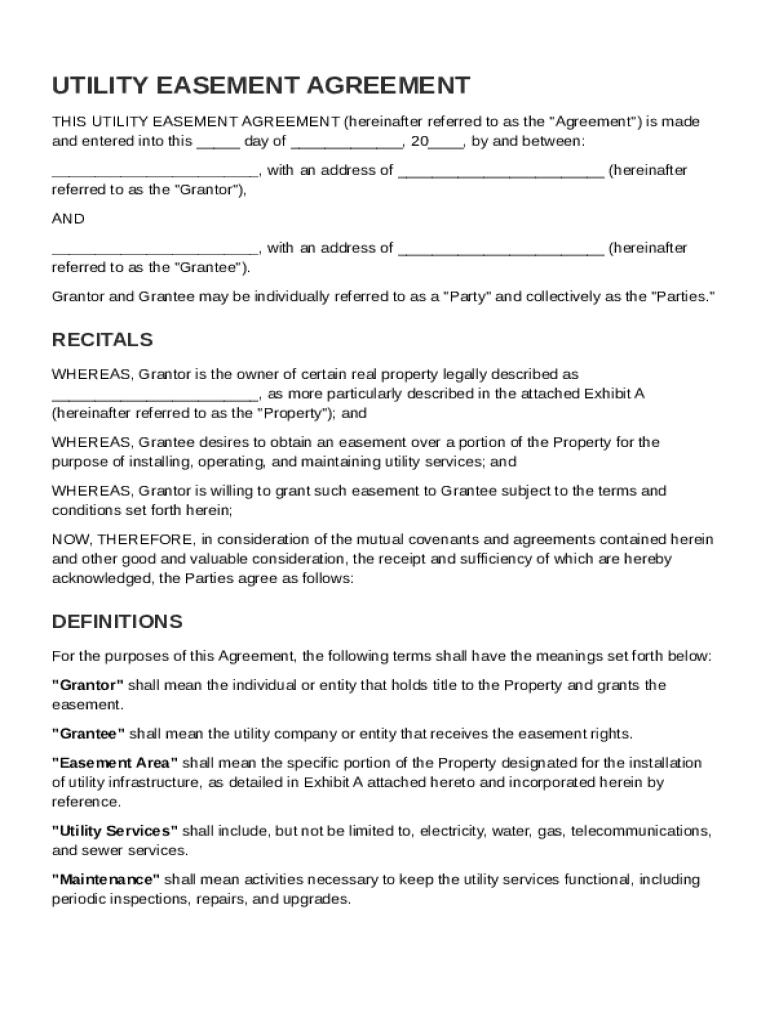







Definition & Meaning
A Utility Easement Agreement is a legal document that establishes the terms under which a property owner, known as the Grantor, grants a utility company, referred to as the Grantee, a right to access a designated section of their property. This access is essential for the installation, maintenance, and operation of utility services such as water, electricity, gas, and telecommunications. The agreement ensures that while utilities can be provided efficiently, the property owner's rights and interests are protected. Different from a land transfer, this arrangement does not grant ownership of the land but allows usage for specific purposes related to the utilities.
Key Elements of the Utility Easement Agreement Template
The Utility Easement Agreement Template is comprehensive, covering several critical components that must be clearly articulated to avoid future disputes. Key elements typically include:
- Easement Area Description: A precise definition of the exact area on the property where the easement rights apply. This often includes legal descriptions, maps, or plans.
- Rights and Obligations: Outline the rights, such as access for maintenance and operation, and obligations of both parties.
- Compensation Terms: Details any financial arrangements or compensation given to the property owner for granting the easement.
- Indemnification Clauses: Provisions that protect the property owner from any liabilities arising from the utility company's use of the property.
- Termination Conditions: Terms under which the easement agreement can be terminated, including breaches of contract or completion of utility needs in the area.
Steps to Complete the Utility Easement Agreement Template
- Gather Necessary Information: Collect details about both parties, the utility company, and the property. This includes contact details and legal property descriptions.
- Define the Easement Area: Clearly mark and describe the portion of the property being used, employing maps and legal descriptions for clarity.
- Outline Rights and Responsibilities: Ensure both parties agree on their respective responsibilities and how utilities will be managed and maintained.
- Include Compensation Details: If applicable, specify the form and amount of compensation to be paid to the Grantor.
- Draft Indemnification and Termination Clauses: Include clauses that protect both parties and determine conditions for termination.
- Review and Finalize: Both parties should review the terms for accuracy, ensuring legal compliance.
- Signatures and Notarization: Secure signatures from all involved parties and notarize the document to ensure its legal standing.
Legal Use of the Utility Easement Agreement Template
The legal use of the template serves to formalize the arrangement between property owners and utility providers, ensuring compliance with local laws and ordinances. The agreement is legally binding once signed and typically requires notarization to be enforceable in a court of law. It is crucial for both parties to ensure that the agreement meets all statutory requirements, especially those specific to the jurisdiction where the property is located. Grantors may wish to consult with legal counsel to confirm all legal obligations are met and the document is executed correctly.
Important Terms Related to Utility Easement Agreement Template
Understanding key terms used in the agreement is crucial for both parties:
- Easement: The right granted by a property owner permitting another party to use the property for a specific purpose.
- Grantor: The property owner who provides the easement right.
- Grantee: The utility company that receives the easement right.
- Non-exclusive Easement: The right to use the property is not exclusive to one utility but can be shared with others.
- Encumbrance: Any claim, liability, or condition that affects the property's use.
- Public Utility: An organization providing essential services like water, electricity, or gas to the public.
State-Specific Rules for the Utility Easement Agreement Template
State laws can significantly impact the terms and enforceability of a Utility Easement Agreement. Each state may have varying rules regarding:
- Recording Requirements: Some states require that easement agreements be recorded in the county’s land records to be legally enforceable.
- Statutory Time Limits: Limitations on how long an easement can legally remain in effect, often state-specific.
- Environmental Compliance: States like California may impose additional requirements concerning environmental protection.
- Access Rights: Each state defines the extent of ingress and egress rights, impacted further by municipal regulations.
Examples of Using the Utility Easement Agreement Template
Real-world scenarios demonstrate the utility of the agreement:
- Urban Development: In cities, utility companies frequently use easements to run power lines or sewage systems through private properties. For example, a San Francisco homeowner might grant an easement to a utility company to place underground cables.
- Rural Infrastructure Projects: For large agricultural lands in Texas, easements may be necessary for water pipelines or renewable energy projects, facilitating expansion while compensating landowners.
Who Typically Uses the Utility Easement Agreement Template
The Utility Easement Agreement Template is utilized by a variety of stakeholders:
- Utility Companies: To ensure they have legal access to private property for the development and maintenance of infrastructure.
- Real Estate Developers: When planning neighborhoods or commercial properties requiring new utility lines.
- Residential Property Owners: Who need to formalize existing informal agreements with utility providers.
- Municipal Governments: As part of public works projects that involve private land.
These entities rely on such templates to navigate complex legal requirements while maintaining clear communication and protecting their interests.