






Definition & Meaning
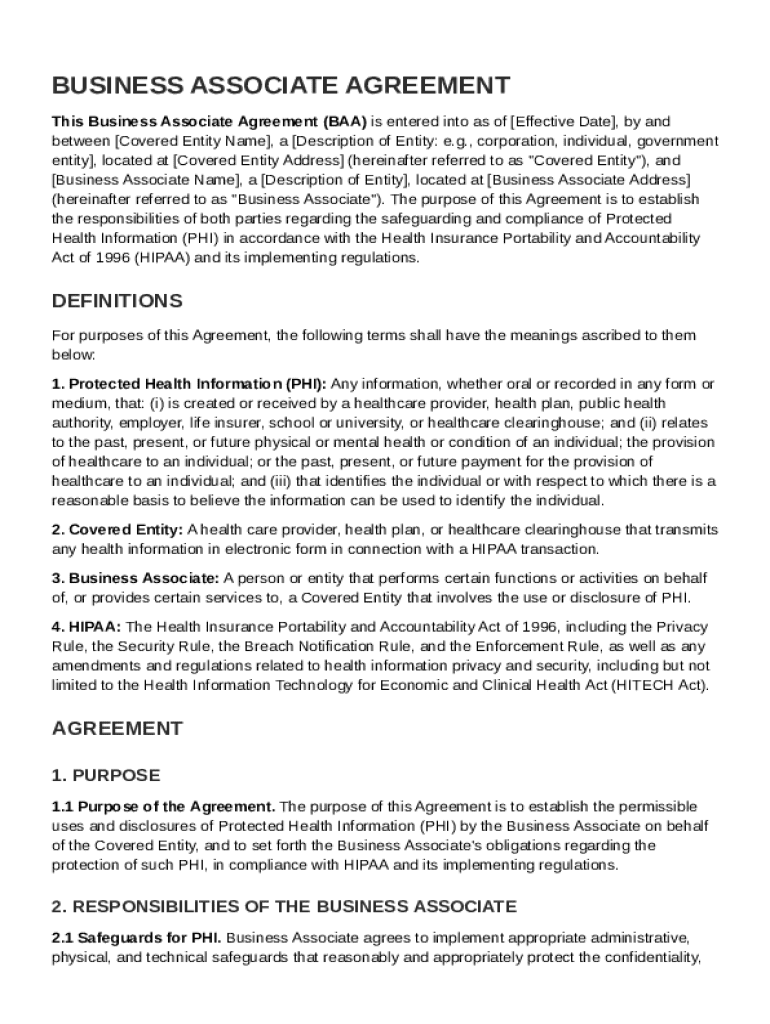
The HIPAA Compliant Business Associate Agreement Template serves as a legally binding document that outlines the obligations and responsibilities between a Covered Entity and a Business Associate in protecting Protected Health Information (PHI). Created under the mandates of the Health Insurance Portability and Accountability Act (HIPAA), this agreement ensures that PHI is handled, disclosed, and safeguarded in compliance with federal regulations. It defines essential terms, stipulates acceptable uses and disclosures of PHI, and mandates necessary safeguards to protect sensitive health information. Such agreements are crucial for maintaining trust and legal compliance between organizations handling PHI.
Example Scenario
Consider a healthcare provider (Covered Entity) that engages a billing company (Business Associate) to manage its medical billing process. The HIPAA Compliant Business Associate Agreement would clearly define the billing company's obligations to protect any PHI it accesses or transmits.
How to Use the HIPAA Compliant Business Associate Agreement Template
Step-by-Step Usage
-
Review the Template: Carefully read through the entire document to understand the roles and specific provisions.
-
Customize the Template: Fill in the necessary details specific to your organization and the business associate, such as names, addresses, and contact information.
-
Define Necessary Terms: Adjust the template to include any specific definitions required by your operation that aren’t already covered.
-
Set Permissible Uses: Clearly define acceptable uses and disclosures of PHI in your context.
-
Establish Safeguards: Detail the physical, administrative, and technical safeguards that the Business Associate must implement.
-
Legal Review: Consider having the document reviewed by legal counsel to ensure all clauses meet specific legal and organizational requirements.
Practical Examples
For a health technology company providing cloud storage solutions, the agreement should focus on data protection measures and access controls.
Key Elements of the HIPAA Compliant Business Associate Agreement Template
Core Components
- Definitions: Establish key terms such as "PHI," "Business Associate," and "Covered Entity."
- Permissible Disclosures: Specify the circumstances under which PHI may be disclosed.
- Safeguard Mandates: Outline the security measures required to protect PHI from unauthorized access or breaches.
- Breach Notification: Detail the protocols for notifying the Covered Entity of any breaches involving PHI.
- Termination Clauses: Include conditions under which the agreement may be terminated, including breaches of terms.
- Indemnification and Liability: Define liability limitations and indemnification for both parties.
Detailed Context
A small clinic outsourcing its data analysis should ensure that the agreement clearly specifies the analysis company's limitation on PHI access and their obligation to report any data incidents immediately.
Who Typically Uses the HIPAA Compliant Business Associate Agreement Template


Organizations Engaging in PHI Handling
- Healthcare Providers: Hospitals, clinics, and dental practices that outsource services like billing or IT support.
- Third-Party Vendors: Companies that provide services such as cloud storage, data analysis, or electronic health record management.
- Insurance Companies: Entities managing patient records or conducting audits on behalf of healthcare providers.
Practical Applications
In an alliance between a telemedicine service and a data hosting provider, the latter must sign a BAA to ensure PHI is securely managed.
Steps to Complete the HIPAA Compliant Business Associate Agreement Template
Completion Process
-
Preparation: Gather all needed information from both parties.
-
Customization: Use online tools like DocHub to fill out sections pertinent to both parties' operations.
-
Review: Ensure every safeguard and clause is applicable to your business practices.
-
Approval: Both parties should review and accept the modified document terms.
-
Signature Collection: Use electronic signature tools to obtain necessary approvals from involved parties.
Real-World Example
A pharmacy partnering with an IT solutions provider should work closely to define terms in the BAA that cover data management specifics and security protocols.
Legal Use of the HIPAA Compliant Business Associate Agreement Template
Compliance Requirements
- Federal Standards: The template satisfies legal criteria established by the Health Insurance Portability and Accountability Act.
- State Regulations: Ensure the agreement also aligns with any state-level health information legislation.
Legal Implications
Non-compliance can lead to significant penalties, making adherence to HIPAA regulations through the BAA crucial for all entities handling PHI.
Important Terms Related to HIPAA Compliant Business Associate Agreement Template
Definitions and Clarifications
- Protected Health Information (PHI): All individually identifiable health information.
- Covered Entity: Any entity that creates, receives, or transmits PHI.
- Business Associate: A person or entity that performs operations involving PHI on behalf of a Covered Entity.
Contextual Examples
An electronic health record vendor without a well-defined PHI clause might inadvertently breach HIPAA rules, highlighting the need for precise definitions within the BAA.
State-Specific Rules for the HIPAA Compliant Business Associate Agreement Template
Customization to Local Laws
- California: Requires additional security for electronic PHI.
- New York: Demands specific disclosure agreements for out-of-state business associates.
Case Study
An Ohio-based mental health clinic working with a firm in Texas must ensure the BAA covers unique state laws, such as Ohio's stringent breach notification requirements.