




Dv-305 2026

Get Form
Dv-305 Preview on Page 1

Here's how it works

01. Edit your form online
Type text, add images, blackout confidential details, add comments, highlights and more.
02. Sign it in a few clicks
Draw your signature, type it, upload its image, or use your mobile device as a signature pad.
03. Share your form with others
Send it via email, link, or fax. You can also download it, export it or print it out.

Definition and Meaning of the DV-305

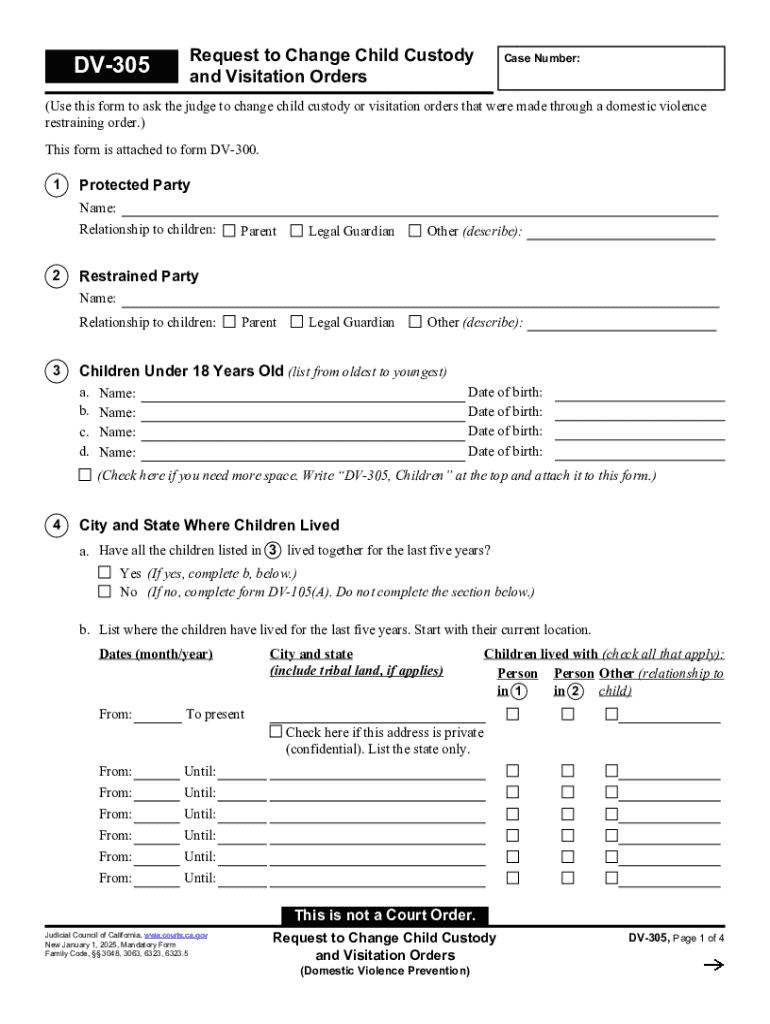
The DV-305 is a legal document used in the context of modifying child custody and visitation arrangements initially determined through a domestic violence restraining order. It serves as a formal request to the court to alter existing orders, providing a structured avenue for parties involved to seek appropriate changes necessary for their circumstances.

Key Details

  • Purpose: To officially request modifications to custody and visitation stipulations.
  • Context: Used in situations involving domestic violence.
  • Focus: Ensures children’s welfare while addressing the needs of protected individuals.

How to Use the DV-305

Using the DV-305 form involves several critical steps to ensure the request for custody or visitation changes is properly documented and considered by the court. This process requires a thorough understanding of the form's requirements and the legal implications of the modifications being requested.

Steps for Utilization

  1. Identify Necessary Changes: Determine what specific adjustments are needed in the custody or visitation order.
  2. Completion of Form: Carefully fill out all required sections of the DV-305, providing comprehensive information about the parties involved and the requested changes.
  3. Submission to Court: File the completed form with the appropriate family court handling the original restraining order.

Practical Example

If a parent is relocating for work and needs to adjust the visitation schedule, they would detail this in the form, explaining how the move impacts the current arrangement and proposing a viable alternative.

Steps to Complete the DV-305

Successfully completing the DV-305 involves several detailed steps, ensuring that all necessary information is accurately recorded and that the form meets the court's requirements. Understanding each section of the form is vital for a smooth submission process.

Completion Process

  1. Filing Party Information

    • Include names and contact details of the protected and restrained parties.
  2. Child Information

    • List details about the children involved, including current living arrangements and any prior orders.
  3. History and Context

    • Provide a history of prior court cases related to the children, emphasizing previous and pending legal actions.

Detailed Instructions

  1. Specific Changes Requested: Clearly specify which aspects of the existing order are to be modified, with detailed explanations.
  2. Reasons for Modifications: Articulate the reasoning behind the requested changes, citing evidence or changes in circumstances that justify the need for amendment.

Legal Use and Implications of the DV-305

Understanding the legal framework within which the DV-305 operates is crucial for ensuring that the form is used correctly and effectively. This involves recognizing the legal principles guiding child custody and domestic violence cases.

Legal Considerations

  • Compliance with Court Requirements: Ensure that all sections of the DV-305 comply with judicial instructions and statutory requirements.
  • Impact on Existing Orders: Acknowledge that the submission could lead to permanent changes in existing child custody and visitation orders.

Potential Outcomes

  • Approval: Modification of existing orders based on new conditions.
  • Rejection: Possible denial if grounds for change are insufficient or improperly documented.

Who Typically Uses the DV-305

The DV-305 is primarily used by individuals involved in child custody arrangements under a domestic violence restraining order. Understanding who uses this form can help in providing the necessary context for its application.


decoration image ratings of Dochub

Users

  • Protected Parties: Individuals seeking safety and modification in visitation due to new safety concerns.
  • Restrained Parties: Individuals who may seek to revise visitation terms or custody rights.
  • Legal Representatives: Attorneys assisting clients through the process of altering custody arrangements.

Important Terms Related to the DV-305

Familiarity with relevant terminology is essential for effectively completing and interpreting the DV-305. This knowledge aids in understanding the form's implications and requirements.

Glossary

  • Restraining Order: A court-issued order intended to protect individuals from harassment or harm.
  • Custody: The legal responsibility to care for and make decisions for a child.
  • Visitation: The right of a non-custodial parent to spend time with their children.

State-Specific Rules for the DV-305

Legal requirements and procedures for submitting the DV-305 can vary significantly from one state to another. Understanding state-specific rules ensures compliance with local legal standards.

Variations

  • Filing Procedures: Differences in how and where the form must be submitted across various jurisdictions.
  • Supporting Documentation: State-specific requirements for additional documents or evidence accompanying the form.

Notable Differences

  • Certain states may have unique considerations concerning children's welfare that impact form completion and submission.

Required Documents for DV-305 Submission

Submitting the DV-305 typically requires accompanying documents to support the requested changes. Ensuring these are in place can streamline the court's review process.

Necessary Documentation

  • Current Custody Orders: Copies of existing legal orders related to custody and visitation.
  • Evidence of Changed Circumstances: Documentation supporting claims for necessary custody modifications.
  • Identification: Valid identification proof for the filing party.

Tips for Submission

  • Prepare documents in advance to avoid delays.
  • Verify document completeness and accuracy to prevent rejections.

By focusing on these key aspects, one can gain a comprehensive understanding of the DV-305 form and its application, ensuring that requests for child custody and visitation changes are handled effectively within legal parameters.

be ready to get more

Complete this form in 5 minutes or less

Get form

Got questions?

We have answers to the most popular questions from our customers. If you can't find an answer to your question, please contact us.
Contact us
Common reasons include: Reconciliation or Improved Relationship: If the individuals involved have reconciled, or if they believe they can safely resume contact without fear of harm, the protected party might request the order be canceled.
1. Judge, it appears you just dont understand this other or you did not read my brief. This is disrespectful to the judge, as it is condescending, disrespectful to the other party and suggests the judge is lazy or stupid for apparently not agreeing with or possibly truly not reading the brief.
Temporary Emergency (Ex Parte) Orders (FL-305) States the courts decision (order) when a party asked for temporary emergency orders. Get form FL-305. 汉语Get form FL-305 in Chinese Simplified (Chinese Simplified)
To a family court judge, you should not say things that are lies, personal attacks, emotional outbursts, or undermine the other parent or the court system, as judges value facts, composure, and a focus on the childs best interest. Avoid blaming the child, using absolutes like always/never, making unsupported accusations, or discussing the case on social media. Stick to the facts, stay respectful, and demonstrate maturity and a willingness to co-parent. What to Avoid Saying Negative Comments: Badmouthing the other parent (calling them names like narcissist or unfit), criticizing the judge, or attacking the court system. Lies Exaggerations: Lying, misleading, fabricating, or exaggerating facts; this destroys credibility. Emotional Outbursts: Losing your temper, making threats, or having emotional outbursts. Blaming the Child: Using the child as a messenger or blaming them for problems; it puts them in the middle. Absolutes Generalizations: Using always or never, as situations are rarely black and white. Unsupported Claims: Making accusations without evidence or discussing legal strategy. Promises You Cant Keep: Dont make commitments youre unsure you can follow through on. What to Focus On Instead Facts: Stick to specific, verifiable facts about events. Childs Best Interest: Frame everything around whats best for the childs well-being. Co-Parenting: Show you can support the childs relationship with the other parent. Maturity: Maintain composure, be respectful, and avoid drama. Honesty: Tell the truth, even if its difficult. What not to say during a custody battle?Miles Mason Family Law Group, PLCWhat should you not say to a judge in a family court? - QuoraAug 17, 2020 Steven Haddock. LL.B. degree, 25 years in litigation, administrative law, collections, bankrupty and professional reguQuora
Judges prefer neutral, conservative colors like navy blue, gray, black, and white, which convey seriousness, professionalism, and respect for the court, while avoiding bright colors (like red, yellow) or bold patterns that can be distracting. The goal is to project calmness and reliability, ensuring the focus remains on the case, not the attire, so opt for muted tones and business-appropriate attire. Recommended colors Navy Blue: A classic choice that signifies seriousness and authority. Gray (Charcoal/Medium): Projects reliability and professionalism. Black: Acceptable, but avoid head-to-toe black as it can seem intimidating; pair with other neutrals. White/Beige/Soft Pastels: Good for blouses or shirts, conveying calmness. Browns: Another solid, sober choice for suits or trousers. Colors and patterns to avoid Bright colors: Red, neon, or anything too flashy can seem aggressive or attention-seeking. Loud patterns: Animal prints or busy designs distract from the proceedings. Overly confident colors: Yellow can sometimes be seen as too confident. General attire guidelines Be conservative: Think business or business-casual attire (suits, dress pants, blouses). Keep it neat: Ensure clothes are clean, pressed, and well-fitted. Minimize distractions: Skip excessive jewelry, strong makeup, or revealing clothing. For legal advice, consult a professional. What Color to Wear to Court - Minick LawSep 7, 2020 by Minick Law | Sep 7, 2020 | Courtroom Etiquette. While the color of the outfit you have decided to wear to your courtMinick Law, P.C.How to Dress for Court: What to Wear Avoid | Daniel Stark Injury LawyersJun 4, 2025 Colors to Avoid. The color of your outfit matters more than you might think. Heres what to steer clear of: Bright red Daniel Stark Injury Lawyers

Security and compliance

At DocHub, your data security is our priority. We follow HIPAA, SOC2, GDPR, and other standards, so you can work on your documents with confidence.

Learn more
ccpa2
pci-dss
gdpr-compliance
hipaa
soc-compliance

People also ask

The fastest way to get a restraining order, especially in immediate danger, is to call 911 for an Emergency Protective Order (EPO) or go to the courthouse in person to file for a Temporary Restraining Order (TRO), as judges review these same-day or next business day, allowing for quick temporary protection while you prepare for a full hearing. Law enforcement can also help request an EPO 24/7. For Immediate Danger (Within hours) Call 911: If you are in immediate danger, call 911. Police can request an Emergency Protective Order (EPO) from a judge, which can be issued verbally, telephonically, or in writing and lasts about seven days. Go to the Courthouse: File your forms in person at the courthouse for the quickest judge review for a TRO (Temporary Restraining Order). Use Drop Boxes (If available): Some courts have drop boxes, but filing in person or online is usually faster for immediate review. For Next Steps (Temporary Permanent Orders) Get Forms: Obtain the required forms from your local courthouse, a womens shelter, or a lawyers office (you dont need a lawyer to get one). Fill Out Forms: Complete them carefully, detailing specific incidents of abuse, violence, or stalking. File: Submit your forms at the courthouse; the clerk will direct you on the next steps. Attend Hearing: You must attend the scheduled hearing to present evidence for a permanent order, as the TRO is only temporary. Key Considerations Types: There are different orders (Domestic Violence, Stalking, Elder Abuse, etc.). Evidence: Be specific with dates, events, and any history of abuse, as this helps judges make quick decisions. Service: The restrained person must be officially served with the papers after the order is issued. Safety: Clear your browsing history after searching online if you fear the abuser may see it. For legal advice, consult a professional. Domestic Violence Restraining Orders in CaliforniaWhat if you need protection right away? In most counties, you will not talk to a judge right away. But, a judge will make a decisiCalifornia State Portal | CA.govFile your request for a domestic violence restraining order You can file your forms: * In person at the courthouse: Find the courthouse in your county that will file restraining order paperCalifornia State Portal | CA.gov
In family court, things that look bad include emotional outbursts, badmouthing the other parent, poor preparation, lying, social media misbehavior, and failing to follow court orders, as judges prioritize stability and the childs best interests, penalizing disrespect, inconsistency, and instability. Actions like yelling, making threats, involving children in disputes, or showing substance abuse issues DocHubly harm credibility and custody chances, while maintaining composure, honesty, and focusing on facts presents a much better image. Conduct Demeanor Emotional Outbursts: Yelling, uncontrollable crying, sarcasm, or instability. Disrespect: Interrupting the judge or opposing counsel, or using angry language. Poor Preparation: Being disorganized, not having documents, or failing to listen to questions. Dishonesty: Lying, exaggerating, or misleading the court. Not Following Orders: Ignoring deadlines or previous court orders. Parenting Co-Parenting Badmouthing the Other Parent: Speaking negatively about them, especially in front of the child (parental alienation). Using Children as Messengers: Making kids carry messages or share adult details. Involving Children: Scheduling over the other parents time or making children choose sides. Inconsistency: Missing visitation or being unreliable. Personal Behavior Risk Substance Abuse: Evidence of alcohol or drug dependency. Risky Behavior: DUI, physical altercations, or excessive police calls. Social Media: Posting hostile, angry, or threatening content, or discussing the case. Making Threats: Threatening the other parent in any form of communication. What Judges Look For (The Opposite) Emotional Stability: Remaining calm and factual. Focus on Childs Best Interest: Demonstrating you prioritize the childs well-being. Facilitating Co-Parenting: Showing you can work reasonably with the other parent. Good Preparation: Being organized and honest. Following Rules: Adhering to all court orders and procedures. What not to say during a custody battle?During a custody battle, parents should not lie, mislead, fabricate, or exaggerate. Avoid criticizing the other parent and let theMiles Mason Family Law Group, PLCWhat Looks Bad In a Custody Battle? - YouTubeMay 21, 2025 Missing or inconsistent visits can make it seem like youre not fully committed, which reflects poorly in custody deciYouTube
The truth, the whole truth and nothing but the truth: Always answer any question asked of you truthfully. A judge is always assessing a witnesss credibility. It is imperative that you be truthful, even if you think something you have to say may not be favorable to your case.

Related links