01. Edit your form online
Type text, add images, blackout confidential details, add comments, highlights and more.

Type text, add images, blackout confidential details, add comments, highlights and more.

Draw your signature, type it, upload its image, or use your mobile device as a signature pad.

Send it via email, link, or fax. You can also download it, export it or print it out.
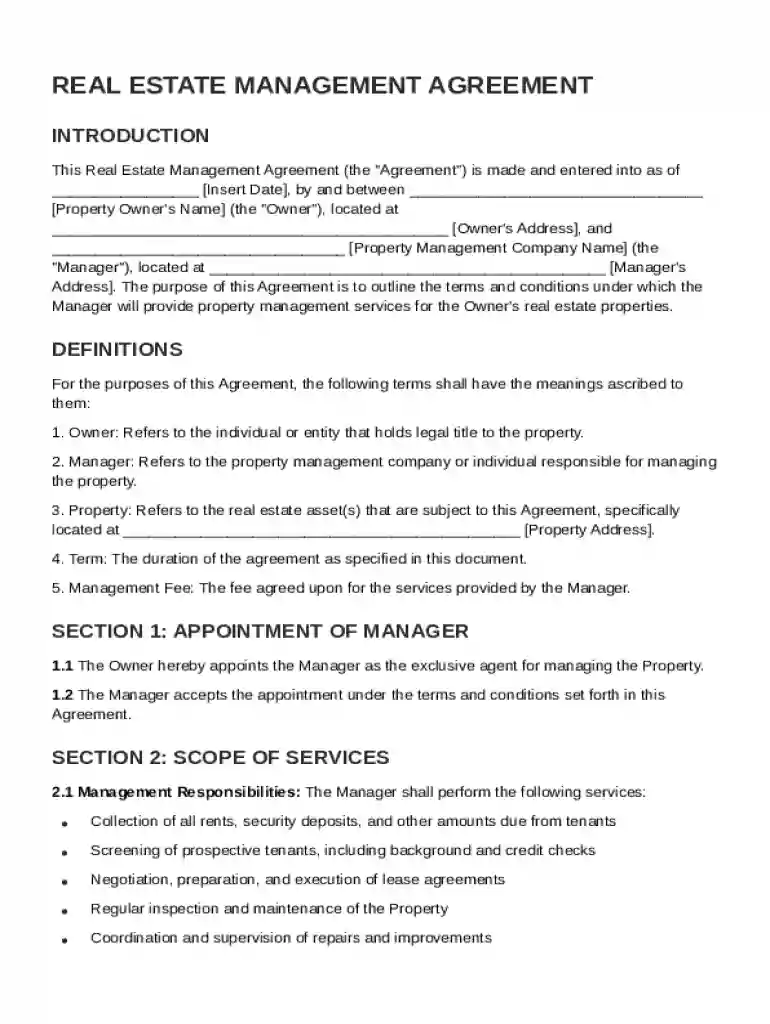
A Real Estate Management Agreement is a formal contract between a property owner and a property management company. It defines the terms and scope of managing real estate properties. This agreement is essential for outlining roles such as rent collection, tenant screening, and property maintenance. Additionally, it specifies compensation, the responsibilities of each party, termination conditions, and legalities like liability waivers and dispute resolution processes. By establishing these parameters, the agreement helps prevent misunderstandings, ensuring a smooth operational framework for property management.
To effectively utilize the Real Estate Management Agreement Template, follow these steps:
Review the Template: Begin by thoroughly reading the entire document to understand each section and its relevance to your specific needs.
Customize Details:
Set Terms and Conditions: Clearly articulate terms related to duration, compensation, and termination procedures.
Legal Compliance:
Signatures: Have all parties involved review and sign the agreement to formalize the contract.
By following these steps, you can tailor the template to your circumstances, ensuring that all parties understand their rights and duties.
The Real Estate Management Agreement Template consists of several critical components:
Including these elements ensures the agreement is comprehensive and protects the interests of both parties.
Follow these detailed steps to complete the Real Estate Management Agreement Template:
Gather Information: Collect all necessary details such as contact information and property specifics.
Draft the Agreement:
Review Legal Terms: Carefully review the legal clauses to ensure they meet jurisdictional requirements.
Get Feedback: Before finalizing, have both parties review and suggest any modifications.
Finalize and Sign: Once all details are confirmed, the parties should sign the document to make it legally binding.
By following a systematic approach, the agreement can be executed efficiently and accurately.
Several key terms are integral to understanding the Real Estate Management Agreement:
Familiarity with these terms helps in comprehending the agreement’s provisions and implications.
For the Real Estate Management Agreement to be legally enforceable, it must:
Legal advisors can provide additional insight to ensure compliance and validity, thus preventing potential disputes.
Real estate laws vary significantly from state to state; therefore, the agreement must:
Given these variations, it is crucial to review state regulations or consult a local real estate expert when drafting the template for a particular location.
This template is commonly used by:
Both parties utilize the template to establish clear operational guidelines and formalize their business relationship, ensuring a mutual understanding of expectations and responsibilities.


At DocHub, your data security is our priority. We follow HIPAA, SOC2, GDPR, and other standards, so you can work on your documents with confidence.