01. Edit your form online
Type text, add images, blackout confidential details, add comments, highlights and more.

Type text, add images, blackout confidential details, add comments, highlights and more.

Draw your signature, type it, upload its image, or use your mobile device as a signature pad.

Send it via email, link, or fax. You can also download it, export it or print it out.
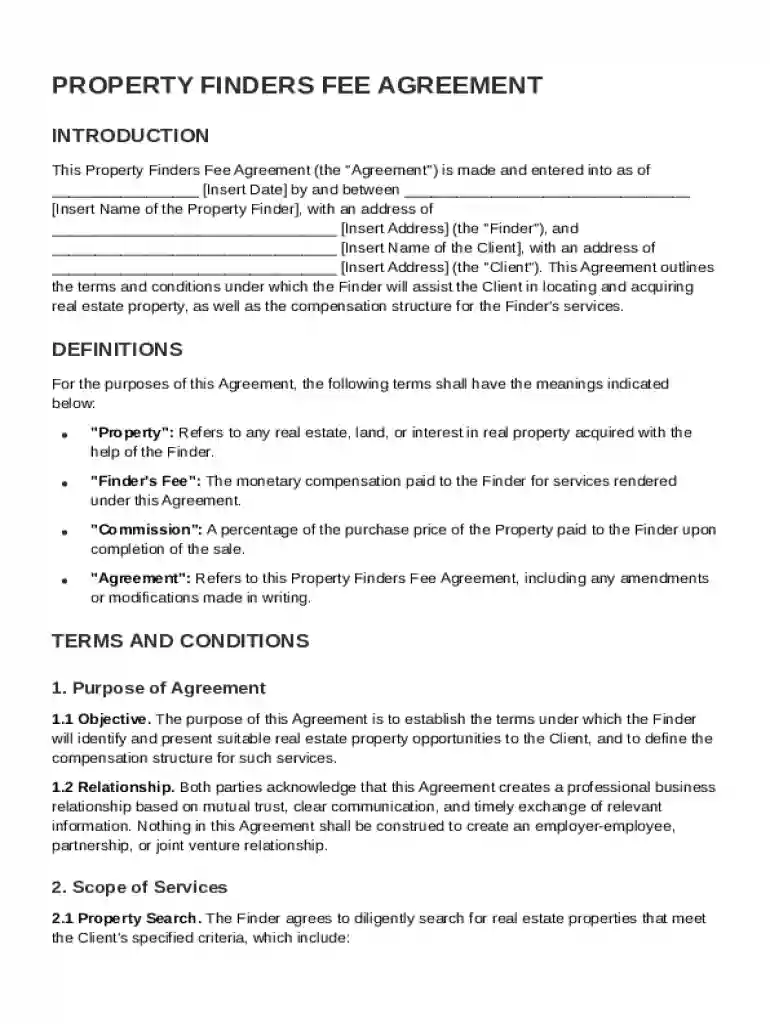
The Property Finders Fee Agreement Template defines the relationship between a property finder and a client. This legal document outlines the terms under which the finder is compensated for services rendered, such as sourcing and introducing potential real estate properties to the client. It clarifies essential terms like 'Property', 'Finder's Fee', and 'Commission'. This agreement is crucial as it ensures transparency and sets expectations for both parties involved in the property transaction process.
The contract often specifies the scope of services to be provided, which may include market analysis, property tours, and negotiations. By detailing these elements, the document creates a reliable framework that safeguards both the finder and the client from future disputes or misunderstandings. Additionally, it establishes a written record of agreement that can be referred to in case of disagreements.
A comprehensive Property Finders Fee Agreement includes several critical components:
Incorporating these elements into the agreement ensures that all aspects of the finder-client relationship are transparent and legally enforceable.
This step-by-step approach ensures that the agreement is complete, precise, and ready for execution.
The Property Finders Fee Agreement Template must be compliant with U.S. law and real estate regulations to be legally enforceable. The document serves as protection for both parties in the agreement, ensuring that compensation for real estate services is fair and acknowledged. Elements like dispute resolution mechanisms and choice of law clauses are critical components that should align with the legal standards in the clients' state.
The agreement should be drafted so that it complies not only with national norms but also state-specific legislation or practices in places within the U.S. Each state might have nuances in how these agreements are interpreted or enforced. Legal counsel may be sought to tailor the template to align with any regional deviations from standard contractual obligations.
Each state in the U.S. may have regulations and rules uniquely governing real estate transactions and intermediary roles, including property finders. States like California and New York, for instance, might have stricter notifications and obligations when compared to others. It is crucial for users of the Property Finders Fee Agreement Template to be aware of and adhere to these specific rules to ensure the agreement’s validity.
Users should research aspects such as licensing requirements for property finders in each state and any disclosed mediation processes required for resolving disputes. Harmonizing the template with state-specific conditions not only reinforces legal standing but also builds a stronger foundational trust between the parties.
The typical users of a Property Finders Fee Agreement include real estate professionals, property finders, buyers seeking specific investment properties, and real estate investment firms. It's particularly valuable for individuals or companies looking to outsource the task of identifying real estate opportunities but who wish to structure the relationship with professionals clearly and legally.
The agreement is also often used by real estate agents who are involved in introducing off-market opportunities to their clients. It is a valuable legal tool that formalizes the relationship, stipulating each party's duties and protecting interests across the transaction process.


Understanding the terminology within the Property Finders Fee Agreement is essential:
Being familiar with these terms equips all parties with the knowledge necessary for a mutual understanding, ensuring no misinterpretation affects the agreement.
Consider a scenario where a real estate investor seeks a commercial property portfolio within a specific urban area. By engaging a professional property finder via a carefully structured Property Finders Fee Agreement, the investor secures access to insider networking and market intelligence, mitigating risks in property identification and negotiation.
A real estate agency looking to expand its clientele might use this template to formalize the commission arrangement with independent property finders who bring forth new properties that attract buyers. These agreements can streamline processes and establish clear expectations with respect to privacy, timelines, and deliverables.
Each of these examples demonstrates the utility and flexibility of this template in different real estate contexts, highlighting its importance in ensuring seamless and clear professional relationships.
At DocHub, your data security is our priority. We follow HIPAA, SOC2, GDPR, and other standards, so you can work on your documents with confidence.