
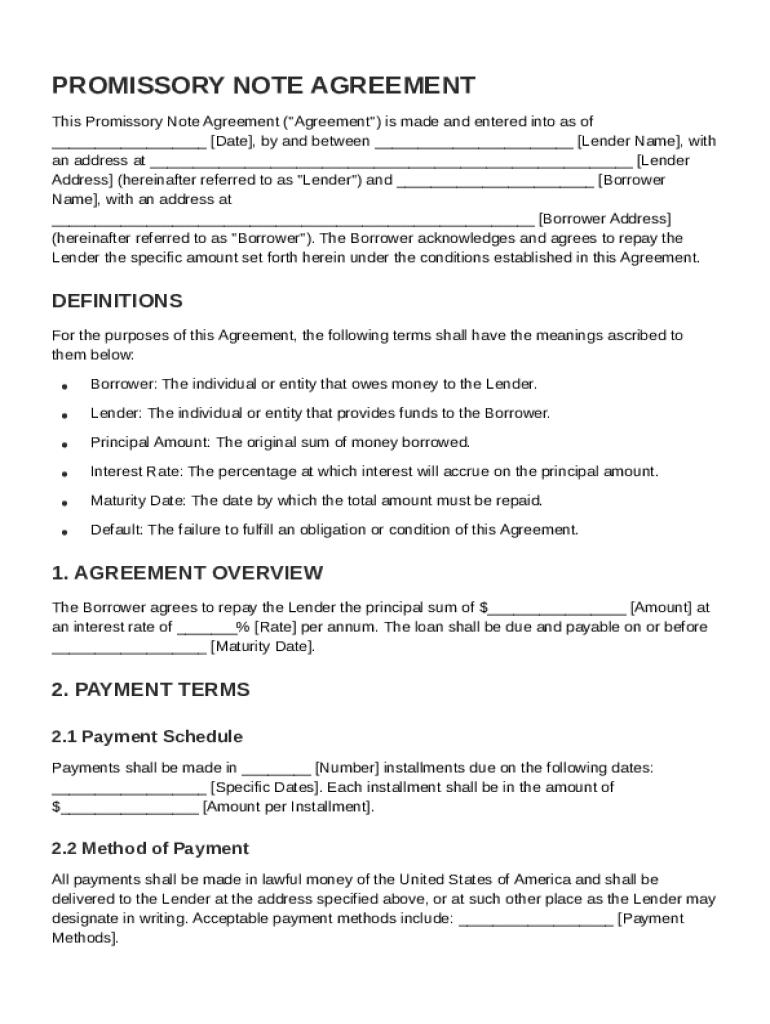







Definition & Meaning
A Promissory Note Agreement Template is a legal document used to formalize a loan agreement between a Borrower and a Lender. The document outlines the responsibilities of both parties, including the amount borrowed, interest rate, repayment schedule, and maturity date. It serves as a binding contract, ensuring that the Borrower commits to repay the Lender under specified terms, which can include additional provisions for consequences if payments are late or the Borrower defaults.
- Key Elements:
- Principal amount: The total sum borrowed.
- Interest rate: The percentage charged on the amount borrowed.
- Repayment schedule: Defines how and when payments should be made.
- Maturity date: The final date by which the loan must be repaid in full.
Key Elements of the Promissory Note Agreement Template
A Promissory Note Agreement typically includes several essential components to ensure clarity and mutual understanding between parties.
-
Borrower and Lender Information:
- Names, addresses, and contact details for both parties are essential for identification and communication purposes.
-
Principal Amount:
- Specifies the exact dollar amount the Borrower agrees to repay.
-
Interest Terms:
- Describes the interest rate and how it accrues. This can be a fixed or variable rate.
-
Payment Schedule:
- A detailed timeline for when payments are due, which can be monthly, quarterly, or at intervals specified in the agreement.
-
Late Payment Penalties:
- Outlines fees or increased interest rates applied if the Borrower fails to make timely payments.
-
Default Clause:
- Defines what constitutes a default and the remedies available to the Lender if the Borrower fails to comply with the agreement terms.
How to Use the Promissory Note Agreement Template
Utilizing a Promissory Note Agreement Template effectively involves understanding each section and appropriately customizing it to fit the specific terms of the loan.
-
Download the Template: Secure a reliable template from a trusted source, ensuring it's up-to-date and complies with current legal standards.
-
Fill Out Borrower and Lender Details: Provide accurate contact information for all parties involved for accountability and correspondence.
-
Specify Loan Details: Clearly state the loan amount, interest rate, and repayment terms to prevent misunderstandings.
-
Customize Legal Provisions: Adjust clauses related to default, prepayment, and penalties to match the specific agreement between parties.
-
Review Legal Requirements: Ensure the document adheres to state and federal guidelines to maintain its enforceability.
Steps to Complete the Promissory Note Agreement Template
Completing a Promissory Note Agreement can be straightforward if you follow a structured approach.
-
Enter Basic Information:
- Fill in the personal and contact details of both the Borrower and Lender.
-
Outline Loan Terms:
- Input the principal amount, interest rate, and repayment schedule directly into the designated sections of the template.
-
Detail Payment Instructions:
- Define how payments will be made (e.g., bank transfer, cheque) and specify the due dates.
-
Include Default and Penalty Terms:
- Clearly outline the consequences of missed payments and the rights of the Lender in case of default.
-
Add Governing Law Provisions:
- Specify which state’s laws will govern the agreement to help interpret the document correctly if a legal dispute arises.
-
Review, Sign, and Date:
- Once both parties have reviewed, print, sign, and date the document to make it legally binding.
Who Typically Uses the Promissory Note Agreement Template
The Promissory Note Agreement Template is widely used in various financial contexts to provide legal protection and clarity for both Lenders and Borrowers.
-
Individuals and Families:
- Used for personal loans between friends or family members, ensuring that all terms are transparent and agreed upon.
-
Businesses:
- Commonly used by businesses when lending or borrowing funds to manage cash flow or finance projects.
-
Financial Institutions:
- Banks and credit unions use these templates when issuing personal loans, mortgages, or business loans.
-
Investors:
- Private investors offering loans to individuals or businesses often utilize promissory notes to secure their investment.


Legal Use of the Promissory Note Agreement Template
Using a Promissory Note Agreement Template within legal boundaries ensures the document’s enforceability.
-
Compliance with ESIGN Act:
- Electronic versions must comply with the Electronic Signatures in Global and National Commerce (ESIGN) Act to be valid and enforceable.
-
Adherence to State Laws:
- Since each state may have specific legal requirements for promissory notes, ensuring alignment with local laws is crucial.
-
Ensuring Clarity and Fairness:
- The terms should be clearly defined and equitable to avoid potential disputes or claims of unfair practices.
Important Terms Related to Promissory Note Agreement Template
Understanding relevant terminology in the Promissory Note Agreement can aid in negotiating and finalizing terms confidently.
-
Maturity Date:
- The date by which the total loan amount, including interest, must be completely paid off.
-
Prepayment Penalty:
- A fee applied if the Borrower chooses to pay off the loan earlier than the scheduled term completion.
-
Accrued Interest:
- The interest accumulated on the principal balance over time, which may be payable at different intervals.
-
Amortization:
- A schedule detailing how each loan payment is applied toward the principal and interest over time.
State-Specific Rules for the Promissory Note Agreement Template
Different states have varying regulations that must be adhered to when crafting and signing a promissory note.
-
Interest Rate Caps:
- Some states impose a maximum allowable interest rate, especially for personal loans, to prevent usurious lending practices.
-
Notarization Requirements:
- While not always mandatory, some states require notarization for promissory notes to be legally binding.
-
Loan Amount Limits:
- Specific states may regulate the maximum amount that can be considered valid under a promissory note for consumer protection.
Understanding these state-specific guidelines is essential to ensure the validity and enforceability of the promissory note within the given jurisdiction.




