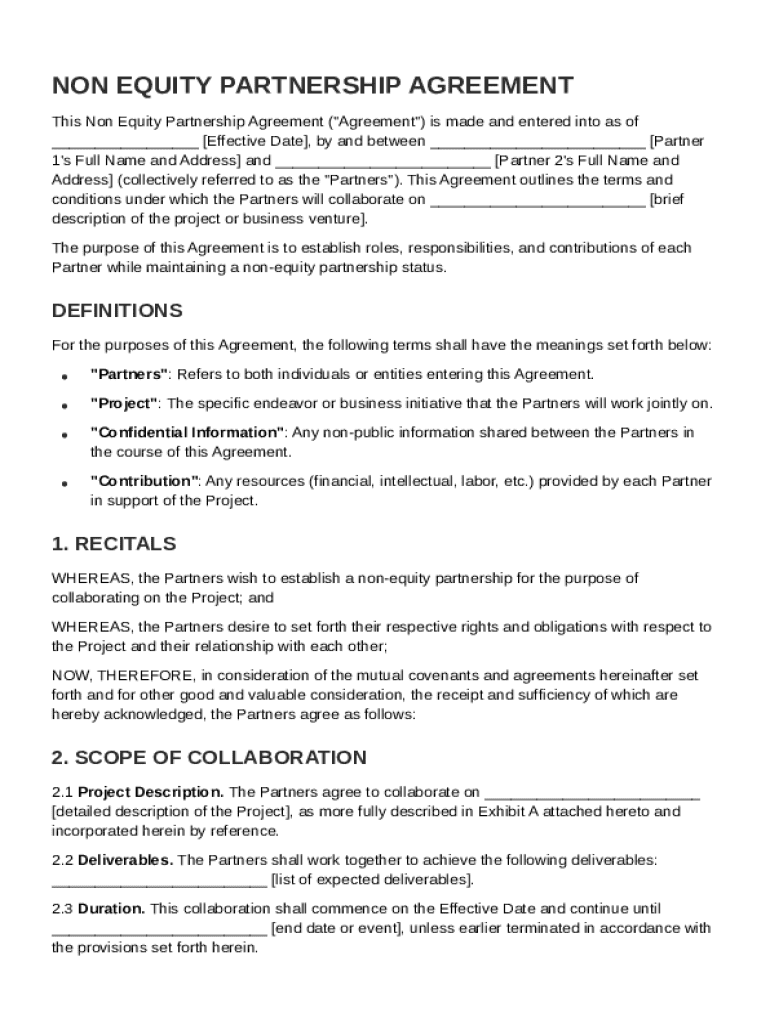







Definition & Meaning
A Non Equity Partnership Agreement is a legal arrangement between two or more parties that want to collaborate on a project or business initiative without exchanging ownership stakes. This type of agreement clearly delineates the roles, responsibilities, contributions, and shared goals of each party involved, ensuring clarity and alignment throughout the collaboration. Unlike equity partnerships, this model maintains each entity's independence, avoiding the complex interactions and obligations tied to shared ownership. This makes it ideal for joint ventures, project-specific collaborations, or partnerships that seek to leverage shared expertise while maintaining individual business control.
Key Elements of the Non Equity Partnership Agreement Template
This template includes several critical components designed to ensure a clear and structured collaboration. Key elements include:
- Roles and Responsibilities: Detailed descriptions of each partner's duties, expected contributions, and the allocation of tasks.
- Intellectual Property Rights: Guidelines regarding the ownership and usage rights of any intellectual property created or shared during the partnership.
- Confidentiality Agreements: Clauses to protect sensitive information exchanged between the partners, outlining what's considered confidential and the permitted use.
- Conflict Resolution Procedures: Steps and mechanisms to address disputes, ensuring that any disagreements are resolved efficiently.
- Termination Conditions: Conditions under which the partnership may be dissolved, including processes for winding down shared responsibilities.
How to Use the Non Equity Partnership Agreement Template
Utilizing this template effectively involves several steps to ensure that the agreement aligns with both parties' intentions:
- Review and Customize: Go through the template thoroughly, and customize it to fit the specific context of your partnership. Adjust sections such as roles, contributions, and any specifics pertinent to your collaboration.
- Discuss with Partners: Ensure all parties involved understand and agree to the terms by discussing each section collaboratively.
- Seek Legal Review: Consult with legal professionals to vet the agreement, ensuring it complies with relevant laws and protects all partners' interests.
- Finalize and Execute: Once all modifications are made and verified, finalize the document with all necessary signatures to enact the agreement officially.
Important Terms Related to Non Equity Partnership Agreement Template
To draft a comprehensive Non Equity Partnership Agreement, familiarity with certain legal and business terms is essential:
- Partnership Scope: Defines the parameters and limits of the partnership, including the specific objectives and projects.
- Contribution: Describes the type of resources (financial, intellectual, or labor) that each partner commits to the partnership.
- Distribution: Outlines how any profits or revenues generated through the partnership are divided among the partners.
- Mutual Indemnification: Legal protection against claims related to each partner's individual actions outside the partnership's agreed activities.
- Liability Limitation: Specifies the extent of each partner's responsibility for debts or obligations incurred by the partnership.
Legal Use of the Non Equity Partnership Agreement Template
Legally, these agreements are versatile tools that facilitate partnership while minimizing risk. They provide a legally binding framework that supports:
- Compliance with State Laws: Ensures that all aspects of the partnership adhere to applicable jurisdictional requirements.
- Secured Rights and Obligations: Clearly identifies legal obligations, safeguarding each partner’s interests.
- Enforceability: Offers legal recourse should any partner fail to honor their specified commitments.
- Legal counsel should review the agreement to tailor it to specific legal requirements and to account for any unique stipulations pertinent to the industry.
State-Specific Rules for the Non Equity Partnership Agreement Template
While the core elements of a Non Equity Partnership Agreement remain consistent across jurisdictions, certain state-specific regulations can affect its content or execution:
- Registration Requirements: Some states may require partnerships to register with state authorities to gain recognition or tax benefits.
- Industry-Specific Regulations: Depending on the industry, additional state laws can impose specific compliance mandates or operational constraints.
- Conflict Resolution Regulations: Different states may have varying requirements for dispute resolution methods, such as required mediation or arbitration processes.
Examples of Using the Non Equity Partnership Agreement Template
Consider these scenarios where this template could be applied:
- Joint Product Development: Two companies collaborate to develop a new technology product. The agreement delineates development stages, intellectual contributions, and revenue sharing from sales.
- Consultancy Projects: A consulting firm and a technology provider partner for a client project, detailing project roles, deliverables, and compensation structures.
- Marketing Collaborations: Two businesses collaborate on a marketing campaign, with one providing creative content and the other offering digital platforms for implementation.
These examples underscore the template’s flexibility across multiple industries and project types.
Business Types that Benefit Most from Non Equity Partnership Agreements
The Non Equity Partnership Agreement is particularly valuable for a variety of business types, including:
- Startups: Seeking to collaborate with established firms without sacrificing equity.
- Small Businesses: Engaging in joint ventures or pilot programs that require shared resources without altering ownership structures.
- Corporations and LLCs: Looking for flexible collaboration opportunities that enhance innovation through partnerships without altering shareholder dynamics.
This agreement type is ideal for organizations focused on maintaining control over their operations while benefiting from the synergies of collaboration.