01. Edit your form online
Type text, add images, blackout confidential details, add comments, highlights and more.

Type text, add images, blackout confidential details, add comments, highlights and more.

Draw your signature, type it, upload its image, or use your mobile device as a signature pad.

Send it via email, link, or fax. You can also download it, export it or print it out.
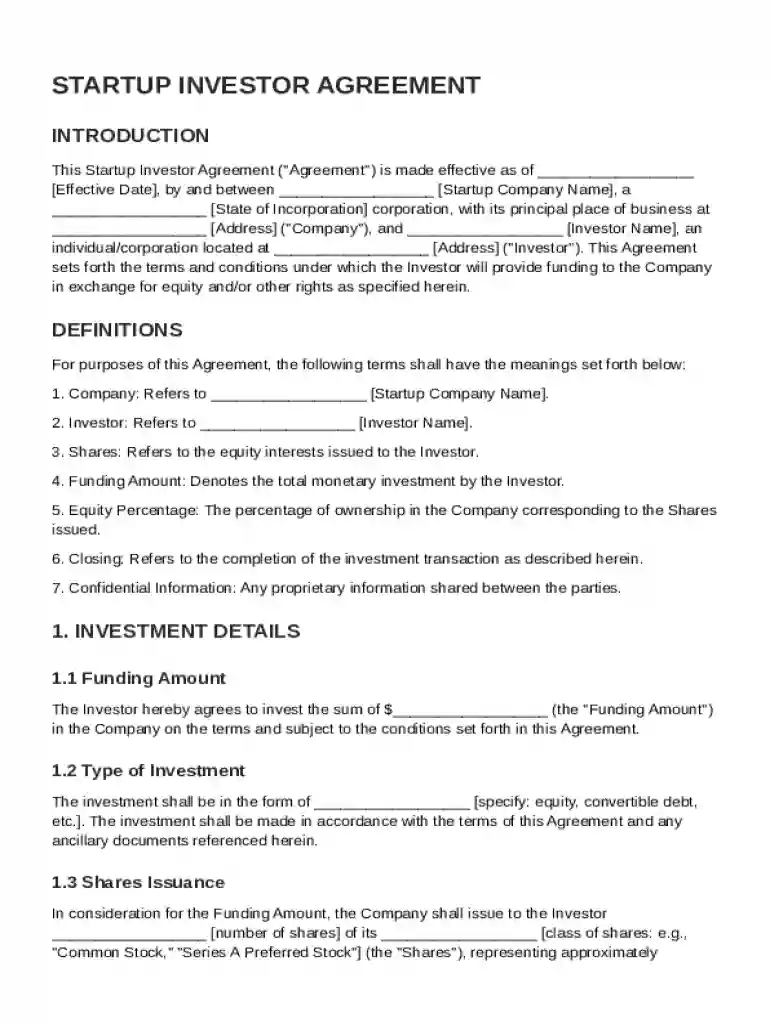
The Startup Investor Agreement Template is a formal document that establishes the terms and conditions under which an investor provides capital to a startup company in exchange for an equity stake. This agreement typically outlines critical components such as the investment amount, valuation, equity percentage, and rights and obligations of both the investor and the startup. It serves as a legal framework to protect the interests of both parties and ensure transparency in the investment process. The template standardizes necessary clauses and considerations, facilitating efficient negotiations and clarity in these types of transactions.
Several essential components comprise the Startup Investor Agreement Template, each vital for capturing the investment's scope and terms comprehensively.
Investment Details: This section outlines the financial specifics, including the amount of capital to be invested, the specific terms of the investment, and any associated milestones or goals.
Equity Stake: Clearly defines the percentage or type of equity the investor receives in exchange for their capital, ensuring that both parties have aligned expectations.
Rights and Obligations: Details what rights the investor has regarding decision-making, voting, and access to company information. Conversely, it also lays out the obligations of the startup to the investor.
Confidentiality Provisions: Establishes rules for the handling of proprietary or sensitive information, which both parties must adhere to.
Dispute Resolution: Provides mechanisms for resolving conflicts or disputes related to the agreement, such as arbitration or mediation clauses.
Successfully completing the Startup Investor Agreement Template involves several methodical steps to ensure accuracy and compliance.
Initial Review: Both parties should thoroughly review the template to understand the scope and implications of each clause.
Customization: Modify the template to reflect the specific terms agreed upon, such as investment amount, equity distribution, and specific investor rights.
Consultation with Legal Experts: It’s advisable to seek guidance from legal professionals to ensure that all legal requirements are met and the document is enforceable.
Draft Review: Conduct a detailed review of the customized agreement draft with all involved parties to ensure clarity and agreement on all terms.
Final Adjustments and Signatures: Make any necessary adjustments before both parties sign the agreement, certifying their consent and commitment to the stipulated terms.
The template serves as a guide to structure the relationship between startup founders and investors.
Facilitating Clear Communication: It helps in facilitating clear communication regarding investment terms, thereby reducing misunderstandings.
Setting Expectations: Both parties can use the template to outline and finalize expectations, timelines, and deliverables.
Legal Compliance: Ensures that the agreement complies with legal standards, protecting both parties in case of future disputes.
Understanding the terminology used in the agreement is crucial for all parties involved.
Valuation Cap: The maximum pre-money valuation at which the investment can convert into equity.
Liquidation Preference: Outlines how proceeds from any liquidation event are distributed between shareholders.
Conversion Rights: Defines when and how convertible securities related to the investment can be converted to equity.
This template is commonly used by:
Entrepreneurs and Startup Founders: To draft and formalize fundraising efforts with potential investors.
Venture Capitalists and Angel Investors: To secure their investment rights and returns in a startup.
Legal Advisors: Assisting in the formulation and customization of the agreement in line with specific client needs.


In the United States, state-specific laws can influence certain aspects of the Startup Investor Agreement Template.
Governing Law: The agreement must specify which state's laws will govern the terms of the contract.
Registration Requirements: Some states may require the registration of investment agreements with local state authorities.
Securities Compliance: Ensure adherence to both state-specific securities regulations and federal laws to avoid potential legal issues.
The legality of the Startup Investor Agreement Template relies on:
Compliance with Federal Laws: Such as the Securities Act of 1933 and the Investment Company Act of 1940.
Meeting State Requirements: Ensuring both parties adhere to applicable state laws where the startup operates.
Due Diligence: Ensuring comprehensive due diligence has been conducted, affirming the legal and financial health of the agreement.
By integrating these aspects into the document, both parties achieve a mutually beneficial and legally sound agreement.
At DocHub, your data security is our priority. We follow HIPAA, SOC2, GDPR, and other standards, so you can work on your documents with confidence.