






Definition and Meaning of LLC Member Buyout Agreement
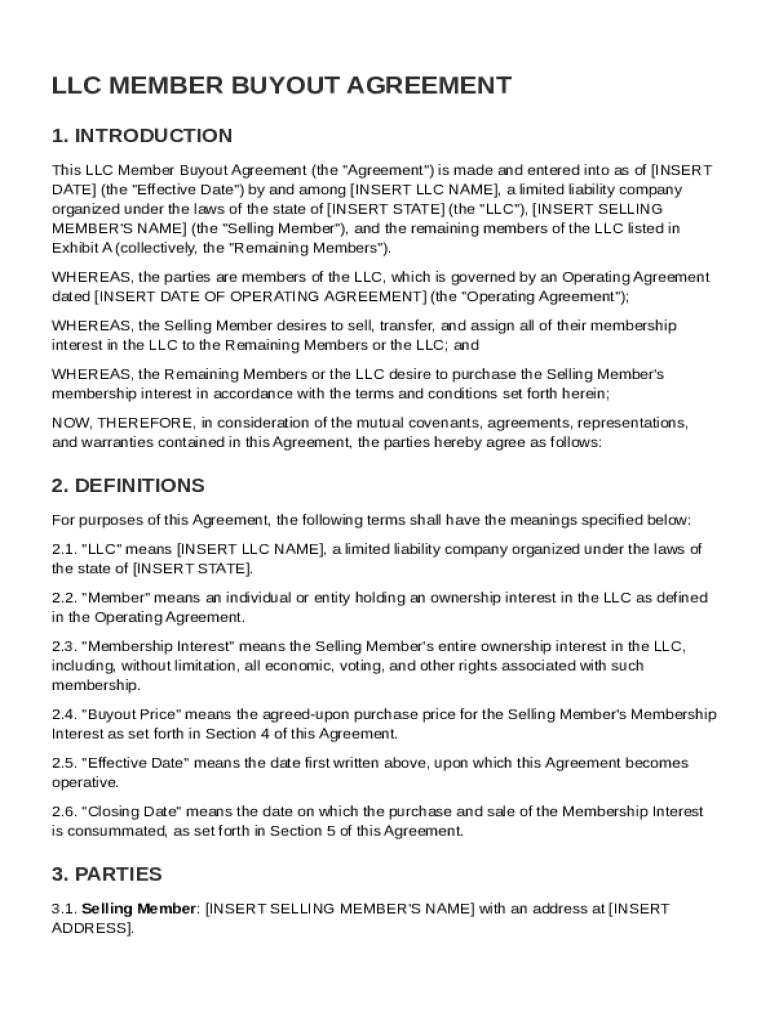
An LLC Member Buyout Agreement is a legally binding contract that delineates the terms under which a member of a Limited Liability Company (LLC) sells their membership interest to the remaining members or the LLC itself. This agreement provides a clear understanding of various aspects such as the buyout price, payment terms, and specific obligations. It is crucial for facilitating a smooth transfer of ownership while safeguarding all parties' interests involved in the buyout.
Key Components of the Agreement
- Buyout Price Determination: Specifies the method used to evaluate the membership interest's value, ensuring fairness in compensation.
- Payment Terms: Outlines how and when payments will be made to the selling member, including installment options or lump-sum payments.
- Representations and Warranties: Protects both parties by confirming the condition of the company and membership interests at the time of sale.
- Mutual Release of Claims: Ensures that all parties waive any future claims against each other following the transaction.
- Confidentiality Obligations: Maintains privacy regarding the business's sensitive information throughout the process.
Steps to Complete the LLC Member Buyout Agreement
Completing an LLC Member Buyout Agreement involves several steps to ensure all necessary information is accurate and filed correctly. Here is a step-by-step guide:
-
Identify Parties Involved: Clearly define the selling member and the remaining members or the LLC.
-
Detail the Membership Interest: Describe the membership interest being sold, including percentage ownership and any pertinent rights.
-
Determine the Buyout Price: Use an agreed-upon method, such as a valuation formula or third-party appraisal, to set the buyout price.
-
Outline Payment Terms: Specify the payment structure, including due dates and any financial institutions involved.
-
Include Necessary Clauses: Incorporate essential clauses like representations, warranties, confidentiality, and claim releases.
-
Governing Law and Miscellaneous Provisions: State the jurisdiction under which the agreement is governed, ensuring compliance with local laws.
-
Execution of Agreement: Have all parties read, agree, and sign the document, and ensure the signatures are notarized if required.
Additional Considerations
- Always review the agreement with a legal expert to confirm compliance with applicable state laws.
- Maintain records of all communication and modification during the negotiation process.
Important Terms Related to the Agreement
Understanding key legal and financial terms is essential for accurately interpreting an LLC Member Buyout Agreement:
- Appraisal: The process of determining the monetary value of the membership interest.
- Indemnification: Assurance that parties will compensate each other for any damages or losses.
- Escrow: A neutral third-party holds funds until conditions are met, providing security for the transaction.
Examples of Terms in Context
- If disagreements arise over the buyout price determination, employing an appraisal can offer an impartial solution.
- Indemnification clauses protect members from unforeseen liabilities post-buyout.
- Using escrow ensures that funds are safely held until all agreement terms are met.
Legal Use of the LLC Member Buyout Agreement
The LLC Member Buyout Agreement must adhere to legal standards to be enforceable:
- Compliance with ESIGN Act: Ensures that electronic signatures are legally binding within the agreement.
- State-Specific Regulations: Acknowledge variations in state laws that may affect buyout procedures and requirements.
- Enforceability: Include clauses that prevent the agreement from being voidable due to oversight or improper execution.
Legal Scenarios and Considerations
- Cross-State Buyouts: Additional complexity may emerge if members reside in different states with varying legal requirements.
- Tax Implications: Understanding the tax consequences of the buyout is crucial for financial planning.
Who Typically Uses the LLC Member Buyout Agreement
LLC Member Buyout Agreements are predominantly used by:
- Members Exiting the LLC: Individuals selling their membership interest in the company.
- Remaining LLC Members: Those who are purchasing the exiting member's interest to maintain or alter company control.
- Legal and Financial Advisors: Professionals guiding members through the buyout process, ensuring legal and financial compliance.

Benefiting Business Types
- Small to Medium Enterprises (SMEs): Often require such agreements for transitioning ownership during growth phases.
- Family-Owned Businesses: Utilize buyout agreements to manage member exits without disrupting operations.
State-Specific Rules for the Agreement
Different states may impose specific regulations or requirements for executing an LLC Member Buyout Agreement:
- Variation in Valuation Methods: Some states may demand particular procedures for appraising membership interests.
- Tax Obligations: Understanding state tax obligations post-buyout can significantly impact financial outcomes.
Examples of State Variations
- California: May necessitate additional documentation for buyouts affecting over 50% interest.
- Delaware: Known for having flexible LLC laws but mandates written agreements for certain actions.
Key Elements of the Agreement Template
The LLC Member Buyout Agreement Template's structure is designed to encompass essential elements for clarity and thoroughness:
- Comprehensive Definitions Section: Clearly define terms to avoid ambiguity.
- Structured Payment Section: Detailed payment schedule with terms to prevent disputes.
- Detailed Member Representations: Outline the representations each member makes for transparency and accountability.
Streamlining Template Usage
- Editable Fields: Include fields that can be easily updated or customized based on specific transaction details.
- Pre-Filled Common Clauses: Provide standard legal language for consistency and compliance.
Examples of Using the LLC Member Buyout Agreement
Real-world scenarios illustrate the application of these agreements in typical business transactions:
- Startup Exit: An original founding member decides to leave after five years, triggering a buyout by the remaining founders to maintain momentum.
- Retirement Buyout: A senior partner in a successful family-run LLC retires, transferring their interest smoothly to younger family members using the buyout agreement.
- Dispute Resolution: A disagreement among members leads to one opting to leave; the buyout agreement facilitates a fair exit process minimizing conflict.
Case Studies and Scenarios
- Case Study 1: An LLC with varying state-registered entities found success in negotiating a buyout by harmonizing different state legal requirements into a cohesive agreement.
- Scenario 2: A member decides to exit after internal policy changes, using the template to structure amicable and efficient buyout transactions amidst organizational restructuring.