01. Edit your form online
Type text, add images, blackout confidential details, add comments, highlights and more.

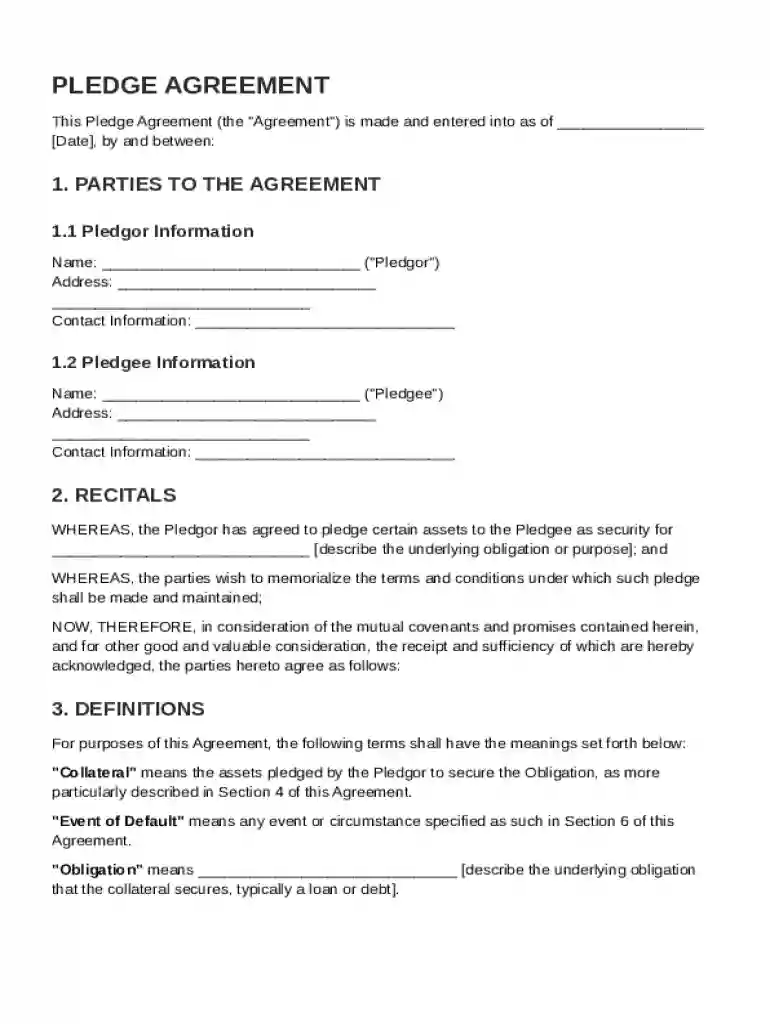
Type text, add images, blackout confidential details, add comments, highlights and more.

Draw your signature, type it, upload its image, or use your mobile device as a signature pad.

Send it via email, link, or fax. You can also download it, export it or print it out.
A Pledge Agreement Template serves as a formal document outlining the terms under which the Pledgor commits certain assets as collateral to a Pledgee to secure an underlying obligation. This legal arrangement articulates the identification and valuation of the pledged assets, the rights and responsibilities of both parties, as well as remedial actions the Pledgee may take in the event of default. The agreement ensures that obligations are clearly defined between all parties involved.
Identification of Assets: Lists the specific assets being pledged, including their characteristics and any identifying information to ensure clarity.
Valuation Details: Provides the assessed value of each pledged asset, ensuring both parties agree on the worth of the collateral.
Parties’ Rights and Responsibilities: Outlines the obligations of the Pledgor and the Pledgee, including maintenance of the assets and any required reporting.
Default Conditions: Specifies what constitutes a default and the steps the Pledgee can take if the Pledgor fails to meet obligations.
Remedial Actions: Details the course of action available to the Pledgee in case of default, including asset seizure or sale.
Completing a Pledge Agreement Template involves several key steps to ensure accuracy and compliance with legal standards.
Gather Necessary Information: Compile detailed information about the assets to be pledged and parties involved.
Fill Out Basic Details: Input the names, addresses, and contact information of the Pledgor and Pledgee.
Describe Assets: Clearly describe the assets being pledged, including identification numbers, if applicable.
Define Terms of Agreement: Specify the term duration, rights, responsibilities, and any special conditions.
Outline Default Procedures: Clearly outline what would constitute a default and the subsequent procedures.
Review and Sign: Ensure all details are reviewed, double-check for errors, and obtain signatures from both parties to finalize the agreement.
Understanding the key elements of a Pledge Agreement Template is crucial for effective utilization.
Specificity: Assets must be clearly described to avoid any ambiguities.
Documentation: Evidence of ownership and asset valuation should be included.
Duration: The length of the agreement should be defined, whether fixed or ongoing.
Conditional Clauses: Terms may include specific conditions under which assets may be reclaimed or replaced.
Modification Clauses: Terms under which the agreement may be modified should be included.
Notices: Procedures for notifying parties of changes or disputes.
Binding Effects: Specifies that the agreement binds successors, heirs, and assigns.
Utilizing a Pledge Agreement Template effectively requires careful adherence to specific steps and understanding of its components.
Purpose Identification: Clearly determine the purpose of the pledge and identify relevant assets.
Compliance Check: Ensure that the usage of the template complies with state and federal regulations.
Accurate Completion: Complete the template accurately with all required fields filled.
Legal Review: Consider consultation with a legal professional to verify compliance and accuracy.
Signing: Gather signatures from all parties to confirm mutual agreement and understanding.
Storage: Securely store the signed agreement for future reference.
Grasping the terminology associated with pledge agreements ensures proper understanding and implementation.
Pledgor: The individual or entity committing assets as collateral.
Pledgee: The recipient of the pledged assets who holds them as security.
Collateral: Assets pledged by the Pledgor as security for an obligation.
Default: Failure to fulfill the terms of the agreement, leading to potential asset seizure.
Severability: A clause ensuring that if part of the agreement is invalid, the rest remains enforceable.
Using the Pledge Agreement Template legally requires adherence to specific legal frameworks and guidelines.
State Laws: Ensure compliance with state-specific laws governing pledge agreements.
Federal Regulations: Follow federal guidelines, especially those related to asset pledging and secured transactions.
Binding Nature: Recognize that when properly executed, the pledge agreement is legally binding on all parties.
Dispute Resolution: The agreement may outline methods for resolving disputes, typically through mediation or arbitration.
Various individuals and entities may require a Pledge Agreement Template depending on their circumstances.

Businesses: Organizations may use pledge agreements to secure loans or lines of credit with financial institutions.
Individuals: Used for personal loans or to secure obligations with high-value assets.
Financial Institutions: Banks and lenders often require such agreements to mitigate risks associated with lending.

Loan Security: A business owner pledges inventory as collateral to obtain working capital.
Investment Collateral: An individual secures a personal loan by pledging ownership in stock portfolios.
State-specific regulations can impact the structure and enforceability of a Pledge Agreement.
Property Laws: States may have unique laws covering personal and real property used as collateral.
Enforcement Procedures: Variations exist in how pledged assets may be seized and liquidated in case of default.
Research: Investigate specific state requirements or seek legal counsel to ensure compliance.
Tailoring: Modify the template to accommodate state-specific legislative requirements.
Real-world applications illustrate how the Pledge Agreement Template can be effectively used.
Small Business Loan: A startup uses equipment as collateral to obtain a loan from a local bank.
Personal Loans: An individual pledges their vehicle to secure financing for home renovations.
Risk Mitigation: Companies reduce lending risks through clear terms and well-documented agreements.
Asset Recovery: Lenders successfully reclaim pledged assets in cases of borrower default, as agreed in the template.
At DocHub, your data security is our priority. We follow HIPAA, SOC2, GDPR, and other standards, so you can work on your documents with confidence.