01. Edit your form online
Type text, add images, blackout confidential details, add comments, highlights and more.

Type text, add images, blackout confidential details, add comments, highlights and more.

Draw your signature, type it, upload its image, or use your mobile device as a signature pad.

Send it via email, link, or fax. You can also download it, export it or print it out.
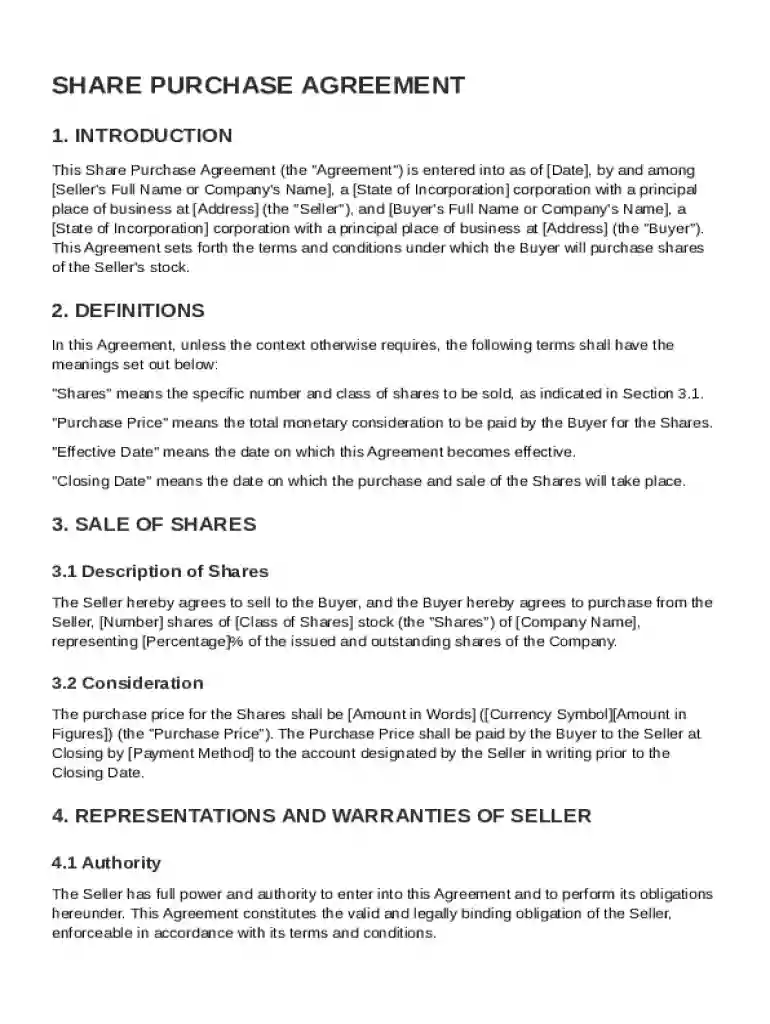
A Share Purchase Agreement (SPA) template is a comprehensive legal document used to outline the terms and conditions of the sale of shares between a seller and a buyer. This agreement specifies the financial terms of the transaction, the representations and warranties of each party, and the conditions that must be met for the sale to be completed. Its primary purpose is to ensure that both parties are legally protected and have a mutual understanding of their obligations. The template serves as a guiding framework, allowing for necessary adjustments depending on the specifics of the transaction at hand.
To effectively use a Share Purchase Agreement template, certain steps must be followed to customize it for a specific transaction:
Review the Template: Begin by carefully reading through the template to understand its structure and the clauses included.
Customize Clauses: Modify sections such as the purchase price, payment terms, and specifics of the shares being transferred.
Add Parties’ Details: Insert the full legal names and contact information of both the buyer and seller.
Update Representations and Warranties: Ensure that section accurately reflects the promises each party is making regarding their respective positions.
Consult Professional Advice: It’s advisable to have a legal expert review the modified document to ensure compliance with applicable laws.
Finalize and Execute: Both parties should thoroughly review the final version before signing. Signatures should be obtained in the presence of a notary if required by law.
Completing a Share Purchase Agreement involves several key steps that ensure the document is legally binding and comprehensive:
Identify the Security Details: Clearly state the class and number of shares being sold, including relevant stock exchange details if listed.
Define Purchase Price: Specify the total purchase price and any payment plans or conditions, such as installment payments or escrow agreements.
Outline Closing Conditions: Detail any conditions that must be satisfied prior to the closing of the sale, such as regulatory approvals or due diligence outcomes.
Specify Indemnification Terms: Include clauses on how and under what circumstances indemnification will occur, ensuring mutual protection.
Establish Governing Law: Clearly state the jurisdiction whose laws will govern the agreement, which can impact enforceability and interpretation.
Finalize Signature Blocks: Make space for the authorized signatories of both parties, along with witnesses if required.
An effective Share Purchase Agreement template should encompass the following critical elements:
Introduction: Specifies the date of the agreement, identifies the parties involved, and provides an introductory overview of the transaction.
Definitions: Provides clear definitions for terms used throughout the agreement to prevent ambiguity.
Transaction Details: Describes the shares being sold, purchase price, and payment terms.
Representations and Warranties: Lists the statements of fact that each party is claiming to be true at the time of agreement, affecting risk allocation.
Covenants: Obligations either to perform certain actions or restrictions against certain actions until completion of the deal.
Closing Mechanisms: Specifies the occurrence of closing, including a timeline and actions required by each party to conclude the transaction.
Dispute Resolution: Outlines the process for handling disputes, whether through arbitration, mediation, or litigation.
Familiarity with crucial terms enhances the effective application of a Share Purchase Agreement:
Escrow: A financial arrangement where a third party temporarily holds funds or assets until all terms of the agreement are met.
Due Diligence: The comprehensive appraisal of a business before buying, covering financial records, assets, and other critical aspects.
Non-Compete Clause: A contractual clause preventing the seller from engaging in business competing with the buyer's company.
Earn-Out: A provision allowing the seller to receive additional payments contingent on future business performance.
Closing Date: The date upon which the sale is officially completed, and ownership of shares transfers from the seller to the buyer.
In the United States, the legal use of a Share Purchase Agreement involves adherence to both federal and state laws governing securities. These agreements must comply with regulations set by the Securities and Exchange Commission (SEC) and other relevant bodies to prevent fraudulent practices. Depending on the location and company size, additional state-level requirements exist that dictate binding implications, registration, and disclosure obligations. A well-drafted SPA can protect both parties by clearly laying out their rights and responsibilities, aiding in the prevention of disputes.
Various types of businesses can leverage a Share Purchase Agreement for their transactions, including:
Startups seeking investment through equity sales rather than traditional financing.
Family Businesses aiming to transfer ownership between family members or to outside buyers while maintaining clear terms.
Private Companies that want to attract investors by selling shares with legal clarity and defined risks.
Corporations engaging in acquisitions or mergers that involve the transfer of shares between entities.
These businesses benefit by using a well-structured SPA to ensure transparency and legal compliance throughout the transaction process.
Certain states impose unique rules or requirements that need to be considered when drafting a Share Purchase Agreement in the United States. For instance:
California: Offers additional protection mechanisms through corporate laws like shareholder rights and disclosure mandates.
Delaware: Known for its business-friendly corporate laws, it requires specific provisions regarding fiduciary duties and limitations on liability for directors.
New York: Has complex securities laws that engage closely with interstate commerce concerns, necessitating clear jurisdictional language in SPAs.
It is vital for parties involved to consult a local lawyer with expertise in state-specific corporate or commercial law to ensure compliance and protect interests.
At DocHub, your data security is our priority. We follow HIPAA, SOC2, GDPR, and other standards, so you can work on your documents with confidence.