






Definition & Purpose of the Barter Contract Template
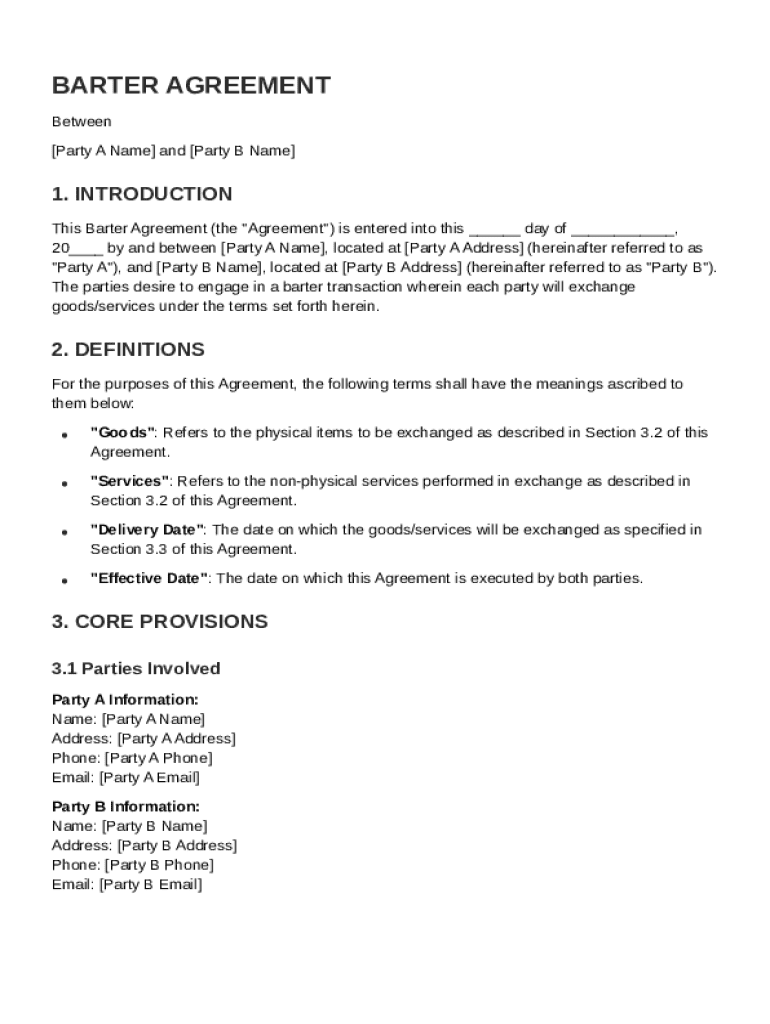
A barter contract template is a legal document that establishes the terms and conditions under which two parties agree to exchange goods or services without using money. This template outlines obligations, rights, and responsibilities, ensuring that both parties are clear about the nature and specifics of the exchange. It typically includes elements such as the description of goods or services, exchange rates or values, and the duration of the agreement. This document is crucial for preventing disputes by providing a clear, mutually agreed-upon framework for the barter transaction.
How to Use the Barter Contract Template
Utilizing a barter contract template involves several steps to ensure its effectiveness. First, parties must clearly identify the goods or services each will provide. Each item or service should be described in detail, including quality and quantity, to avoid misunderstandings. Next, specify the terms of exchange, such as timelines for delivery or completion of services. The template should also include provisions for resolving disputes, modifying terms, and any termination clauses. Finally, after reviewing and agreeing upon the terms, both parties should sign the document to legally bind the agreement.
Key Elements of the Barter Contract Template
The barter contract template consists of several critical elements that ensure comprehensive coverage of all necessary aspects of a barter agreement. These elements typically include:
- Party Information: Names and contact details of both parties involved in the agreement.
- Description of Goods/Services: Detailed descriptions of what each party will exchange.
- Terms of Exchange: Timelines and conditions for the exchange.
- Representations and Warranties: Assurances from each party regarding the goods or services.
- Dispute Resolution: Methods for resolving disagreements, including mediation or arbitration.
- Miscellaneous Provisions: Other important terms, such as governing law and tax implications.
Legal Use of the Barter Contract Template
In the United States, barter transactions are recognized and enforceable under the law, provided they adhere to legal standards and both parties reach mutual agreement. The barter contract template is designed to meet these standards, ensuring the agreement is legally binding. It must include all necessary elements, such as clear terms and signatures, to be enforceable in court if disputes arise. Furthermore, parties must ensure that their contract complies with federal and state laws, including those governing contracts and specific industry regulations.
State-Specific Rules for the Barter Contract Template
Although barter contracts are generally governed by contract law, there may be state-specific rules that affect their enforceability. Each state might have different requirements concerning the registration of barter agreements, tax obligations arising from barter transactions, and dispute resolution procedures. For example, some states may require disclosures about the fair market value of exchanged goods or services for tax purposes. It is advisable for parties to consult legal professionals or refer to state-specific guidelines to ensure full compliance.
Examples of Using the Barter Contract Template
The barter contract template finds application in various real-world scenarios. Small businesses might use it to trade services, such as a graphic designer creating a website for a coffee shop in exchange for free coffee. Artists can trade pieces of artwork with each other using the template to establish terms. Community-driven projects might involve bartering skills or resources between non-profit organizations, with the contract clarifying the expectations and responsibilities of each party involved.
Important Terms Related to the Barter Contract Template
Understanding key terms associated with barter contracts is critical. These include:
- Consideration: The value exchanged between parties in a barter agreement, not involving money.
- Fair Market Value: The estimated worth of goods or services exchanged.
- Party: Individuals or entities who are entering into the barter agreement.
- Confidentiality Clause: An agreement to keep specific terms or details confidential.
- Termination Clause: Conditions under which the contract may be ended before completion.
IRS Guidelines on Barter Transactions
In the U.S., barter transactions have tax implications as outlined by the IRS. The IRS requires both parties to report the fair market value of the goods or services received as income. Barter exchanges are considered taxable events, and both businesses and individuals must adhere to these guidelines, including reporting requirements. Form 1099-B, Proceeds from Broker and Barter Exchange Transactions, is often used to report these transactions. It is vital to maintain accurate records of barter deals to ensure compliance with IRS regulations and avoid penalties.