






Definition & Meaning
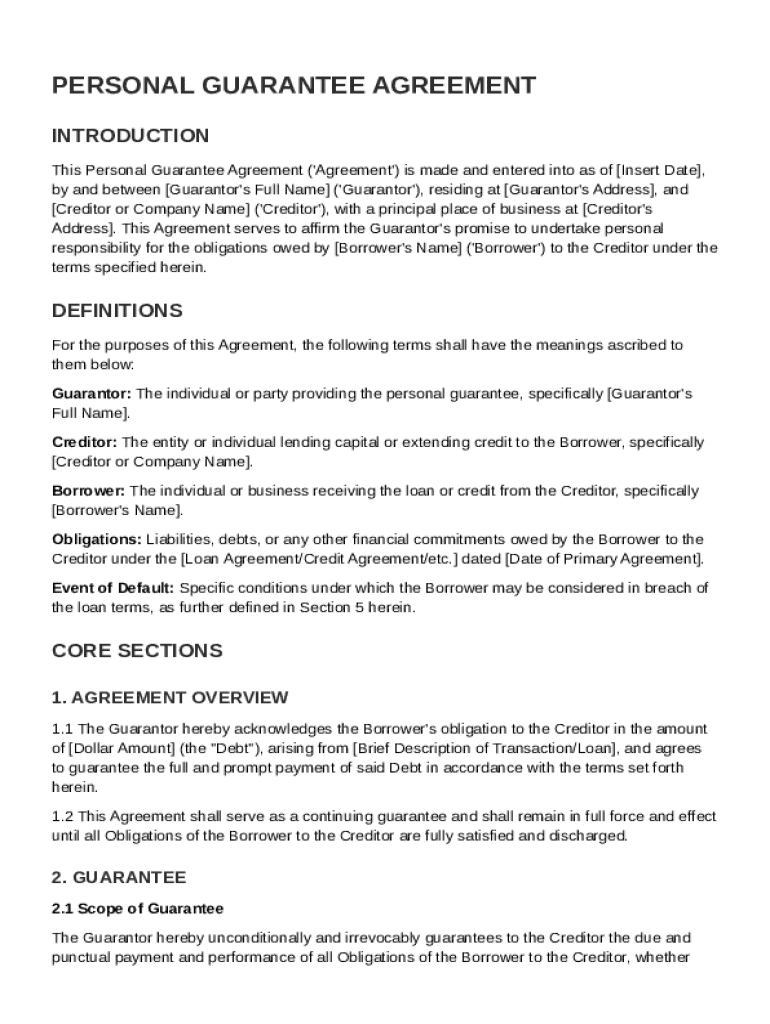
A Personal Guarantee Agreement Template is a legal document that outlines the responsibilities and obligations of a Guarantor who promises to cover the financial debts of another party, known as the Borrower, if that Borrower defaults. This legally binding contract lays out key terms clearly, detailing the scope, duration, and specific conditions under which the Guarantor must fulfill these obligations.
Essentials of the Template
- Guarantor's Role: Clarifies the Guarantor's commitment to covering the Borrower's debt.
- Legal Framework: Includes relevant legal terms and provisions to ensure compliance with applicable laws.
- Duration: Specifies how long the guarantee is valid.
- Conditions of Default: Details circumstances under which the Guarantor's responsibility is triggered.
Key Elements of the Personal Guarantee Agreement Template
A Personal Guarantee Agreement Template typically includes several critical components to ensure that all parties understand their roles and obligations. These are fundamental to protecting the interests of both the Creditor and the Guarantor.
Major Components
- Identifying Information: Names and details of the Creditor, Borrower, and Guarantor.
- Scope of Guarantee: Description of debts and obligations covered.
- Terms and Conditions: Specific conditions under which the guarantee is activated.
- Representations and Warranties: Assurances provided by involved parties regarding their legal capacity and intentions.
Additional Provisions
- Indemnification Clauses: Outline the extent to which one party will protect another from certain damages or claims.
- Governing Law Provisions: Specify which jurisdiction’s laws will govern the agreement.
- Amendment Clauses: Conditions under which the agreement can be modified.
Steps to Complete the Personal Guarantee Agreement Template
Completing a Personal Guarantee Agreement Template involves a methodical approach to ensure accuracy and legal compliance.
- Review the Template: Start by carefully reading each section to understand its implications.
- Fill in Identifying Details: Enter accurate information for Guarantor, Borrower, and Creditor.
- Specify the Terms: Clearly define the debts being guaranteed and the conditions that activate the guarantee.
- Include Legal Provisions: Ensure all mandatory legal clauses, such as indemnification and governing law, are addressed.
- Signature and Date: Have all parties sign and date the document to formalize the agreement.
Tips for Accuracy
- Cross-check all details before finalizing.
- Consult with legal counsel to ensure the template complies with applicable laws.
Legal Use of the Personal Guarantee Agreement Template
The legal utility of a Personal Guarantee Agreement Template hinges on its capacity to articulate a clear understanding between involved parties while adhering to legal standards.
Legal Considerations
- Binding Nature: Once signed, the agreement is legally enforceable.
- Jurisdiction-specific Laws: Ensure compliance with state laws where the agreement is executed.
- Enforcement Mechanisms: Detail how the agreement will be enforced in case of disputes.
Benefits of Legal Compliance
- Reduces the risk of misunderstandings.
- Provides legal recourse in case of Borrower's default.
- Ensures all parties are clear about their commitments.
Important Terms Related to Personal Guarantee Agreement Template
Understanding the terminology used within a Personal Guarantee Agreement Template is vital for comprehending its implications.
Key Terms
- Guarantor: The individual or entity that provides the guarantee.
- Borrower: The party whose obligations are being guaranteed.
- Creditor: The party to whom the obligations are owed.
- Default: Failure by the Borrower to meet financial obligations.
- Indemnification: A clause that protects a party from bearing certain costs or damages.
Legal Nuance
- Governing Law: The legal jurisdiction that applies to the agreement.
- Warranties: Assurances provided by parties that certain facts or conditions are true.
Examples of Using the Personal Guarantee Agreement Template
To fully grasp the functionality and utility of the Personal Guarantee Agreement Template, considering real-world applications can be helpful.
Practical Scenarios
- Business Loans: Often used when securing financing for a small business, where the owner’s personal assets are leveraged as part of the loan conditions.
- Rental Agreements: A landlord may require a personal guarantee from the primary tenant's financial backer.
- Vendor Contracts: Suppliers might ask for a personal guarantee when dealing with a new business client to mitigate financial risk.
Case Studies
- Example 1: A small tech startup uses a personal guarantee agreement to secure a business loan from a local bank.
- Example 2: A landlord requests a personal guarantee from the father of a student renter to ensure financial responsibility.
Who Typically Uses the Personal Guarantee Agreement Template
Various parties across different sectors may require a Personal Guarantee Agreement Template, highlighting its widespread applicability.


Common Users
- Small Business Owners: Often used to secure credit or loans.
- Landlords: To ensure rental payments through an additional guarantor.
- Financial Institutions: When issuing loans where the Borrower's creditworthiness requires additional security.

Advantages for Different Users
- Business Security: Provides lenders with additional assurance, facilitating access to capital.
- Risk Management: Enables landlords and suppliers to manage financial risks more effectively.
State-specific Rules for the Personal Guarantee Agreement Template
State regulations can influence the applicability and enforcement of personal guarantee agreements. Understanding these nuances is crucial.
Variations by State
- Usury Laws: Some states have specific restrictions on interest rates that may affect agreement terms.
- Legal Documentation: States might have unique requirements for legal documentation and signing.
Navigating Regulations
- Consult local legal counsel to ensure compliance with state-specific requirements.
- Be aware of differences in state enforcement practices and creditor rights.